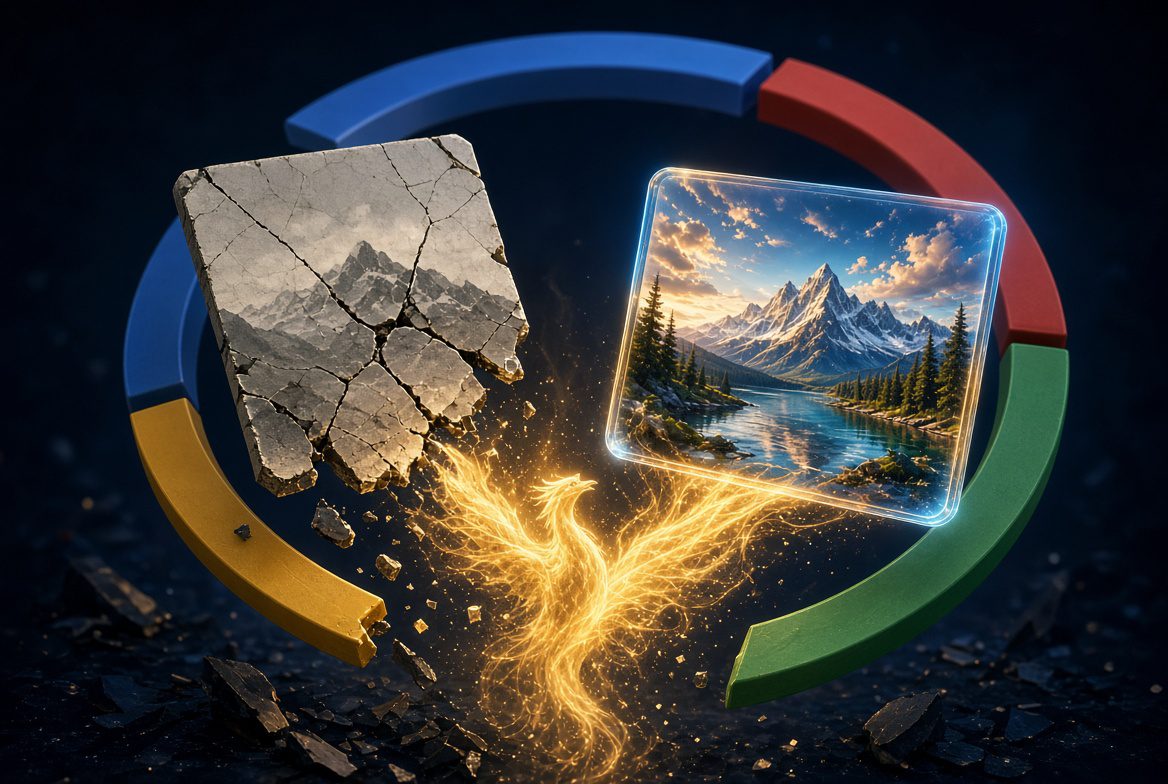
The best image format of the decade lost the war without ever getting to fight it. JPEG XL compresses better than AVIF, encodes faster and understands ordinary JPEGs, but Google kicked it out of Chrome at the end of 2022 and the web wrote it off as dead. In February 2026, Chrome 145 brought it back to life with a decoder written in Rust.
This analysis reconstructs why a superior format lost, what changed for Google to reverse course three years later and what you should serve on your website today. The story matters because it repeats every time a big platform decides which technology lives and which does not, as we already saw with Office on Linux and Flatpak.
The promise of JPEG XL
JPEG XL was born to retire JPEG without breaking anything. Created in collaboration between Google Research and Cloudinary with guidance from the photographic experts group, the format compresses 30 to 60 percent better than classic JPEG depending on the image, with faster encoding than AVIF and a winning card nobody else had. It recompresses existing JPEGs to a smaller size without losing a single bit, so migrating an archive costs no quality.
The photographer stores less weight with the same eye. The web loads faster with identical fidelity. Archives hold decades of photos in less disk space without touching a single pixel of the originals. On paper it had no rival, because it improved on the grandfather in everything and matched or beat the modern challenger in almost everything else.
The Cloudinary timeline from March 2026 tells the saga with drama unusual for a technical blog. Google, paradoxically, was one of the parents of the creature and also its executioner. That contradiction is the heart of this story.
Why did Google kick it out of Chrome in 2022?
At the end of 2022, Google removed experimental support for JPEG XL in Chromium with a devastating argument. There was not enough ecosystem interest to continue. The phrase, quoted to this day in every debate, sounded like a technical verdict when in fact it described a self-fulfilling prophecy. Without Chrome there is no ecosystem, and without an ecosystem there is no Chrome. The other browsers looked the other way and developers shelved the format.
Behind the official reason weighed a rival bet. Google had invested years in AVIF, built on the AV1 video codec of the Alliance for Open Media, where Google itself calls the shots. AVIF was already flying on YouTube and Netflix, had decoding hardware on the way and an impeccable industrial narrative. Sustaining two new formats at once split efforts, and the company chose the child of the house over the brilliant nephew.
The community protested, rightly so. Photographers, archivists and free-software tool developers pointed out that burying a superior format for lack of ecosystem, when you are the ecosystem, borders on abuse of position. The protest was useless in 2022. It served to put it on record, which three years later would weigh on the reversal.
The return of JPEG XL
The Register reported the reconciliation on January 14, 2026. Google reinstated the JPEG XL decoder in the Chromium code, reversing the 2022 decision. A month later, Chrome 145 reached the stable channel on February 10 with native support, as detailed in Lilting's tracking from March 2026.
The technical key to the return has a name and it is Rust. The new decoder is written in a memory-safe language, which wipes out at a stroke the security objection that weighed on the previous C code. As ImageGuide explained in August 2026, Chrome 145 re-added decoding three years after removing it thanks to that memory-safe decoder. The same reason that brings Rust back to the heart of Ubuntu brought JPEG XL back to the browser.
Context also helped. Apple has supported JXL in Safari since 2023, Firefox keeps it behind a flag and the format matured in authoring tools. When Chrome returned, it was no longer returning to the desert of 2022 but to an ecosystem that had survived without it. The self-fulfilling prophecy broke from the opposite end. Someone kept the flame burning.
JPEG XL versus AVIF, which one works today?
The practical question allows no romanticism. For web production in 2026, the recommendation from OpenReplay in July 2026 is clear. Serve AVIF, with 93 percent global browser coverage in mid-2026 and mature support in CDN, CMS and build tools. JPEG XL is technically the stronger format, with faster encoding and better responsiveness, but its coverage is still being rebuilt after the return to Chrome.
| Format |
Compression |
Encoding |
2026 coverage |
Best use |
| Classic JPEG |
Baseline |
Instant |
Universal |
Total compatibility |
| AVIF |
Excellent |
Slow |
93 percent |
Web in production today |
| JPEG XL |
Excellent and superior |
Fast |
Being rebuilt |
Archiving and the future web |
| WebP |
Good |
Medium |
Universal |
Risk-free transition |
The table hides a case-by-case decision that should be spelled out before touching your image pipeline, because each scenario calls for a different format and getting it wrong costs bandwidth or compatibility.
- Long-term photography and archiving go with JPEG XL, for its lossless JPEG recompression and its encoding speed.
- Mass public web goes with AVIF backed by WebP or JPEG, for coverage and tooling.
- Experiments and cutting-edge sites can serve JXL with fallback, to start warming up the pipeline.
If you manage a photo archive, migrating JPEGs to lossless JXL saves between a third and half the space without touching a pixel. If you manage a store with a million visits, AVIF with CDN is the sensible answer this year. Confusing both scenarios is like choosing a camera by megapixels.
Audacity 4.0 renews the free audio software with Qt6
The bag of tricks does not end at compression. JPEG XL handles high dynamic range and wide gamuts for serious photography, decodes progressively for slow connections and even supports animation to replace GIF without its miseries. AVIF has none of that in a single package, and everything travels in a container built to last decades. Those who archive think about these details more than the ratio headline.
How do I start using JPEG XL today?
Trying it costs ten minutes and commits you to nothing. On Debian and Ubuntu there is the official tools package from the reference library, which installs the command-line encoder and decoder. The Konvrt guide from April 2026 follows this same path for developers who want to serve JXL as soon as possible.
sudo apt install libjxl-tools cjxl foto.jpg foto.jxl -q 90 djxl foto.jxl foto-recuperada.png
The first command converts at visual quality 90 out of 100, a point where the eye cannot tell it from the original. The second reverses the process to check that everything is still in place. If you come from a JPEG archive, the trick is lossless recompression, which cuts between a third and half the weight without touching a pixel. For large batches, a shell loop with find does the work of an afternoon while you drink coffee.
On the web, the right way to serve it is the picture element with chained fallbacks, so that each browser picks the first format it understands. The visitor on Chrome 145 gets JXL, the one on an old browser falls back to AVIF or JPEG without noticing.
<picture> <source srcset="foto.jxl" type="image/jxl"> <source srcset="foto.avif" type="image/avif"> <img src="foto.jpg" alt="Photo description"> </picture>
Check the result by opening the page in Chrome and in Safari, and check in the developer tools which file each one downloads. Then measure the total weight with the network tab before and after the change. If the savings do not justify the complexity of generating three variants per image, your CDN is already doing its job well and you can sit back and wait for coverage to settle.
The first lesson is that technical superiority does not vote. JPEG XL won almost every benchmark and lost three years to a product decision by a single company. Open formats need sponsors with browsers, not just committees with specifications. Without a Chrome, a Safari or a Firefox pushing, the best codec is a pretty paper.
The second lesson is that security sells what compression could not. The Rust decoder unlocked the return where compression percentages failed. Writing critical infrastructure in memory-safe languages has become the argument that opens doors in browsers and distributions. Anyone maintaining a codec in C would do well to take note.
The third lesson looks Big Tech in the eye. A platform can bury an open standard with a phrase about the ecosystem and dig it up three years later with another. The community that kept JXL alive in free tools, viewers and archive workflows deserves more credit than the reversal statement. Without those guardians there would have been nothing to return to. The free alternatives to escape Big Tech exist precisely for these cases.
JPEG XL was not a technical failure, it was a political failure with a reconciliation ending. It lost the 2022 battle against the interests of its own creator and won the 2026 one with a secure decoder and an ecosystem that refused to die. Today it coexists with AVIF in a sensible split according to the use you give each image.
If you edit photos, try converting your archive to JXL and see the space you recover. If you develop websites, leave the pipeline ready with fallbacks while coverage settles. And the next time a platform buries something excellent for lack of ecosystem interest, ask who the ecosystem is. The answer usually has a logo and headquarters in Mountain View.