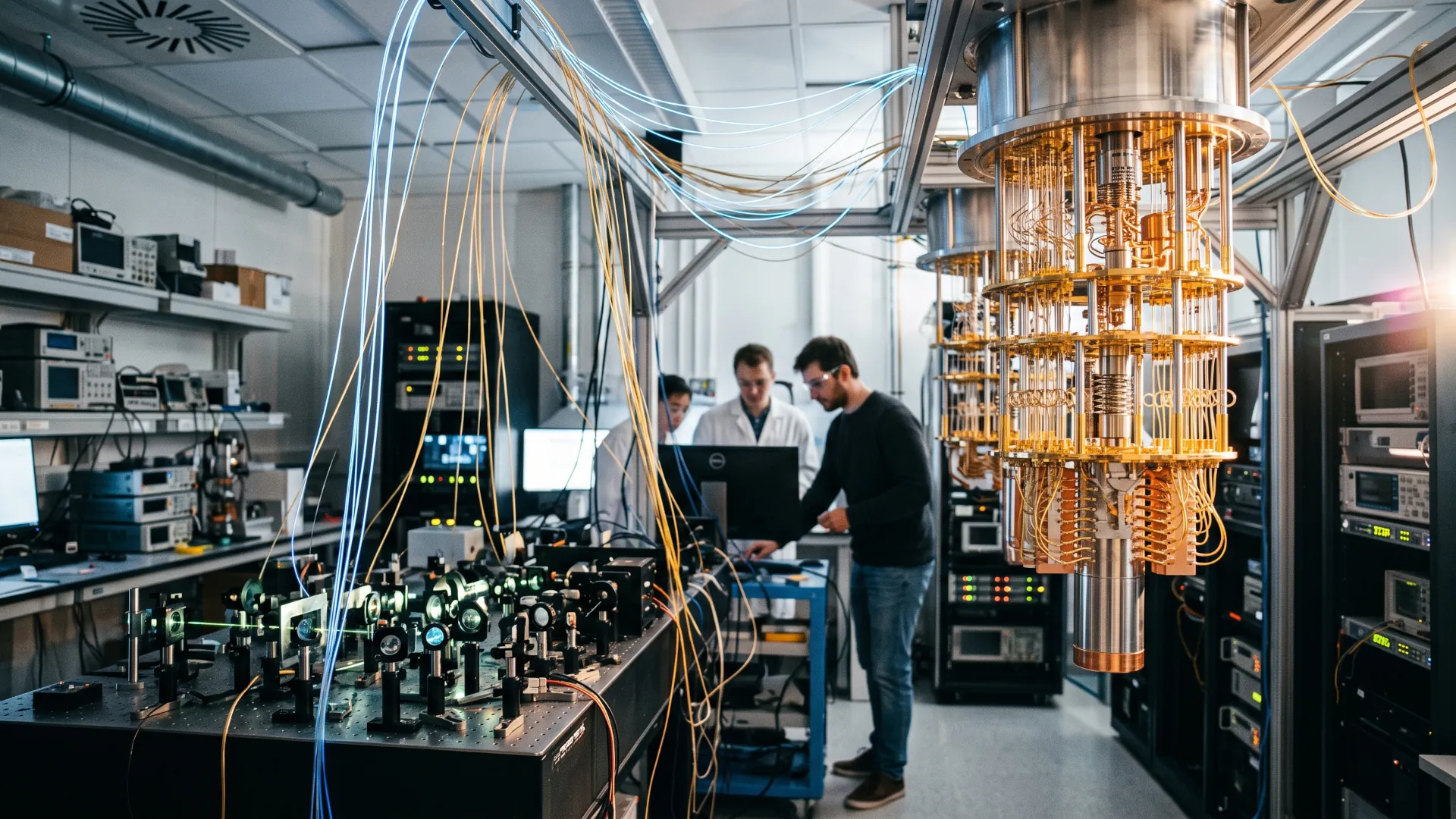
Google published an advance that cannot be seen but that shapes everything else in quantum computing. Its Quantum AI team managed to automate "magic state cultivation", the process by which the resource quantum computers need to run non-trivial operations is produced. Until now that step was a bottleneck with an enormous cost in physical qubits.
The expression sounds esoteric and describes something simple. Qubits can perform two types of operations: some that are easy to correct and others that are essential to gain an advantage over a classical computer. The latter require an auxiliary state, the magic state, which must be manufactured with great precision and which degrades with every attempt. Producing them at scale was one of the reasons fault-tolerant computing remained theoretical.
The announcement comes a week after Gartner said the opposite in public: that the quantum threat is behind the timeline that had been assumed. Both things can be true, and the combination is what matters for anyone who has to decide when to migrate their cryptography. The announcement comes in a month in which the industry itself is debating whether the threat timeline has moved or whether the narrative serves to justify budgets.
The real achievement beyond the hype
Cultivation is a technique that manufactures magic states of increasing quality from worse states, at a cost that scales favorably. Google's contribution is a method that reduces that cost and makes it more suitable for a surface code error-correction architecture, the one the team itself has chosen as its path.
The technical explanation is signed by the team itself in Google's blog of October 15.
What has not happened is a quantum computer capable of breaking cryptography. Not even a prototype with the thousands of logical qubits that would be needed. What was announced is a piece of engineering that reduces the number of physical qubits needed to build a quality logical qubit, and that shifts the timeline without bringing it to next year.
The useful comparison is that of the engine and the fuel. For years the engine has been improved, that is, gate fidelity and error correction. Cultivation solves the fuel supply with less waste, and without that supply the engine does not turn.
The crypto industry must "watch" and act
All the public-key cryptography the internet uses depends on two problems that a sufficiently large quantum computer would solve: factorization and discrete logarithms. That includes RSA, elliptic-curve key exchanges and the signatures that protect bitcoin and ethereum transactions.
The technical answer has existed since 2016: post-quantum algorithms, standardized by NIST in 2024 with ML-KEM and ML-DSA among others. The operational answer does not exist, because migrating a certificate infrastructure takes longer than developing the algorithm.
The practical problem lies in harvest-now-decrypt-later. An adversary can record encrypted traffic today and decrypt it when they have the computer. For data with a lifespan of decades, such as medical records or state secrets, the migration is already late in a logical sense.
The debate reopens: Is asymmetric cryptography safe in 2026?
Two positions coexist in crypto. One holds that the threat is remote and that the community has time, as Vitalik Buterin has argued by placing the risk of artificial intelligence ahead of the quantum one. Another pushes migration to post-quantum signatures on main networks, and several have already begun.
Ethereum has a working group on post-quantum cryptography and has published analyses on how to integrate it without breaking compatibility. Bitcoin is more complicated by design: public keys are exposed at the moment of spending and old wallets with balances are a problem no one has solved.
There is a third front that almost no one discusses: the post-quantum algorithms themselves. This month research has been published on a side channel in ML-KEM and on the difficulties of some alternative schemes, which is a reminder that no migration is free or definitive.
The realistic timeline
The deadlines handled by national security agencies place full migration between 2030 and 2035, with system inventory and testing in the first half. An advance like Google's does not bring that timeline forward: it reduces the risk that the timeline stretches out.
The decision for a company does not change with a laboratory announcement. It is still about inventorying what uses public-key cryptography, starting with what transmits long-lived data and assuming that the change will be done with hybrid systems for years. The October advance makes it more likely that this work will serve a purpose.