The president of Racing and Argentina
To achieve this, Argendata translates the data into the language of football. It talks about championships, rivals, standings and knockout stages, and draws on humor and pop culture references to explain economic concepts that, in a technical report, would reach a much smaller audience. Thus, Argentina can win a match while losing ground on price stability; beat a rival on life expectancy but fall behind on income per capita; or stand out for its educational and scientific tradition while continuing to grapple with inflation, debt and economic stagnation.
In short, a country can be world champion and still live with major economic challenges. Football acts as an emotional hook, Argendata as the bridge connecting that interest with the data, and the result is a closer, more understandable way of grasping an economic reality that cannot be summed up in a single statistic or in a match score.
Sebastián Ceria
First of all, it is worth pausing on the figure of Ceria, the person who connects Racing de Santander with Argendata. A mathematician by training, Ceria is one of Argentina's most recognized technology entrepreneurs. He developed much of his career in the United States, where he founded companies specializing in advanced analytics and artificial intelligence applied to the business world. Over time he returned to Argentina to drive various projects linked to innovation, education and public policy. He currently chairs both Racing de Santander and Fundar, the think tank that has developed Argendata.
Although these are very different fields, Ceria advocates relying on data and evidence to make decisions. At Racing he bets on digitalization, statistical analysis and artificial intelligence to improve the club's management, professionalize its processes and reduce its dependence on intuition. At Fundar he brings that same philosophy to the design of public policy, promoting decisions based on technical knowledge, experimentation and rigorous evaluation.
And in both cases the same question arises: how to use information to understand a complex reality and decide better? In a football club, data makes it possible to analyze player performance, the evolution of the youth academy, the economic situation or sports planning. In a country, it helps to understand phenomena such as inflation, poverty, productivity, foreign trade, education, energy or the quality of institutions.
Rivals as economic mirrors
The settings are very different, but the underlying idea is the same: measure, compare, put information in context and learn from it before acting.
That is why the World Cup has given Argendata a unique opportunity to bring that way of thinking to a mass audience. Football provides the shared emotion and a language that millions of people understand immediately; the data does the rest, turning every match into an occasion to explain the country's economic reality in a close and understandable way.
Argendata's World Cup campaign began by using Argentina's rivals as a mirror to analyze the country's economic reality. Instead of focusing solely on the players or on each national team's sporting prospects, Argendata compared the countries using indicators such as years of schooling, life expectancy, inflation, GDP per capita or greenhouse gas emissions. Thus, every match also became a comparison of economic and social development.
This perspective offers a very different ranking from football's. Austria, for example, clearly outperformed Argentina in income per capita and also posted better results in education, while Jordan showed very similar figures in life expectancy. In other indicators, however, the order changed. The message was clear: a country's development cannot be summed up in a single data point or understood as a competition with only one winner. Argentina won 2/0.
The treatment of inflation
Argendata used these comparisons to show that an economy can combine strengths and weaknesses at the same time. A country can have a well-educated population and yet suffer high inflation. It can have abundant natural resources and maintain a poorly diversified production structure. Or it can achieve good health levels while going through deep economic instability.
One of the most striking examples was the treatment of inflation. With a phrase loaded with humor, Argendata summed up the situation: In inflation over the past year we are undisputed champions. Argentina held first place, but in a championship nobody wants to win. The irony turns a complex economic indicator into an easy-to-understand idea and reminds us that, in economics, leading a ranking does not always mean being in a better position.
Another example came when Argentina faced Egypt in the round of 16, in a match that ended 3-2 in favor of the Argentine national team. Argendata used that encounter to compare the two countries based on four indicators: years of schooling, life expectancy, annual inflation and GDP per capita measured in purchasing power parity.
Argentina-Egypt
In the data, Argentina appeared ahead of Egypt in all the indicators analyzed. However, the platform itself warned that this reading could be misleading: In the round of 16 we met Egypt, whom we outperform in all indicators. This is not always good because we also outperform them in annual inflation. The example served to remind that data always needs context. A high figure can be good news when it measures life expectancy, schooling or income, but it becomes a problem when it reflects rising prices.
The chart showed that Argentina had 11.2 average years of schooling, compared with Egypt's 10.1, and a life expectancy of 78 years, compared with 71.6 in the African country. It also recorded a higher GDP per capita, although high inflation clearly worked against it. Therefore, being above Egypt in all indicators did not necessarily mean obtaining a positive result in all of them.
World Cups as an economic calendar
Argendata also uses the World Cups as time references to analyze the evolution of Argentine exports. The platform starts from a question: How have our exports changed since the 2002 World Cup?
The journey begins in Korea-Japan, a tournament especially painful for Argentina, which was eliminated in the group stage despite arriving as one of the favorites. From there, the chart compares the data corresponding to the 2002, 2006, 2010, 2014, 2018 and 2022 World Cups, and completes the series with the 2025 figures.
Many people do not remember what was happening with Argentine exports in 2006 or 2014, but they do remember where they watched certain matches, who eliminated the national team or how far the team got. World Cups turn years into recognizable experiences and make it possible to organize economic evolution on an emotional calendar. In this way, a statistical series stops being a succession of numbers and becomes a narrative associated with defeats, finals, celebrations and shared memories.
Export calendar
On that calendar, Argendata traces the trajectory of four major exporters: soy, oil and petrochemicals, automotive, and beef and bovine leather. Soy appears as the great star of the period, rising from about 5.1 billion dollars in 2002 to around 21.4 billion in 2025. The trajectory, however, was not linear. Exports grew strongly during the early years, reached high levels around 2014, declined afterward and suffered a particularly visible drop around 2018, before recovering and reaching a new peak near 2022. Argendata sums it up in football language: Beyond a sharp fall in the forgettable 2018 World Cup, soy was the star export complex.
The metaphor turns a set of agricultural products into the main striker of the Argentine economy, but behind it a structural question appears. Soy provides a decisive share of the foreign currency the country needs, and its evolution influences tax revenue, international reserves, the exchange rate and the capacity to finance imports. That strength is an advantage, but it also reveals a dependence. A national team that rests too much on a single figure can suffer when that star is injured; an economy concentrated in one product is exposed to droughts, changes in global demand and swings in international prices.
Oil and petrochemicals are another of the great engines of Argentine exports. Their sales abroad went from about 5.2 billion dollars in 2002 to nearly 11.8 billion in 2025. Argendata highlights this growth as a sign of the energy sector's growing weight in the country's economy.
Exporting oil
However, the challenge is not only to export more oil. The big question is whether Argentina will use that momentum to develop a more solid industry, with greater investment, innovation, skilled employment and local companies, or whether it will simply replace one economic dependence with another.
The automotive industry has followed a different path. Its exports grew from about 1.9 billion dollars in 2002 to around 8.8 billion in 2025, although the advance slowed after 2014. Argendata sums up that situation with a very graphic phrase: The automotive sector seems to have found a ceiling in 2014. The message reflects the industry's difficulties in continuing to grow without improving its productivity, incorporating new technologies or opening new markets.
Beef and bovine leather complete the journey. Their exports rose from about 1.2 billion dollars in 2002 to nearly 4.7 billion in 2025. Although growth has been steady, it remains far below that recorded by soy, oil or the automotive sector.
Beef
The data show a reality that often goes unnoticed. Although Argentina is famous worldwide for its beef, today its main export revenues come from other sectors, especially soy and energy.
Argendata concludes this explanation with the idea that for a sector to be able to play the next World Cup, you first have to know where it comes from, what situation it is in and what it needs to keep growing. Behind that metaphor the message is that a country cannot plan its development without knowing which sectors generate the most exports, which create employment, which contribute innovation and which have the greatest growth potential.
Moreover, today's success does not guarantee tomorrow's. A good moment for soy, oil or industry can depend on external factors, such as international prices or demand from other countries. Turning those opportunities into lasting growth requires stability, investment, technology, infrastructure and long-term policies.
The Madonna-England correlation
In Argendata's World Cup, the winner is not the sector that exports the most, but the one that proves it has the best conditions to keep growing in the future.
The campaign also left room for humor and music. Before the semifinal between Argentina and England, Argendata published a chart titled Correlation between Argentina-England matches at World Cups and Madonna albums. The image linked each victory or defeat to the release of an album by the singer. In 1986 True Blue coincided, in 1998 Ray of Light and, curiously, in 2002 there was no album… nor an Argentine victory. For 2026, a new release again coincided with a win against England by 2-1 in favor of Argentina.
The platform itself joked on X: Haters will say it's spurious correlation. Behind the joke there was a very simple statistical explanation: two events happening at the same time does not mean one is the cause of the other. It is an original way of explaining a concept that usually appears only in statistics books or classes.
Another of the posts shows a pie chart titled: They can take the players out of Argentina, but not Argentina out of the players. It shows that the vast majority of the national team's footballers play for foreign clubs, while only a small portion compete in the Argentine league.
Spain-Argentina
The message accompanying the chart says: There are things data cannot explain. For everything else there is Argendata. With that phrase, the platform acknowledges that statistics have limits. Data can show where footballers play and in which countries they develop their careers, but they cannot measure the sense of belonging or the bond they maintain with Argentina.
Lionel Messi is the best example. He spent most of his career in Spain and France, and currently plays in the United States, but he remains the country's main sporting symbol. The chart thus shows another form of export: that of sporting talent. Most of the Argentine national team's players develop their careers abroad without losing their connection to the national team.
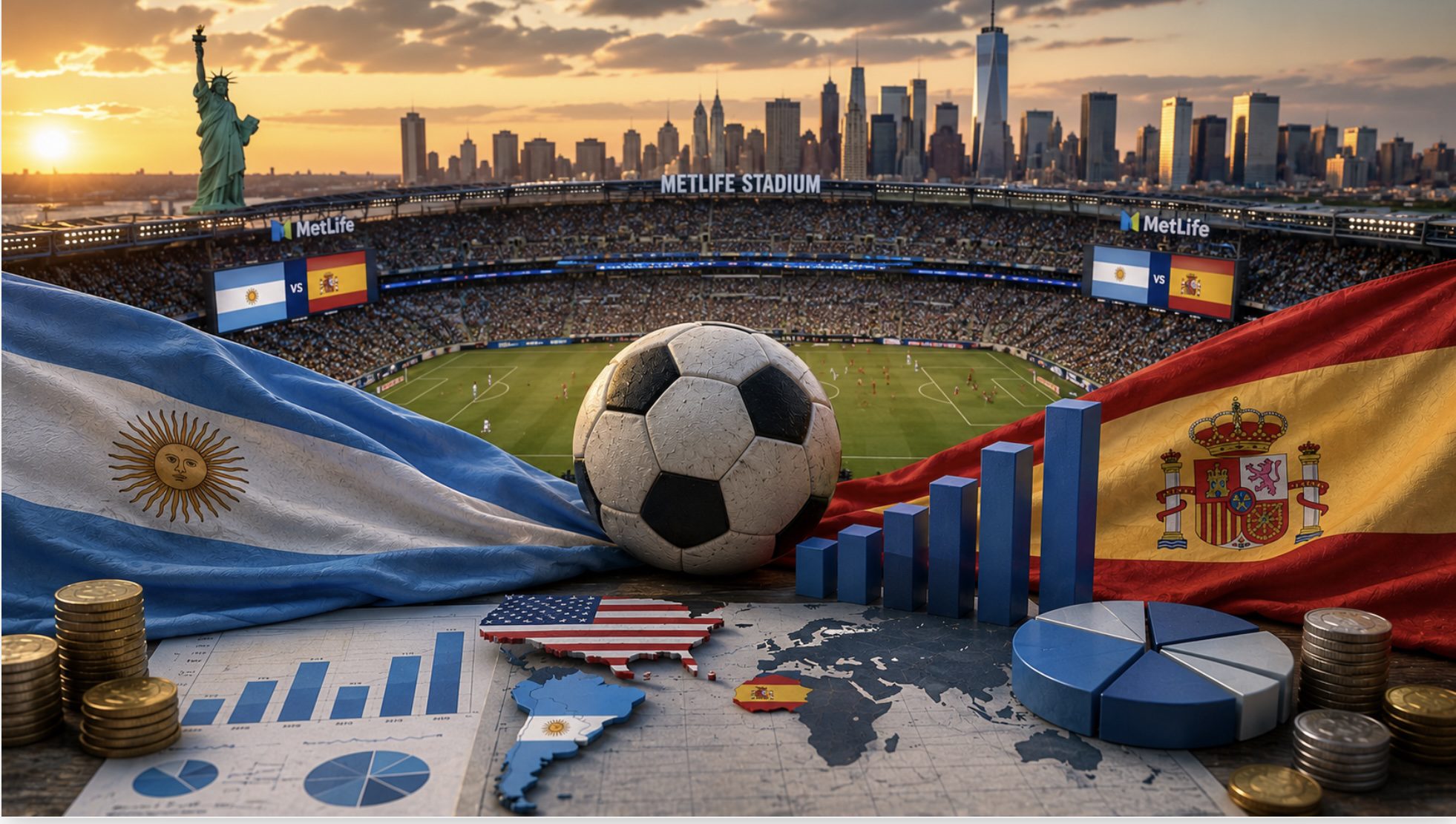
What is clear is that while the world watches the ball, Argendata has found an original way to explain the country, turning the World Cup into an economics class and every match into an opportunity to better understand Argentine reality. About this Sunday's grand final between Spain and Argentina, it has so far said nothing. Perhaps it is one of those occasions when not even data can resolve a dilemma between two countries that today are part of the same story of Sebastián Ceria.