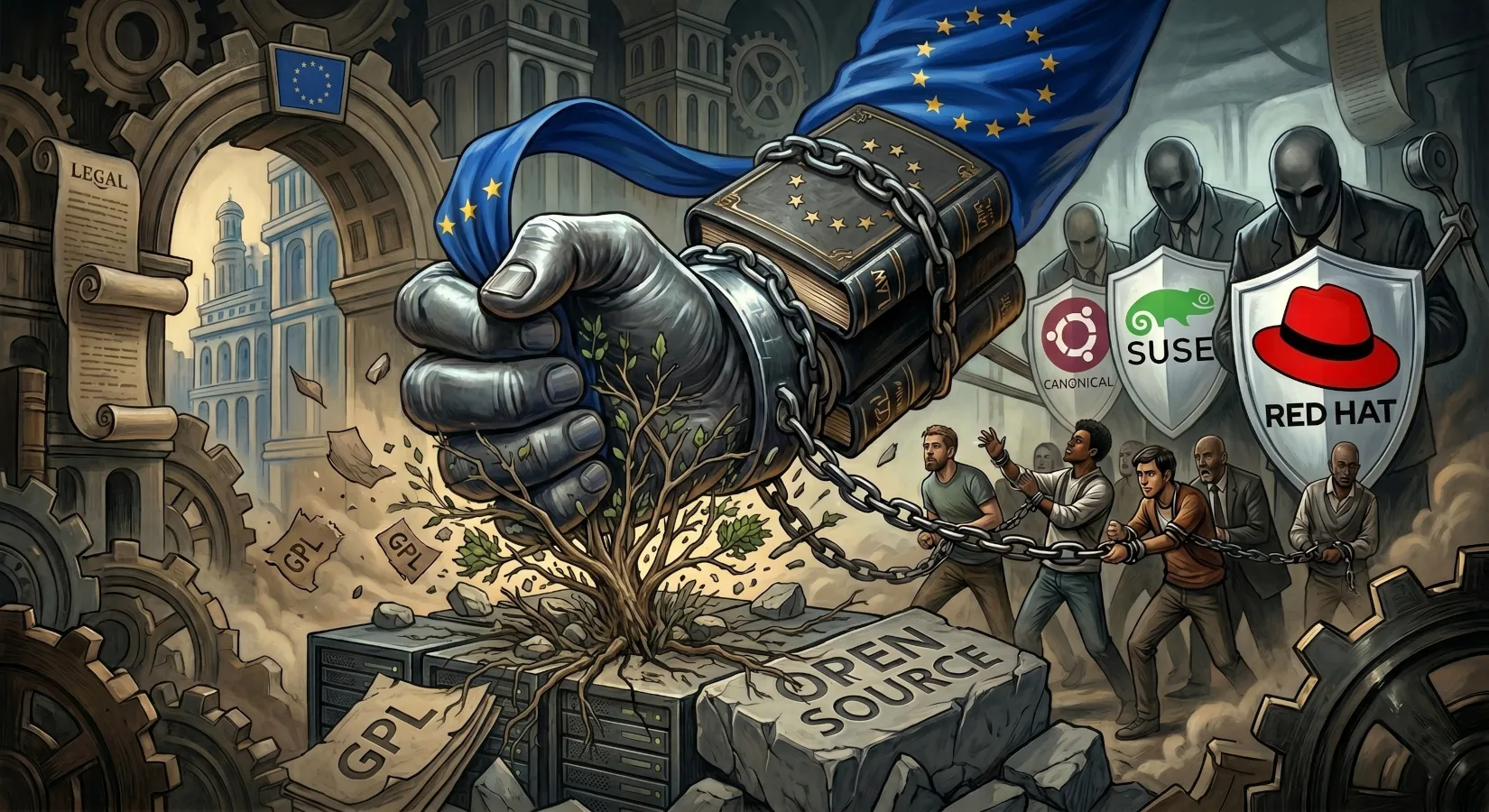
Open Source First: Europe wants software independence, but its proposal is a corporate trap
The European Commission is preparing to present the Tech Sovereignty Package, which includes the long-awaited proposal for the Cloud and AI Development Act (CAIDA).
In the current political context, an influential coalition of technology firms led by the company SUSE has sent an open letter demanding the mandatory implementation of an "Open Source First" directive in public procurement by member states.
The proposal seeks to legally oblige public administrations to evaluate and prioritize qualified open source alternatives before purchasing any proprietary software from foreign vendors. However, behind this rhetoric of digital independence lies a regulatory trap that threatens to suffocate community developers and proprietary developers alike, permanently alter the foundations of open technology and line the pockets of a few who have been unable to stand out in the sector.
The mirage of digital sovereignty and the procurement mandate
The initiative "Open Source First" in Europe aims to reverse decades of public-sector purchasing decisions that have perpetuated proprietary lock-in, or vendor lock-in. According to SUSE CEO Dirk-Peter van Leeuwen, real sovereignty lies not simply in the physical location of a data center on European soil, but in the ability to inspect, modify and replace the software architecture in use.
"Buildings become European; dependency does not," warns the executive to illustrate the risk of hosting inaccessible proprietary systems under local laws. The signatories of the open letter therefore demand that every public tender process transparently document and audit the search for free software alternatives.
The underlying goal is to transform these open source projects into viable commercial competitors to the North American technology giants. To this end, European authorities believe that "much of the value generated by local open developments is currently exploited outside the European Union," disproportionately benefiting large multinational corporations.
However, the proposal makes the critical mistake of focusing exclusively on incentivizing public demand. By omitting supply-side support mechanisms, the European strategy creates an asymmetry that weakens the very software it claims to defend and that may end up suffocating the sector, especially given the regulatory and compliance requirements it wants to apply to largely community projects with no financial support.
The fragility of the commons and the WordPress lesson
The fundamental premise of "Open Source First" very wrongly assumes that the open infrastructure needed to replace proprietary systems will exist spontaneously. But reality is far wilder and harsher. And that reality is that free code does not automatically equal digital sovereignty, especially if the ecosystem's foundations lack real financial support.
Joost de Valk, a specialist in the sector, notes in a recent post on his personal blog, that procurement directives channel public funds toward vendors of end products built on open source, but ignore the plumbing of the Internet and the entire community fabric behind it. Critical elements such as package managers, federated repositories, language registries and certificate authorities continue to operate thanks to the volunteer work of overburdened teams and, to some extent, of foreign companies and institutions with no counterpart in Europe.
Disconnect from reality
Moreover, the disconnect between the software license and control of the infrastructure was laid bare by the WordPress updater crisis in 2024. In that case, unilateral control of the update distribution infrastructure (by WordPress) blocked thousands of websites from accessing critical patches. And in that case, neither permissive licenses nor community foundations could prevent a single point of failure from affecting the network's global security.
And worse, despite efforts to decentralize and ensure the neutrality of these channels, such as the Federated and Independent Repositories (FAIR)project, all of them failed due to a lack of financial support from the commercial ecosystem. Making it clear that without direct investment in maintaining these commons, the community proposal will recreate the same problem of dependency at scale.
Where was Europe at that time? Trying to regulate AI, a technology still misunderstood and whose full scope we cannot yet be sure of, while the WordPress community (on which more than 60% of the world's websites are built) was going through a crisis and needed real support. An absolute display of disconnect from reality and ignorance of the sector, taken to its infinite expression.
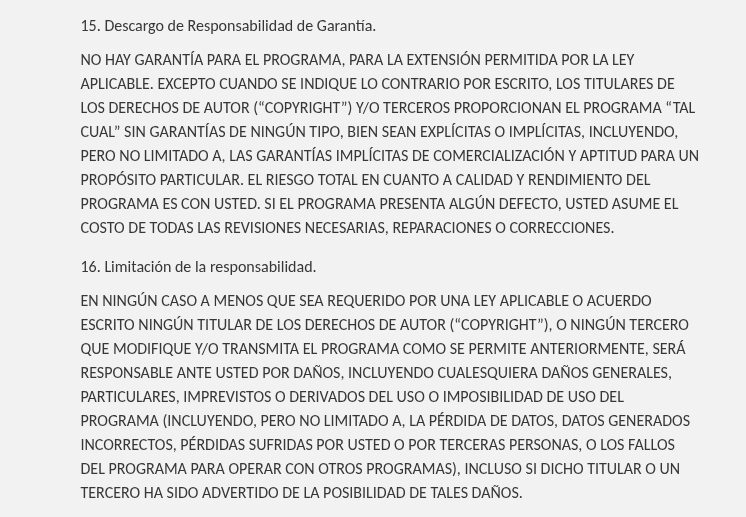
Historically, free software has thrived under permissive and copyleft licenses that include an absolute liability exemption clause. In other words, just look at a license such as GPL or BSD and see things like these:
GPL v3 license disclaimer
The principle that code is provided "as is" has allowed thousands of independent developers to collaborate in good faith without fear of catastrophic legal repercussions. However, the new European Union regulatory framework implicitly removes this protective shield for much of the community.
The PLD Directive (Directive EU 2024/2853) explicitly classifies software as a "product," subjecting its creators to a strict liability regime, or liability without fault, for material or immaterial damage caused by security defects.
Although the directives claim to exclude software developed outside a commercial activity, the marketing definitions adopted are extremely broad, dangerously broad. For example, any developer who accepts recurring donations, receives corporate sponsorship or provides paid support services is considered a commercial actor and must therefore assume legal liability for vulnerabilities integrated into third-party products.
Additionally, the CRA introduces the legal category of "open source steward," obliging community foundations to implement strict cybersecurity policies and actively report exploited vulnerabilities within less than 24 hours under threat of administrative sanctions.
An example of the danger
If you are not deeply familiar with the open source sector, this will seem "logical" and even desirable. But the reality is that it is a measure that may end up destroying everything that has been built in the community. Let's look at some examples. Recently the Linux kernel (largely developed by US companies, their employees and a large community of global contributors) had a series of serious flaws, including Copy Fail.
This flaw was introduced (unintentionally) in 2017 by smuellerDD, a free software developer specializing in cryptography (of whom there are very few) who has made major contributions to the kernel and to languages such as Lean, the latter being well known for its versatility in generating ZKP proofs on blockchain. The contribution sought to improve the kernel's cryptographic capability to make communications more secure (something it achieved) but introduced a local exploitation vector that gave rise to CopyFail in 2026.
Well, under European legislation, this person should face legal consequences for that work. Work done communally, without financial sponsorship and in good faith. But none of that matters; for the EU, this person must face the legal consequences of code introduced in 2017 that led to a serious local security flaw; the rest does not matter.
Under those conditions, no one would want to participate in a project for fear that their lines of code might end up leading to a fine or worse, jail.
But faced with the prospect that a good-faith mistake could ruin an independent developer's life, large corporations have found their golden opportunity. Companies will now present themselves as "saviors" through CLAs (Contributor License Agreements).
The deal is simple, in the purest mafia style: "You assign me the ownership and rights to your code, and my legal department protects you from Brussels' fines." Thus, the law that sought to protect the end user ends up concentrating all the power of free software in the same hands as always: private software companies.
For companies like Canonical or SUSE itself, author of this Open Source First open letter, this situation is the perfect paradise. Canonical, for example, has one of the most brutal and absurd CLAs in the ecosystem. If you want to contribute to Ubuntu or they consider your code to be of interest, they will make you sign those CLAs by every possible means.
The result? Absurd cases like the absolute and total takeover of LXC/LXD development (a container system for Linux) that is now a solution developed exclusively for Ubuntu. Thus, a community development becomes a piece of proprietary software controlled by a company. Of course, the community has created a free version called Incus, but from now on they are entirely different things.
The SUSE case
Now, the SUSE case is no different. Although the German firm champions rhetoric in defense of genuine open source, its corporate moves follow the same logic of control through legal shielding.
After acquiring Rancher Labs (Kubernetes), SUSE consolidated its dominance over one of the most widely used container orchestration tools in the world. For independent developers, contributing to Rancher or to projects in the SUSE ecosystem means accepting its own contributor agreements (CLA) that transfer commercial control of your code to the company. Basically, "Write code for us, improve our tool, but control of the code, its copyright and any rights you may have over it now belong to SUSE."
Furthermore, after the storm unleashed by Red Hat when it closed the RHEL code (although it keeps CentOS and Fedora open), SUSE moved quickly by creating OpenELA alongside other giants. Under the promise of "saving" the enterprise ecosystem, what is really being built is a corporate bunker.
This makes one thing clear: the new European regulations do not help free software; they only serve to create versions of "The Godfather" in the sector, corporatizing it and making it increasingly dangerous for community developments.
The era of automated vulnerability and artificial intelligence
And this problem only deepens and becomes more chronic with a new actor: AI. Here, the debate over software liability has intensified unexpectedly due to the development of artificial intelligence models capable of auditing code at massive scale. Advanced cybersecurity-oriented models, such as Anthropic's Claude Mythos, have changed the rules of the game by autonomously discovering thousands of complex vulnerabilities in production operating systems.
This capacity for autonomous discovery represents a legal turning point for the technology industry and digital asset management. Under the new European regulations, the classic argument that "a code error was inevitable" loses validity if a commercial artificial intelligence can identify it in minutes.
In the field of blockchain infrastructure and the custody of any token or cryptoasset, where code security is the only guarantor of funds, the rapid-update pressures imposed by the CRA will prove unsustainable for small development teams. In fact, we recently discussed security in DeFi, and that is just a reflection of this problem.
An unsustainable path for European technology
With all this, it is clear that the European Union's strategy under the banner of digital sovereignty suffers from a fundamental internal incoherence and a total disconnect. At the same time as it promotes "Open Source First" to escape dependence on foreign vendors, it raises a bureaucratic and punitive wall that discourages the creation and maintenance of open projects within its own borders.
Moreover, the obligation to assume the legal liabilities typical of large manufacturing companies over community projects devoid of budgets will only suffocate local talent.
For the European technology ecosystem to thrive, it is essential that regulations recognize the non-hierarchical, free-collaboration nature of open technology. Forcing communities to operate like corporations with regulatory compliance departments undermines software resilience and fragments the global community network.
If Europe insists on turning security into a tool of legal coercion, instead of prioritizing direct funding of basic open infrastructure, it will end up achieving an isolated region, deprived of secure alternatives and technologically subordinate, if not to the United States, then to China, but subordinate nonetheless.