There was a moment, in mid-2024, when the offices in Redmond stopped looking at the Windows operating system as a container for heavy programs. Secretly, a team of Microsoft engineers began programming on a radically different canvas: one where traditional windows, .exe applications and the iconic Windows logo gave way to an omnipresent intelligence.
The experiment was given the code name Project Aion. Although the materials that revealed its existence were recently leaked through the Beta Wiki Discord server and reporting by specialist journalists such as Zac Bowden, Project Aion represents Microsoft's boldest and purest attempt to bring a revolutionary idea to life: an agentic operating system built entirely by and for artificial intelligence.
An operating system born in the cloud
Project Aion was born in 2024 as an internal incubation effort. At the time, the general public saw Microsoft Copilot as a subtle sidebar in Windows 11 or a web chat assistant. Behind closed doors, however, the vision was far more ambitious. Instead of embedding AI on top of an old operating system loaded with legacy code, the engineers asked themselves: What would a computer look like if it were designed from scratch in the era of generative AI?
Chips in space and companies without humans? The ruthless X-ray of the Musk ecosystem
To achieve this, they turned to a hardware-agnostic strategy. They did not create a new chip or programming language; they took the Microsoft Edge browser engine and turned it into the shell of the operating system itself. Basically, Aion was designed to run smoothly both on desktop computers on a lightweight Windows base and on mobile devices via Android (AOSP).
The core of this technical experiment relied on «Win3«, a new Windows codebase stripped of all the historical traces accumulated over decades. The side effect was an extremely lightweight system, with almost instant boot times and drastically reduced battery consumption, but at a high price: the loss of native compatibility with classic desktop applications. It was an attempt by Microsoft to start from scratch.
Dominated by the mind of Copilot
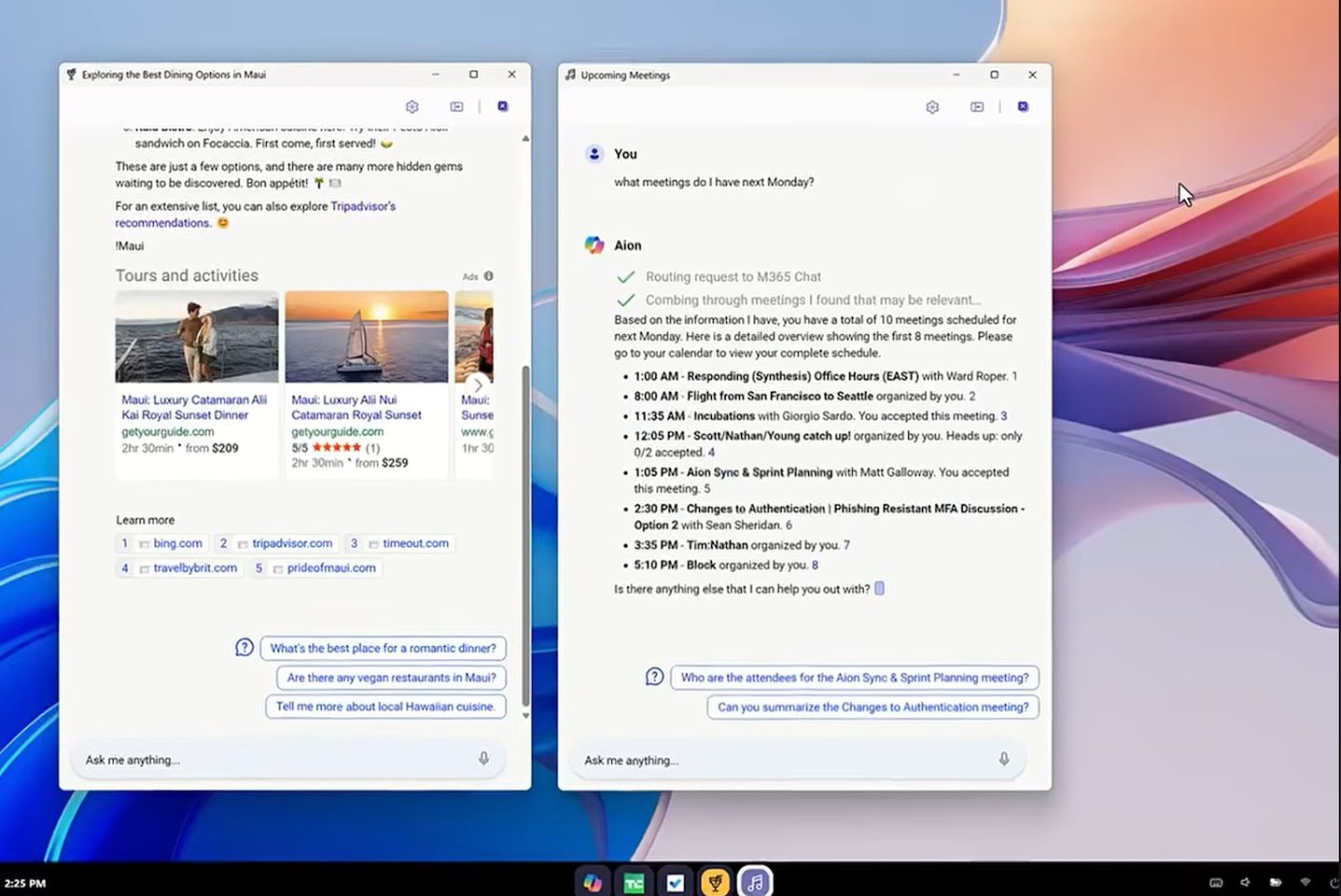
In Aion's leaked interface, the conventions that have governed computing since the 1990s disappear. When the device is turned on, the first thing that stands out is a clean environment, governed by the following innovations:
- The Start Menu is Copilot: The Windows button with the tiles or the app list no longer exists. Instead, in the corner of the taskbar, sits the circular Copilot logo. When clicked, a large multimodal dialog box (an omnibox) opens. From there, by typing or speaking, the user initiates any action: searching for files, browsing the web, opening web tools or giving complex commands.
- The Concept of «Spaces»: The system does not organize work by standalone programs, but by intentions. Copilot automatically groups web pages, documents and tools into thematic «Spaces» according to the task being performed. In the taskbar, these spaces appear highlighted as visual containers of different colors, which allows complex projects to be closed and resumed with a single click.
- Floating Applications and Absolute Context: Since the entire system runs on web technologies, applications run in floating windows that can be minimized or docked. This gives Copilot an analytical advantage: as a unified interface, the AI fully understands the context of everything the user has open on screen. It can read a scientific article, summarize it and draft an email attaching it, without the user ever having to leave the chat flow.
- The bridge to the past (Windows 365): What happens if an Aion user urgently needs to open a classic Win32 program, such as the full version of Word or corporate software? Lacking native support, the operating system invisibly generates a remote link to a cloud instance through Windows Cloud PC, running the program in virtualized form.
What is Microsoft aiming for with this development?
Project Aion works as a window into Microsoft's conceptual vision of the future of computing. The goal behind this incubation was not to launch a direct rival to replace Windows 11 overnight, but to explore the limits of agentic operating systems. Microsoft seeks to transition from a model where the user handles tools to a model where the user interacts with an «agent» that handles the computer for them.
Although the Aion prototype dates back a couple of years and industry sources suggest the project in its original state may be shelved, its philosophy is more alive than ever. The company recently announced initiatives such as Project Solara, another agentic operating system approach focused on generating «just-in-time» interfaces (just-in-time UI) according to the user's needs.
Project Aion shows that, for tech giants, the traditional desktop of folders and shortcuts is already a prehistoric paradigm. The true operating system of the future doesn't want you to search for your applications; it wants to understand what you want to do and build the experience to your measure in real time.
The end of the Linux monopoly: Microsoft integrates Containers into Windows to retire Docker
An idea with no future?
But the Project Aion leak soon stirred up a cloud of skepticism in tech forums and traditional user communities.
And it is that what for Redmond engineers was a clean and revolutionary environment, for the advanced user represented an alarming loss of digital sovereignty. After all, the radical transition to a purely web-based operating system strips the user of direct control over their local files and tools, forcing them to depend on a permanent internet connection and subscriptions such as Windows 365 to open a simple classic word processor.
Moreover, this disconnection from the roots of the Win32 format awakens the fear of a future where the user no longer owns their software, but rents it virtually in the cloud. Beyond the technical infrastructure, the real point of friction lies in the implicit privacy that an AI with «absolute context» requires.
For Copilot to be able to anticipate intentions, group tasks into workspaces and draft emails autonomously, the operating system must constantly monitor and analyze every pixel, text and open window on the screen. This level of algorithmic scrutiny inevitably revives the misgivings provoked by other controversial Microsoft deep telemetry tools, fueling an ethical debate over whether users are willing to sacrifice their digital privacy in exchange for automated convenience.
The new board against Google and Apple
The birth and subsequent evolution of experiments such as Project Aion place Microsoft at the epicenter of a new and intense tech cold war, where the battlefield is no longer measured by hardware power, but by the integration of artificial intelligence at the very heart of the operating system.
On this new board, competitors such as Google are advancing steadily by gradually transforming the Android ecosystem through Gemini's agentic functions, designed to break down the barriers between mobile applications and execute complex tasks across the device.
Tokenization firm Securitize debuts on Wall Street with a rise of up to 16%
For its part, Apple defends a diametrically opposite philosophy with Apple Intelligence, betting on a hybrid approach but strongly rooted in local processing and extreme privacy, delegating the computational load to the chips of its own devices instead of turning fully to the cloud as Microsoft's web vision proposes.
Project Aion, together with the company's new guidelines such as Project Solara and its approach to interfaces generated on the fly, shows that the tech industry is rewriting its own standards. Success in the coming years will no longer depend on which ecosystem has the store with the most applications, but on which company manages to design the most autonomous, invisible and effective artificial agent, capable of transforming old static interfaces into liquid experiences that adapt in real time to human needs.