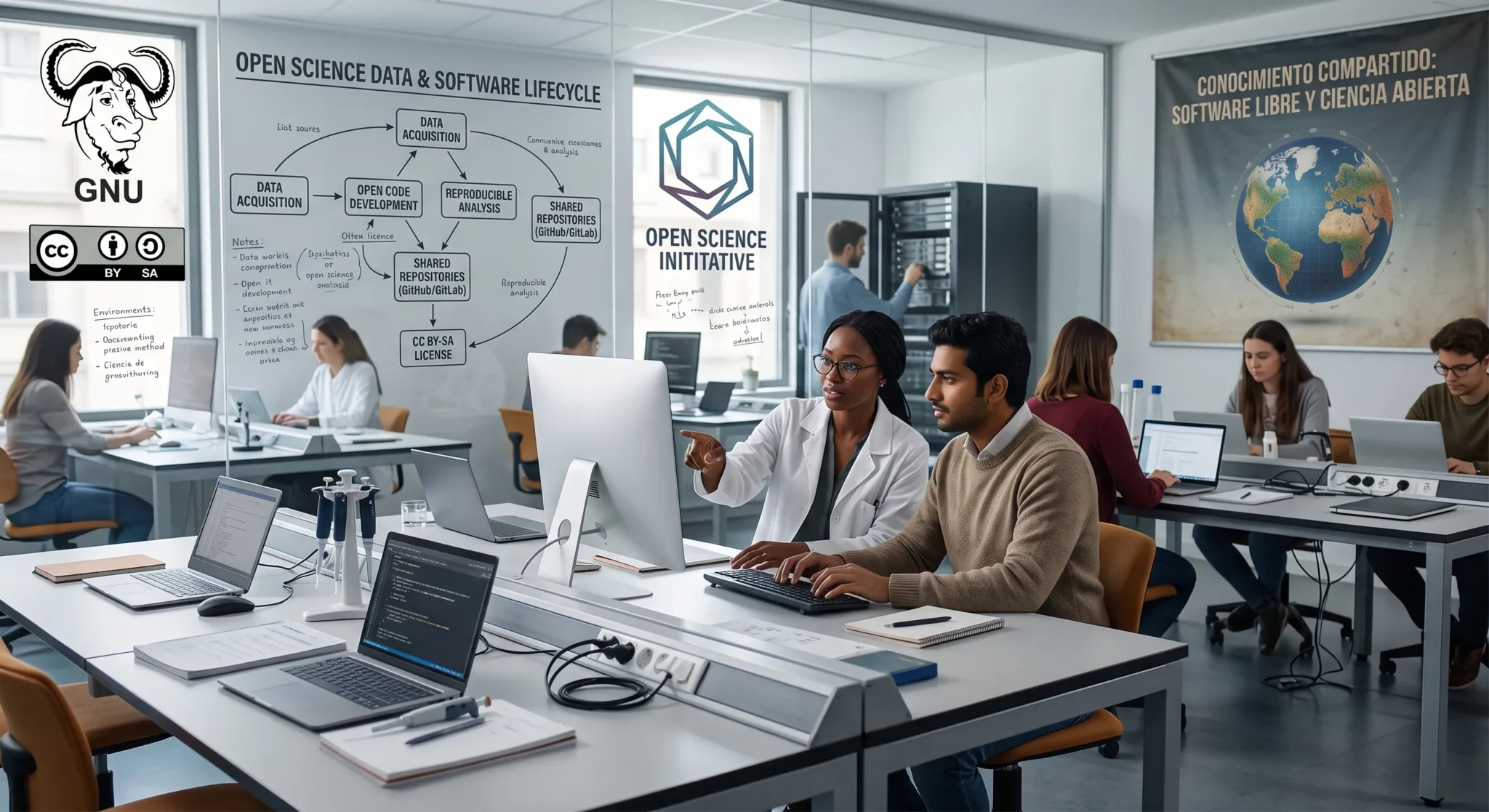
Modern science is no longer done with pipettes and telescopes alone; instead, most of it is done with software and powerful computer simulations. More than 90% of researchers depend on computer programs, and much of that technological base is free and open-source software.
In turn, open science, the movement that drives the sharing of data, methods and results, could not advance without tools that anyone can examine, modify and reuse. Two movements that were born separately now share the same nervous system; protecting that alliance is protecting knowledge itself.
Two movements, one spirit
Free software predates the Internet as we know it. In September 1983, programmer Richard Stallman announced the GNU project; in 1985 he published the GNU Manifesto and founded the Free Software Foundation.
Its central idea was political: a program is free if it grants its user four freedoms:
- to use it for any purpose
- to study it
- to modify it
- and to redistribute it
By 1998, part of the community adopted the term open source to focus on the technical advantages, even though Stallman's original spirit still spoke of freedom. Both terms now coexist as two sides of the same coin: code that anyone can read, correct and share.
In that same spirit, open science reached a global milestone much later: on November 23, 2021, the 193 UNESCO member states unanimously adopted the first universal definition of open science, which expressly includes open software and source code as part of "open scientific knowledge", alongside publications, data and educational resources. That 193 countries agreed on that framework means that open access to publicly funded knowledge stopped being a minority aspiration and became international policy.
Both movements share an ethical starting point: open exchange as the basis of trust. Stallman began building GNU because in the MIT laboratory where he worked, researchers and students passed code around like people passing around recipes, a culture identical to the one science has practiced for centuries. And so free software digitized a value that was already in the DNA of the scientific method.
AI changes the rules of development, warns the World Bank
A symbiosis that works in both directions
But the relationship between the two ecosystems is not a casual loan, but a mutual dependence that reinforces itself. Software is the invisible infrastructure on which research rests: surveys by the Software Sustainability Institute reveal that 92% of UK academics use research software and that 69% say their work would not be viable without it; a survey of US postdocs put usage at 95%. An analysis of Nature articles from the first quarter of 2016 found that 80% mentioned software, with an average of seven programs per article.
In that landscape, open source dominates. Python's scientific ecosystem (NumPy, SciPy, Matplotlib, pandas, scikit-learn) underpins research in physics, chemistry, biology, astronomy, psychology and economics. In 2020, the journal Nature devoted a review article to NumPy noting that it was no longer a small community project but "core scientific infrastructure". Modern research cannot be explained without these programs: scientists use them, fix them and give back improvements, a virtuous cycle that proprietary licenses cut off at the root.
The current also flows in the opposite direction: science is one of the most powerful engines of free software. Researchers write code, maintain packages and build communities; projects such as Astropy (astronomy), rOpenSci (environmental sciences) and AiiDA (materials science) were born in universities and are now standards in their disciplines. Science contributes demanding users and difficult use cases; free software contributes transparency and reproducibility. A result published without the code that generated it is, in practical terms, a claim that no one can verify.
Results that speak for themselves
The concrete evidence of this alliance lies in the biggest recent scientific milestones. For example, the detection of gravitational waves, announced on September 14, 2015 and recognized with the Nobel Prize in Physics in 2017, was achieved thanks to a data infrastructure built on Python.
Another achievement is the first image of a black hole, published in 2019 by the Event Horizon telescope, which was processed with the Python scientific ecosystem. The James Webb telescope, launched on December 25, 2021, calibrates its data with a pipeline whose source code is open and published on GitHub.
Clearly, these are not anecdotes or isolated facts: the most sophisticated scientific infrastructure humanity has ever built rests largely on software that anyone can inspect and improve. Organizing it any other way would have made science more expensive or handed it over to a handful of vendors.
Who benefits from this alliance
The symbiosis benefits not only scientists but also the public that funds research. Public funds that pay salaries, telescopes and laboratories also pay for the software that makes them work; keeping that software under lock and key is paying twice. The "Public money, public code" campaign of the Free Software Foundation Europe, launched in September 2017 and backed by 237 organizations and more than 39,000 signatories, sums up that principle: what is built with public money must be accessible to the public.
It also benefits countries with fewer resources: when tools and knowledge are open, a researcher in a modest laboratory anywhere in the world works with the same instruments as an elite center, an explicit goal of the UNESCO Recommendation. A student who cannot afford a proprietary license can still learn and contribute with open tools.
And it benefits the economy: PLOS estimates that a closed research system would leave long-term GDP roughly 2% below an open one, thanks to the reuse of data, software and methods, which avoids duplicating efforts. Open infrastructures also generate more value than they cost: NumPy, sustained on modest budgets, yields benefits several orders of magnitude greater than its cost.
The crypto industry demands access to large AI models to protect the Bitcoin network
Why protect it and incentivize it?
The fact that the alliance works does not mean it is free. The Achilles' heel of open scientific software is sustainability: many academic projects are abandoned a few years after their creation, depend on the volunteer work of students and researchers with no professional incentives, and agencies rarely recognize software maintenance as research activity. A report by Ithaka S+R, published in March 2026, warns that one-off grants are not enough and calls for funding software as infrastructure: continuously and reliably, the way a road or a telescope is funded.
Nor is openness immune to commercial capture. The "paid open access" model (gold open access) shifted the cost from reading to publishing: article processing charges range from about $3,000 to $12,000, and the big publishers maintain margins close to 40%.
In 2026, funders such as Cancer Research UK withdrew their support for that model and the US NIH is studying capping those fees. The lesson for software is direct: openness without sustainable funding degrades or ends up captured by whoever can pay for it. A perspective published in Nature Human Behaviour in August 2026 also recalls that openness does not sustain itself: it depends on governance and continuous maintenance, work that is poorly paid and little recognized.
The future of the alliance
There are, however, recent regulatory advances in the right direction. On June 3, 2026, the European Commission published its Technological Sovereignty package, which explicitly recognizes the "public money, public code" principle and plans to mobilize 2 billion euros over seven years for the open-source ecosystem.
In the United States, the OSTP memorandum of August 2022 and the NIH public access policy of 2025 eliminated the one-year embargoes for federally funded research. The path is promising, but the hardest part remains: turning principles into continuous funding and real incentives.
Therefore, looking ahead to the coming years, the question is not whether free software and open science are desirable, but how to pay for and recognize the work that sustains them: treating code as a research output on equal footing with the article, with a DOI, citations and professional credit; requiring funders to mandate open code as a condition of their grants; and having institutions maintain infrastructure with stable budgets, not ephemeral grants.
The symbiosis between free software and open science is not a technical luxury, but the condition for cheaper, fairer and more verifiable science. Protecting it is protecting the right to know how the world works, and that matters to all of us.