While rumors of a Stripe acquisition of PayPal dominate headlines for their symbolic scale, the real seismic shift has to do with the invisible "plumbing" of the Bridge system. The $1.1 billion purchase of Bridge has not only turned out to be the Collison brothers' true strategic "bargain," but has also given Stripe a technological edge that no traditional merger could match.
With 300% growth in transaction volume in the middle of a bear market, Bridge has completed Stripe's transformation. The Collison brothers' company is no longer competing solely for screen time or user interface; it has become the new global financial highway built on stablecoins, operating outside the friction of conventional banking.
The end of speculation, the beginning of utility
Over the past year, the volume processed by Bridge quadrupled while the crypto market retreated. This data shows that the utility of moving money efficiently is immune to the cooling of speculation. Today, adoption is no longer measured by asset prices, but by the strength of infrastructure.
In 2025, businesses operating on Stripe generated $1.9 trillion in volume, a figure that represents approximately 1.6% of global GDP. Bridge is the emerging layer of a payments network that, by volume and efficiency, already rivals national economies.
Stablecoins as the "plumbing" of the 21st century
The Bridge acquisition is the definitive bet on the new role of stablecoins. What matters is not tokenization per se, but a structural shift in mindset: stablecoins stablecoins have ceased to be crypto assets and have transformed into the invisible plumbing of digital money. It is a technology designed to move value at internet speed, eliminating the bottlenecks of the traditional financial system.
Cryptoasset orchestration is the technological piece that allows businesses to operate across multiple blockchain networks without inheriting their technical complexity. In this ecosystem, Bridge acts as a critical abstraction layer: it manages the full lifecycle of each transaction, from receiving and converting funds to smart routing between chains and final settlement.
YAHOO FINANCE INTEGRATES COINBASE TO TURN ITS NEWS INTO BUY BUTTONS
The practical impact is the elimination of historic technical barriers. Businesses no longer need to operate nodes or custody private keys, two tasks that combine operational complexity and security risk. Instead, they can integrate blockchain payments as just another service, while Bridge absorbs the complexity of the distributed ledger and translates it into a seamless experience.
Efficiency as a competitive advantage
Bridge's engine monitors networks such as Ethereum, Solana, Polygon or Stellar in real time to determine the most efficient route for each payment. Gas fees, congestion and confirmation times are evaluated dynamically so that an international transfer can settle in minutes instead of days.
This smart routing is what has allowed companies such as Starlink or Bitso to scale their cross-border operations without friction. Bridge thus functions as a permanent optimization hub where technical complexity is transformed into operational efficiency and where the promise of instant global payments begins to materialize in real cases.
Regulation
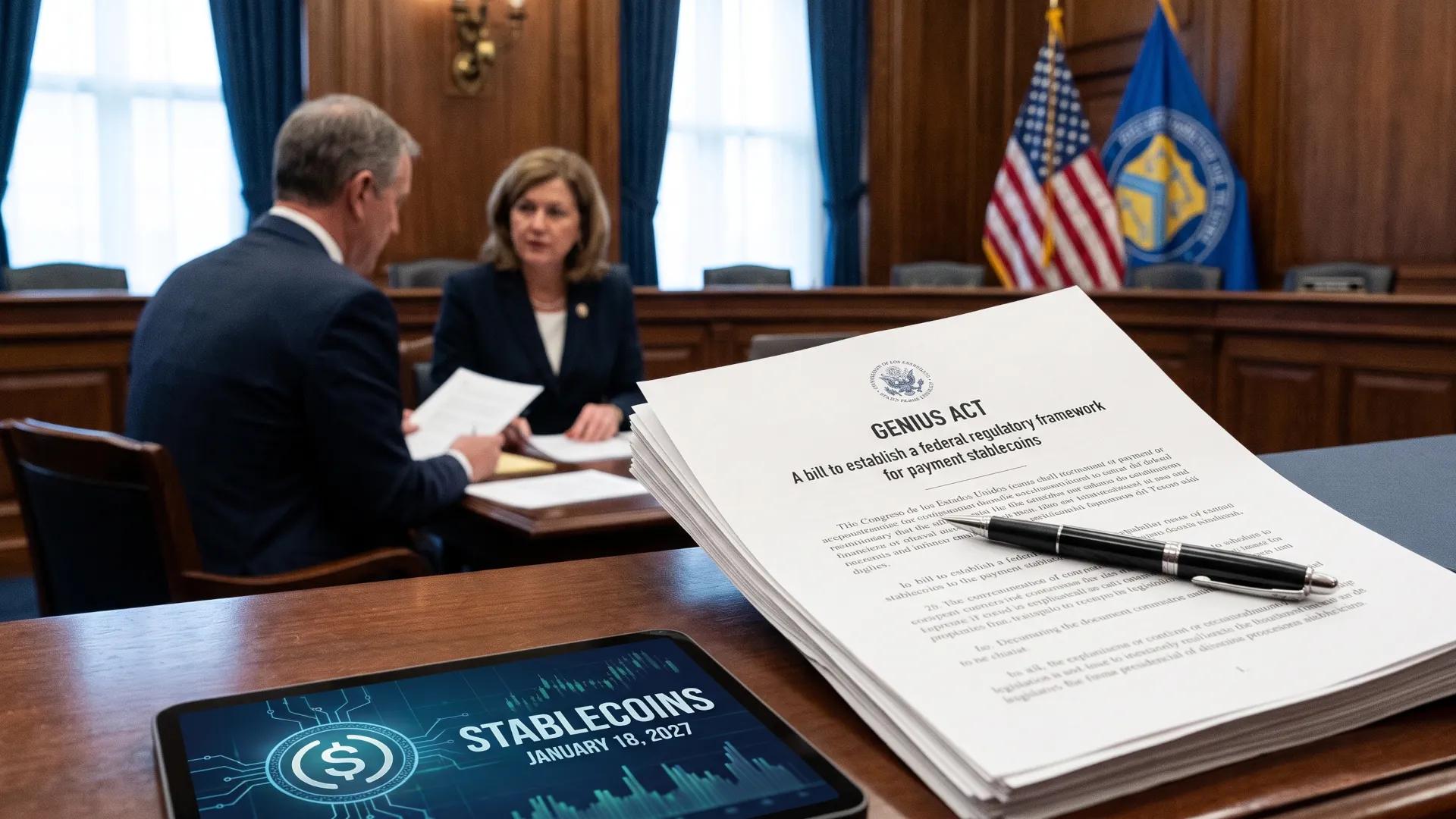
Another key factor in Bridge's expansion has been the regulatory evolution in the United States. The 2025 approval of the GENIUS Act established for the first time a clear federal framework for stablecoin issuers, requiring 1:1 reserves in liquid assets and periodic oversight by regulators.
Leveraging that environment, Bridge obtained conditional approval from the Office of the Comptroller of the Currency to operate as a National Trust Bank. This status allows Stripe's subsidiary to issue tokens, manage reserves and orchestrate transactions under a single federal license, avoiding the state regulatory patchwork that has historically limited the expansion of payments companies.
Tempo, next-generation infrastructure
In parallel, Stripe and investment firm Paradigm launched Tempo in 2025, a Layer 1 blockchain network designed specifically for payments. The initiative responds to a structural limitation of general-purpose blockchains: congestion and unpredictable fees during periods of high demand.
Built on the Reth client and compatible with the Ethereum Virtual Machine, Tempo aims to combine the performance of centralized processors with the transparency and programmability of blockchain technology. The network aspires to exceed 100,000 transactions per second with near-instant finality, a capacity margin far above Stripe's current peak and one that anticipates the growth of global digital commerce.
Beyond acquisition rumors, Stripe's move points to the convergence of traditional fintech and crypto infrastructure. Bridge, Tempo and the growing role of stablecoins suggest that the next battle in payments will not be fought in user-facing interfaces, but in the invisible layer where money moves. And in that race, Stripe seems determined to build the highway before the rest of the industry understands where the traffic is heading.