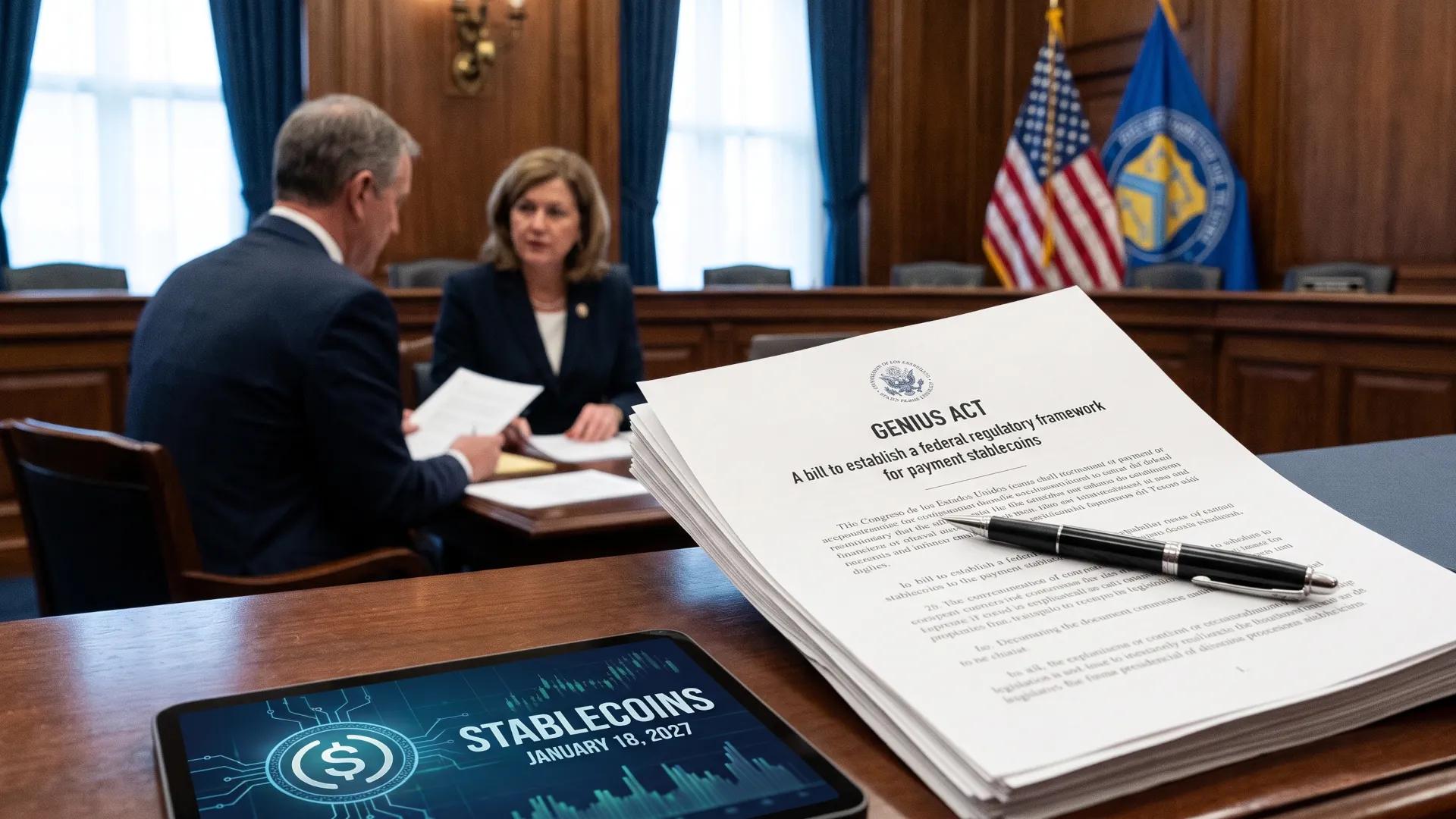
World Liberty Financial, a company owned by the family of US President Donald Trump, has applied for a national trust bank charter with the Office of the Comptroller of the Currency (OCC), the agency that oversees federal banking in the United States. If approved, the company would operate as a bank under the name World Liberty Trust Company. That would make it one of the first projects directly linked to a presidential family to gain access to the regulated banking system through a structure designed to operate with cryptocurrencies.
A bank for the Trumps
The application was announced by the company on January 7, 2026, and seeks to integrate, under a single regulated entity, the issuance, custody and conversion of stablecoins, with a special role for USD1, the stablecoin created by the company itself.
Since its creation in September 2024, two months before Trump won the election, the company has been controlled by the president's family circle. In fact, his sons Donald Trump Jr. and Eric Trump are the public faces of the project. The development and expansion of World Liberty Financial have accelerated notably since Trump came to power, thanks to a highly favorable environment for stablecoins.
What USD1 is
World Liberty Financial's main asset is USD1, a stablecoin announced in March 2025 and officially launched in April of that same year. According to the company, it is 100% backed by short-term US Treasury bonds, bank deposits and cash equivalents.
Trump's stablecoin rose $2.13 billion in a day after investment in Binance
Unlike other stablecoins, USD1's growth was not gradual. Its rapid takeoff was tied to a $2 billion institutional investment in Binance, made through this stablecoin. Thus, between April 29 and 30, 2025, USD1's market capitalization went from practically zero to more than $2.13 billion in just 24 hours. The reason was its use as an exchange asset in a transaction between Binance and the Abu Dhabi-based Emirati sovereign fund MGX.
The transaction was publicly confirmed by Zach Witkoff, an executive at World Liberty Financial, during the Token2049 conference held in Dubai. MGX, specialized in artificial intelligence and emerging technologies, used USD1 as a vehicle to channel its capital entry into Binance, the world's largest cryptocurrency exchange.
Trump's pardon of CZ
What happened gave USD1 immediate legitimacy in international markets and placed World Liberty Financial at the center of a network connecting sovereign capital from the Middle East, major crypto platforms and US political power.
It is worth recalling that in October 2025, Donald Trump granted a pardon to Changpeng Zhao, founder and owner of Binance, after his conviction in the United States for violating federal money laundering prevention laws. The pardon erased the legal effects of the sentence and closed one of the largest criminal cases against a major crypto platform.
To get an idea of how the Trump family's stablecoin has evolved, it is important to note that in less than a year of existence it is about to surpass in market capitalization PYUSD, the stablecoin from PayPal, which was launched in August 2023. While PYUSD, launched in August 2023, is around $3.6 billion, USD1 has exceeded $3.4 billion.
Comparison with PayPal's stablecoin
Currently, USD1 has a circulating supply of 3.43 billion tokens and a daily trading volume close to $800 million, while PYUSD, the stablecoin from PayPal, has a similar supply, around 3.65 billion tokens, but a much lower daily volume, about $60 or 70 million. The figure underscores that, despite PayPal's weight in global markets, USD1 moves more than ten times more capital each day than the stablecoin of the payments giant
Why the Trumps want a bank
A national trust bank would allow the Trump family to control and protect its stablecoin as if it were part of the financial system. Through USD1, they could issue digital dollars without the central bank's permission, as long as they are backed by dollar assets. It would give them control over issuance and custody, allow them to shield themselves from regulatory changes or offer services to large clients. At bottom, what they seek is to turn the USD1 stablecoin into stable financial infrastructure of the state. The custody infrastructure is backed by BitGo.