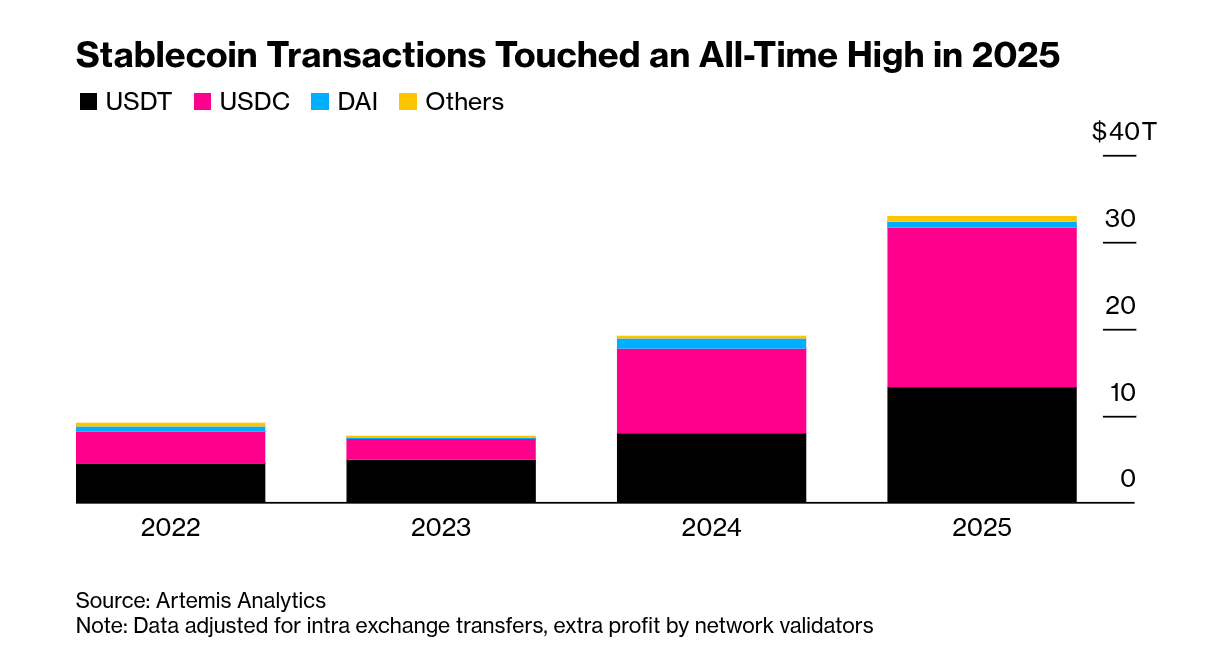
The stablecoin market reached in 2025 a volume of transactions of 33 trillion dollars, where the use of USDC, the stablecoin issued by Circle, stands out. Although Tether (USDT) has historically maintained its position as the stablecoin with the largest market capitalization, the close of 2025 revealed that true operational utility has shifted toward other horizons. In this new scenario, USDC has managed to take the lead in terms of real transactional activity, positioning itself as the preferred vehicle for moving capital around the world
USDT STABLECOIN COMES TO RUMBLE AS A PAYMENT METHOD ON THE VIDEO PLATFORM
Billion-dollar figures
This rise is reflected in figures that underscore an increasingly evident activity gap between the two assets. While USDT recorded a transaction volume of 13.3 trillion dollars, USDC reached 18.3 trillion dollars during the same period. This difference shows how the market prefers platforms that offer greater guarantees of compliance and transparency.
The dynamism of this sector became particularly visible in the last quarter of 2025, a period of unprecedented expansion in which the combined transaction volume reached an all-time record of 11 trillion dollars between October and December.
USDC's consolidation as the leader of the transactional market is the direct result of its ability to integrate with the traditional financial system. Industry experts agree that this dominance stems from a combination of deep liquidity and robust regulatory trust. By operating under stricter supervisory frameworks and offering greater clarity on its reserves, USDC has become the standard of trust for corporations and banks seeking to leverage the efficiency of blockchain technology without compromising the legal certainty of their operations.
The political push: Trump and the Genius Act
Of course, this strengthening of stablecoins as a pillar of the modern financial system is closely tied to a paradigm shift in US economic policy. The push is the result of a regulatory environment that President Donald Trump's administration has radically transformed.
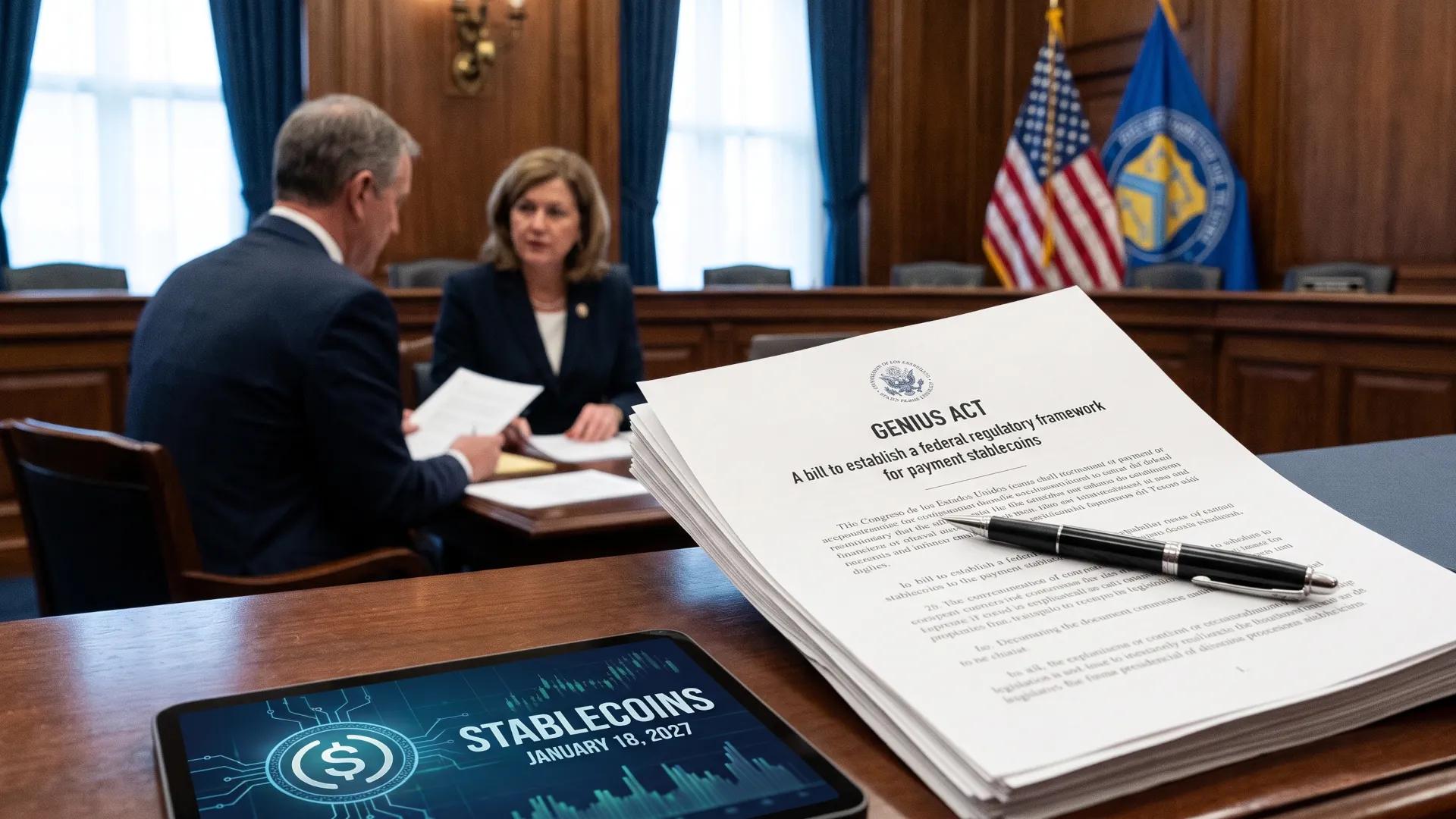
The executive's pro-crypto stance marked a turning point, moving away from the ambiguity of previous years to offer an ecosystem with greater legal certainty. And the fundamental catalyst for this transition was the approval of the Genius Act (GENIUS Act) in July 2025, historic legislation that defined clear legal standards and provided the structure needed for digital assets to operate with the same legitimacy as traditional financial instruments.
WARREN WARNS THAT THE GENIUS ACT ALLOWS TRUMP TO REGULATE IN FAVOR OF HIS STABLECOIN
The implementation of this legal framework has served as a bridge of trust for the global corporate sector, allowing industry giants such as Walmart, Amazon and Standard Chartered to begin integrating stablecoin technology into their payments and services infrastructure. This institutional opening has lowered barriers to entry, fostering healthy competition and constant innovation in how value is settled at massive scale. Clarity in the rules of the game has turned stablecoins into strategic business solutions for operational efficiency and market expansion.
Mass adoption and the digital dollar
The evolution of cryptocurrencies toward everyday use has reached a turning point, consolidating the concept of the "digital dollar" as a tangible reality for millions of people. According to Anthony Yim, co-founder of Artemis, the exponential growth in transaction volumes reflects mass adoption driven by the need for stability in times of uncertainty. This phenomenon is especially strong in an unstable geopolitical context, where stablecoins have become a safe haven from the volatility of traditional markets and international tensions.
STABLECOINS: THE UNSTOPPABLE DIGITAL DOLLAR REVOLUTION WITH TRUMP AT THE HELM
In various regions of the world, particularly in countries facing critical levels of inflation and devaluation of their local currencies, stablecoins have ceased to be a speculative asset and become a tool for economic survival. For the citizens of these nations, access to physical dollars is often restricted or expensive. By contrast, digital versions of the US currency offer the simplest, fastest and most efficient way to preserve purchasing power. This ability to hold savings in dollars digitally and globally has democratized access to a reserve currency, allowing anyone with a mobile device to protect their wealth without relying on conventional banking infrastructure.
Ultimately, what we are witnessing is the migration of value toward blockchain networks, in response to the demands of a constantly changing world.