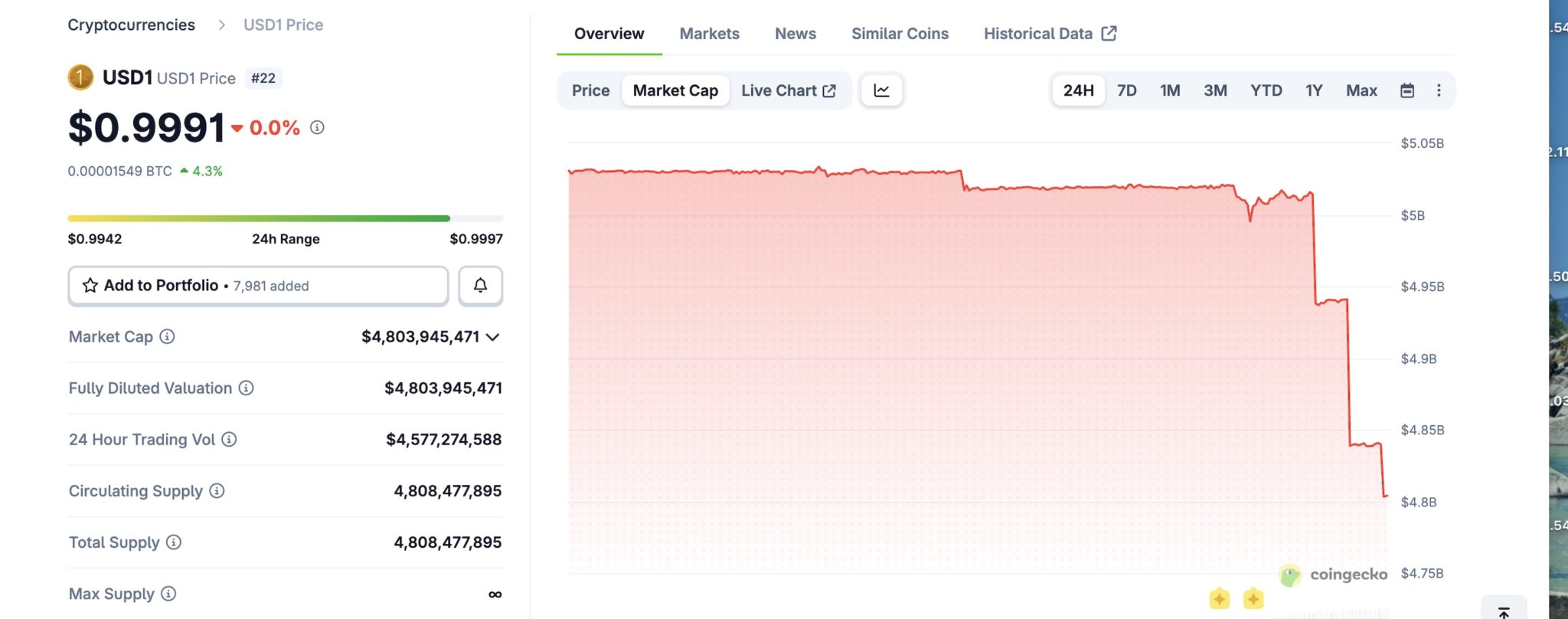
World Liberty Financial, the crypto arm linked to the Trump family, has acknowledged episodes of selling pressure on its stablecoin USD1, which caused a temporary loss of parity with the dollar and a visible drop in its market capitalization. According to CoinGecko, the asset hit an intraday low of $0.9942 before partially recovering to $0.9991.
The Trump stablecoin rose $2.130 billion in a day after investment in Binance
The stablecoin loses its peg
The chart shows that market capitalization went from moving slightly above $5 billion to around $4.8 billion, implying an outflow of approximately $200 million within hours. The sequence shows several downward steps culminating in a final stretch of vertical decline, followed by stabilization in the lower zone with no significant rebound.
The company maintains that the episode stems from speculative movements and not from structural solvency problems. In its statement, World Liberty Financial explains that the episode corresponds to a deliberate attempt to destabilize the market.
In a message posted on X, WLF asserts that a coordinated attack was launched against USD1, in which, according to its account, accounts linked to co-founders would have been compromised, disinformation campaigns financed on social media and short positions opened to amplify the impact on the price.
A one-off loss of confidence
The firm maintains that the attempt failed to break the asset's stability thanks to its minting and redemption mechanism and its 1:1 backing, arguing that the stablecoin kept its structural peg despite intraday volatility. The team urges users to trust only verified channels to prevent the spread of rumors.
The 24-hour trading volume, close to $4.570 billion, confirms a significant increase in supply turnover during the episode. This activity coincides with the volatility observed in the chart and points to rapid selling and liquidity repositioning rather than a technical failure of the peg.
Overall, the chart's behavior suggests a one-off loss of confidence followed by stabilization, with USD1 still slightly below its theoretical parity. Although the current deviation is small, the sharp drop in market capitalization and the lack of an immediate rebound show an episode of tension that tests the stablecoin's resilience in scenarios of coordinated market pressure.