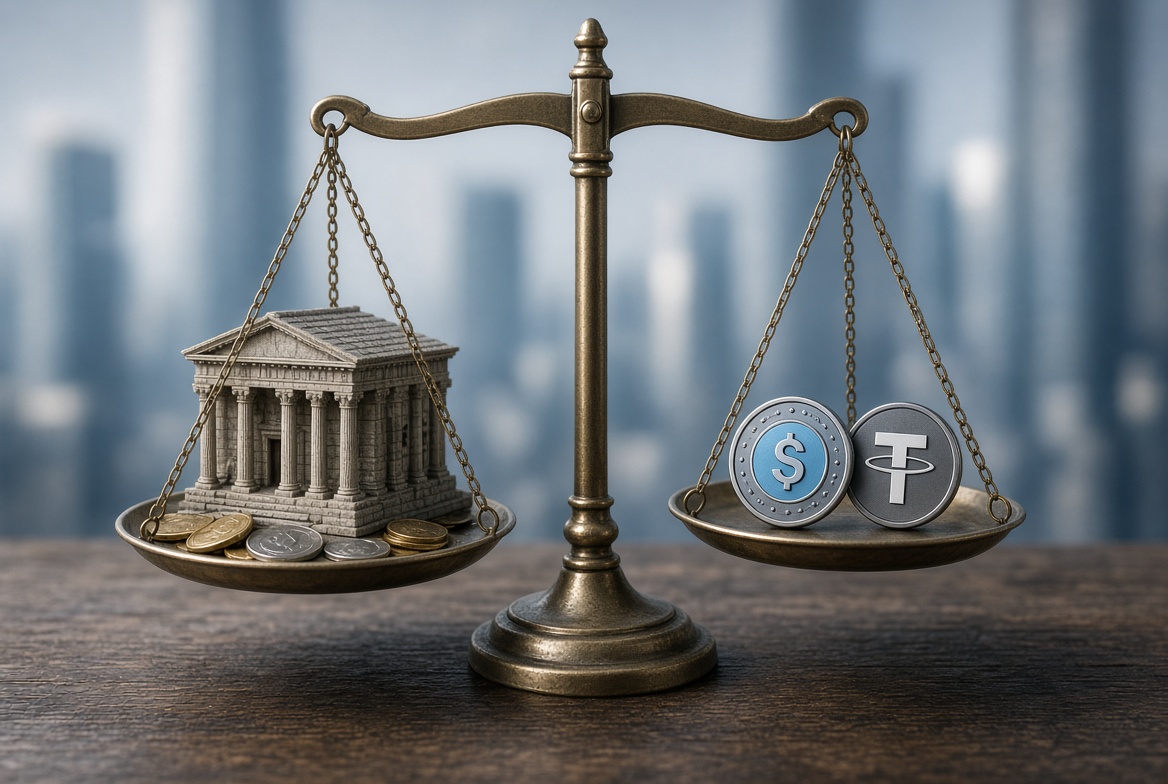
Carolyn Wilkins, an external member of the Bank of England's Financial Policy Committee, says stablecoins could end up becoming a gigantic global distribution network for the dollar. And, along the way, a new source of buyers for US government debt. Wilkins made these remarks in a speech delivered yesterday, September 15, at Queen's University Belfast on stablecoins, money and international power.
Her analysis starts from the fact that around 98% of the value of stablecoins is denominated in dollars. In other words, although blockchain was born with the promise of creating an alternative financial system, the vast majority of the stable money currently circulating on these networks reproduces the dominant currency of the traditional financial system: the dollar.
Digital dollarization
Wilkins recalls that the market is no longer small. Stablecoins in circulation reached approximately 300 billion dollars in mid-2026, compared with less than 5 billion at the start of 2020. The Bank of England representative uses the concept of digital dollarization to explain one of the most interesting transformations that stablecoins can bring about.
Let's imagine a person living in a country whose currency is rapidly losing value and who wants to save in dollars. Traditionally, getting them could require a dollar bank account, going to the foreign exchange market or turning to financial intermediaries. A stablecoin changes that logic.
With USDT or USDC, that person can hold an asset designed to be worth one dollar on their phone without needing a bank account in the United States. This allows the dollar to reach places and users it previously had more difficulty reaching.
Stablecoins can also move between countries 24 hours a day and reduce dependence on some traditional correspondent banking chains. The difference can be especially relevant where sending money is still expensive. In 2024, sending a 200-dollar remittance cost around 6.4% on global average. In sub-Saharan Africa, approximately 8.5%.
Wilkins asks what all this has to do with US debt. A lot, because when someone buys 100 USDT or 100 USDC, behind those tokens there must be assets backing their value. Issuers hold those reserves in liquid assets, including short-term US government debt.
The 12 risks that central banks see in stablecoins
The GENIUS Act passed in the United States in 2025 reinforces precisely this model by requiring eligible reserves worth at least one dollar for every dollar of stablecoins issued. Therefore, the more the stablecoin market grows, the more reserves its issuers need. And part of that money ends up in US Treasury bills.
The result is starting to be considerable. At the end of 2025, USDT and USDC jointly held almost 150 billion dollars in Treasury bills. During that year alone they made net purchases of around 33 billion dollars.
The Bank of England notes that, although these amounts are still small relative to the gigantic US debt market, the largest stablecoin issuers have already become important players in the short-term government debt market.
The circle that benefits the dollar
The more people use stablecoins, the more digital dollars circulate around the world, and the more stablecoins are issued, the more reserves their issuers need. And the larger those reserves are, the greater the purchases of US Treasury bills can be. This creates a kind of circle, where more stablecoins mean more digital dollars, more reserves and more demand for US debt.
In turn, the enormous liquidity of US financial markets makes dollar-denominated stablecoins especially attractive. The US Administration is aware of this opportunity. In this regard, Wilkins recalls that Treasury Secretary Scott Bessent has expressly argued that dollar-denominated stablecoins can strengthen the international role of the US currency and increase demand for Treasury securities.
That is why stablecoins have ceased to be solely a matter for the crypto industry. They have also become a question of monetary policy and economic power.
The risks of the circle
But there is a second side. If billions flow into stablecoins, issuers buy assets to back them. If the opposite happens and millions of users want to redeem their dollars simultaneously, issuers need cash. And to get it they may have to sell part of their reserves.
If the stablecoin market grew enormously and several large issuers sold Treasury bills at the same time, those sales could increase tensions in the US debt market. Wilkins makes clear that today stablecoins are still not large enough to represent a major threat to the US Treasury market.
The concern is what could happen if they reach a much larger scale. There is already a precedent that helps understand the risk. When Silicon Valley Bank collapsed in March 2023, Circle had approximately 3.3 billion dollars of USDC's reserves deposited in the bank. Uncertainty about that money triggered a wave of redemptions and USDC temporarily lost its parity with the dollar. The stablecoin recovered the one-dollar level after US authorities guaranteed Silicon Valley Bank's deposits.
What happened showed that a stablecoin can circulate on a blockchain, but its stability continues to depend on the assets and financial institutions that exist behind it.
The 98% that can change the map of money
The big question the Bank of England raises is what all this could mean for the international power of the dollar. The US currency has lost weight in global official reserves. Its share has gone from somewhat more than 70% around the year 2000 to approximately 57% in the first quarter of 2026.
But it remains extraordinarily dominant in international financial markets: it was present in 89.2% of over-the-counter foreign exchange transactions in April 2025.
Now stablecoins offer the dollar another channel to spread. And this time it does not need to do so exclusively through banks. A USDT or a USDC can circulate on a public blockchain, cross borders and end up on the phone of a person located thousands of kilometers from the United States.
The infrastructure is new. The currency is not. In fact, Wilkins raises a particularly interesting paradox: the international payments system can become increasingly digital and multipolar while the dollar continues to strengthen its presence within those new networks.
China and other countries are building alternative payments infrastructures. CBDCs, stablecoins and new digital platforms can reduce dependence on traditional banking channels controlled from the United States. But that does not necessarily mean they stop using dollars. And that is probably the great US opportunity.
Stablecoins can make money travel along new roads while the dollar remains the vehicle. If the market keeps growing, stablecoin issuers will not only distribute digital dollars across the planet. They could also become increasingly relevant buyers of the debt that finances the United States.