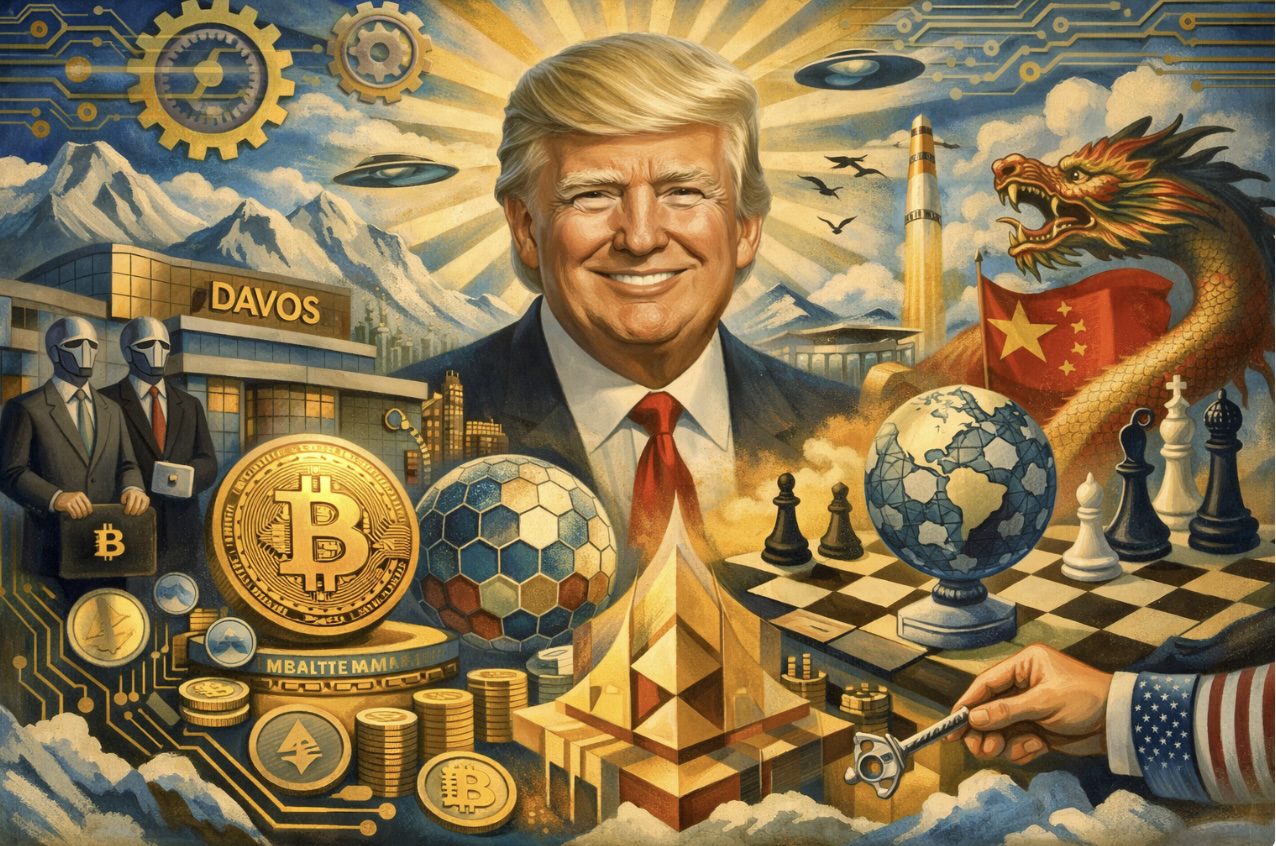
The most awaited speech in Davos was that of the President of the United States. He neither disappointed nor enthused. Perhaps he frightened some, those whom he labeled as enemies from the very start of his address. What is certain is that his tone of power-laden self-satisfaction is unattractive and deeply unsettling. He barely said anything new. He devoted himself to describing his new happy world, and how he is creating it for us. Even hinting at how little the whole of Humanity appreciates it. Well then, in that new happy world of the Trumpian speech there was a moment for cryptocurrencies. That is to say, and bearing in mind the speaker, it is certified that cryptocurrencies will be part of the new happy world.
Trump in Davos
Quite a symptom that the Davos meeting should be condensed into the message of the US President. It is as if his word were enough. A meeting that, in its more than half a century of existence, has been ideally conceived as a moment of encounter among global leaders, on equal footing, to discuss the world's problems, has been reduced to an "I'm in charge here and I solve the problems the way I want them solved."
What is more, the motto of the 56th Annual Meeting of the World Economic Forum held in the Swiss city this week was: "The spirit of dialogue." But it has looked more like the spirit of the hive, with a great queen bee. More than a meeting among equals, it has resembled a meeting in the boss's office where he shows off his achievements, what he plans to do and, perhaps most importantly, what he expects the rest of us to do, with a particular scolding for Europeans in general and Spaniards in particular. Something akin to this was heard: I love you Europeans very much, and I wouldn't like to take measures I don't want to take. Like a boss to a subordinate employee, who does not seem to be performing his role satisfactorily. Davos has become the boss's office.
The organic executive of capitalism
After being introduced by the host of this year's meeting. None other than Larry Flink, the current organic executive of capitalism, dedicated to the task of colonizing the future for this economic system. Also quite a message from Davos: it is not about fixing the world's problems, but about guaranteeing the survival of capitalism. In this context and from the very first moment, Trump began to recount how phenomenally the world has been doing since he returned to the Presidency for the second time. He said it: "I have come to this year's World Economic Forum with truly phenomenal news from the United States".
While the world seems to be crumbling, peace trembles, the world order appears as the fruit of imposition, democracy in the United States dissolves like a sugar cube in water and the specter of bloody totalitarianism shows itself in the form of summary street executions in Minneapolis, Trump speaks to us of his new happy world.
Well then, in this new happy world there was a minute for cryptocurrencies. The current world economic order appears old, in a phase of disappearance, and among the features of the new one is the leading role of cryptocurrencies.
Regulation
He introduced cryptocurrencies through the so-called Genius Act (Guiding and Establishing National Innovation for U.S. Stablecoins). In Trump's own words, it is a regulation to structure the cryptocurrency market. The ecosystem has long demanded regulation and more regulation, as if any regulation would do, as long as there was one, provided it was "made in USA." Flink himself has argued that the development of cryptocurrencies is being held back by a lack of regulation.
From this perspective, regulation is the heavy backpack of cryptocurrencies that had not yet been opened. Especially if it was not an American regulation. Well then, the aforementioned Genius Act has as its main objective to establish a federal regulatory framework for payment stablecoins , guaranteeing transparency, stability and consumer security. The rule seeks to strengthen the market, boost financial innovation, establish 1:1 reserves, protecting users against insolvencies, and combat money laundering.
The reasons given for supporting cryptocurrencies were four, summarizable in a general slogan: cryptocurrencies for Americans. It should be clarified that, in Trump's language, Americans means US citizens. The first is the argument of principles, which states that his policy in favor of cryptocurrencies aims to fulfill the principle of financial freedom for Americans.
Returning the favor
The second reason is also related to principles, though of another kind. It is about repaying the great support his presidential candidacy received from the crypto industry. Trump thus makes clear that he personally honors promises, commitments and threats.
The third reason can be considered a convergence of the previous two, since it consists of returning the favor to the North American crypto users who helped him win the elections. He acknowledged that he won them to a large extent because many users voted against Biden. At least, he assumes that they did not vote for him because of his promises or attractions, but because his predecessor had the political clumsiness to be against cryptocurrencies.
The fourth reason present in his speech in support of cryptocurrencies is geopolitical in nature. It is about seizing the market before China does. The goal is to dominate the market, under the notion of turning America into the "world capital of cryptocurrencies."
In the Davos office, boss Trump held forth at his ease. To realize this, one only needs to look at his body language. He scolded some, while he thanked others for their efforts. Among the latter are cryptocurrencies.
Words of gratitude that seem like the certification of having a place in Trump's new happy world. What I do not know is whether, having friends like that, the image of cryptocurrencies and therefore their use will benefit or whether an ideological wall will be erected around them. Perhaps Trump should keep his hands off crypto.