Coinciding with the author's 77th birthday, the publisher Paidós has released in Spain the latest book by the Slovenian philosopher Slavoj Zizek. Its title is Point Zero and, although less packed with the winks and ironies that run through the author's previous work, it still offers attractive and, above all, provocative texts. Texts capable of radically polarizing society. Well, in this latest book he devotes one of his chapters to the metaverse.
Technological feudalism
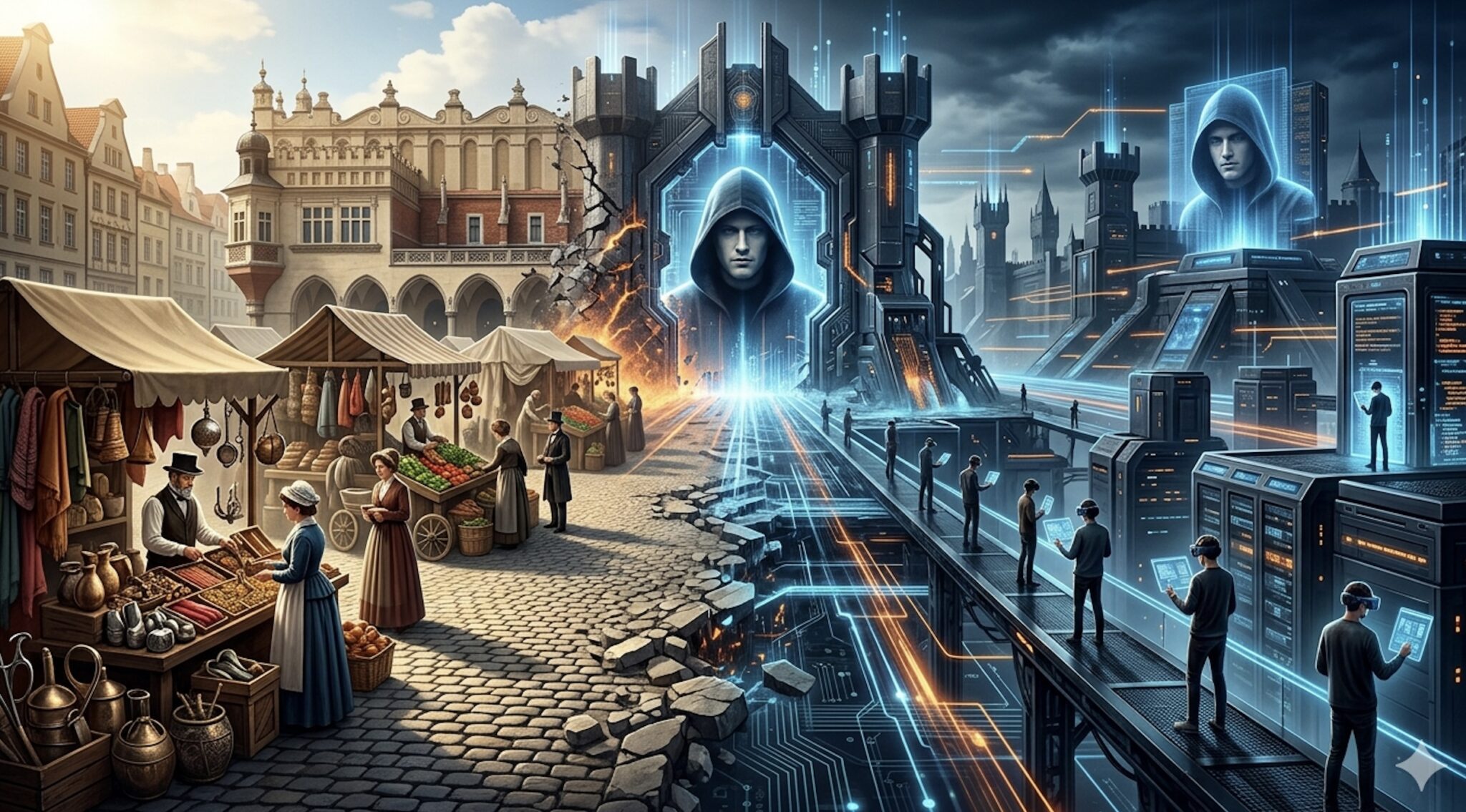
Mind you, it is the metaverse as he attributes it to the strategies of Zuckerberg and his company Meta. That is, as he attributes it to one of those he considers the main lords of so-called high-tech feudalism. For Zizek, the heroes of the metaverse are not the avatars who win battle after battle, who manage to pass test after test. No, the heroes of the metaverse are the usual ones: Zuckerberg, Musk, Bezos, Gates, etc. The avatars, the new serfs of high-tech feudalism.
Zizek defines the metaverse as a virtual space beyond -meta- our fractured and painful reality, in which we will be able to interact smoothly through our avatars, with elements of augmented reality, defined in turn as reality superimposed from digital signifiers. That is, not a different reality, but a superimposed reality. A reality that hides another reality. Of course, this second one always painful and suffering. That is what these intellectuals are for, revealing to us how the world suffers, even though the world does not realize it is suffering.
The argument is very reminiscent of, for example, the 1960s-70s and the superficiality of the happiness of the consumer society, which concealed the exploitation of the working masses, now consumerist, with their car, their home and their retirement. Their happiness, due to such a qualitative leap in life, was a mirage born of the most absolute alienation. The abundance of the consumer society was denounced as a deception. Well, now it is the metaverse's turn. According to Zizek, the metaverse is -using that old tag of the critical language of those 1960s-70s: ultimately- a deception. A deception to alienate us better, to manipulate us better, to exploit us better.
A sentence to servitude
The metaverse as a great deception, where that freedom of movement and imagination offered by virtual immersion becomes a sentence. A sentence to servitude to the interests of a handful of great lords of feudalism high-tech.
One of the main reasons underpinning this feudalism high-tech, a term coined by the Greek Varoufakis, is that through these digital spaces, which are privately owned spaces, our interactions are regulated and monitored. Public space is transformed into private space. Even though, as far as is known, none of the metaverses in operation has previously had a public character.
If public space, with its dense and fundamental interactions among citizens, were to move to the virtual space of the metaverse, it would be because the latter had acquired such relevance and importance that it would certainly have subsumed us. We should be grateful for the warning; but the thing seems quite distant and the scarce public, governance spaces that are being created from blockchain technology seem far from this model of private property concentrated in a few hands.
The rest of our reality
In any case, we must not lose sight of the perverse intentions of those who, like Zuckerberg, set out to propose THEIR metaverse. According to Zizek, Zuckerberg's desire is for his metaverse to encompass the rest of our reality, connecting fragments of real space here with real space there (virtual and his), and completely subsuming what we consider the real world. That is, they warn us that we run the danger of the real world being the virtual and augmented world that Zuckerberg has planned for us.
Zuckerberg wants the metaverse to ultimately encompass the rest of our reality, connecting fragments of real space here with real space there, and completely subsuming what we consider the real world. Staying faithful to his words: "it is not that Zuckerberg's simulations reach the level of reality, but that our behaviors and interactions will become so standardized and mechanical that they will cease to matter. Instead of making human facial expressions, our avatars will be able to make iconic thumbs-up gestures". Wow, what a horror!
The paradoxical thing is that this feudalism high-tech is the strategy of current capitalism. That is, it is as if the subsequent historical phase metabolized into the preceding phase. Capitalism transforms into its predecessor. Capitalism, which is the socioeconomic system that managed to bury feudalism by liberating human beings and goods, would deny itself in order to transform into what was overcome. A rather strange monstrosity. As if we had never stopped being in feudal systems or as if their seed had been kept for almost four centuries, returning as soon as we let our guard down. Sometimes, behind the provocation and star concepts, with great potential for selling books and giving lectures, hide opacities like millstones.
The big technology companies concentrate a great deal of economic and social power. Much of their business is based on imposing technological standards, which become behavioral standards for millions of users. Their logic is that of centralization, very few decisions at the top, and expulsion of competition from the market based on such imposition of standards. This opens the door to saying that we are as tied to them as the serfs of the glebe were tied to the land of the feudal lord. There is some exaggeration, just as there is something true. But the room for action of citizens still exists. Resistance is present. In fact, one of the current practices of distinction among young people is to stop using social networks.
Financial weaknesses
There is room for action. There are technological alternatives. And if the purpose of these feudal high-tech corporations is to ruin our lives, it could lead them to ruin. In fact, during the first quarter of this year, several have shown financial weaknesses, having to reduce their workforces. Of course, competition among them, especially based on AI, and their alternatives are not taken into account.
These reflections are fine, capable of catching our attention. But, as tends to happen with any populist outcry, they tend toward excessive simplification and caricature. A good strategy for selling books.
In principle, the metaverse is an immersive digital system that allows users to interact, work, play and carry out transactions in real time through avatars in a 3D space. Of course Meta and other companies have a special interest in their metaverse model being THE METAVERSE MODEL.
The business
The business horizon is enormous. It would be the business that controls where business is done. Perhaps, as Varoufakis and Zizek accuse, also where politics and society are controlled, since whoever controls business has great possibilities of controlling society and its politics. But, so far, the signs of success of this absolutist metaverse model are scarce. In any case, we will have to stay attentive and the warning is appreciated. For now, the heroes of the metaverse are elsewhere. Different from Zuckerberg's Meta.