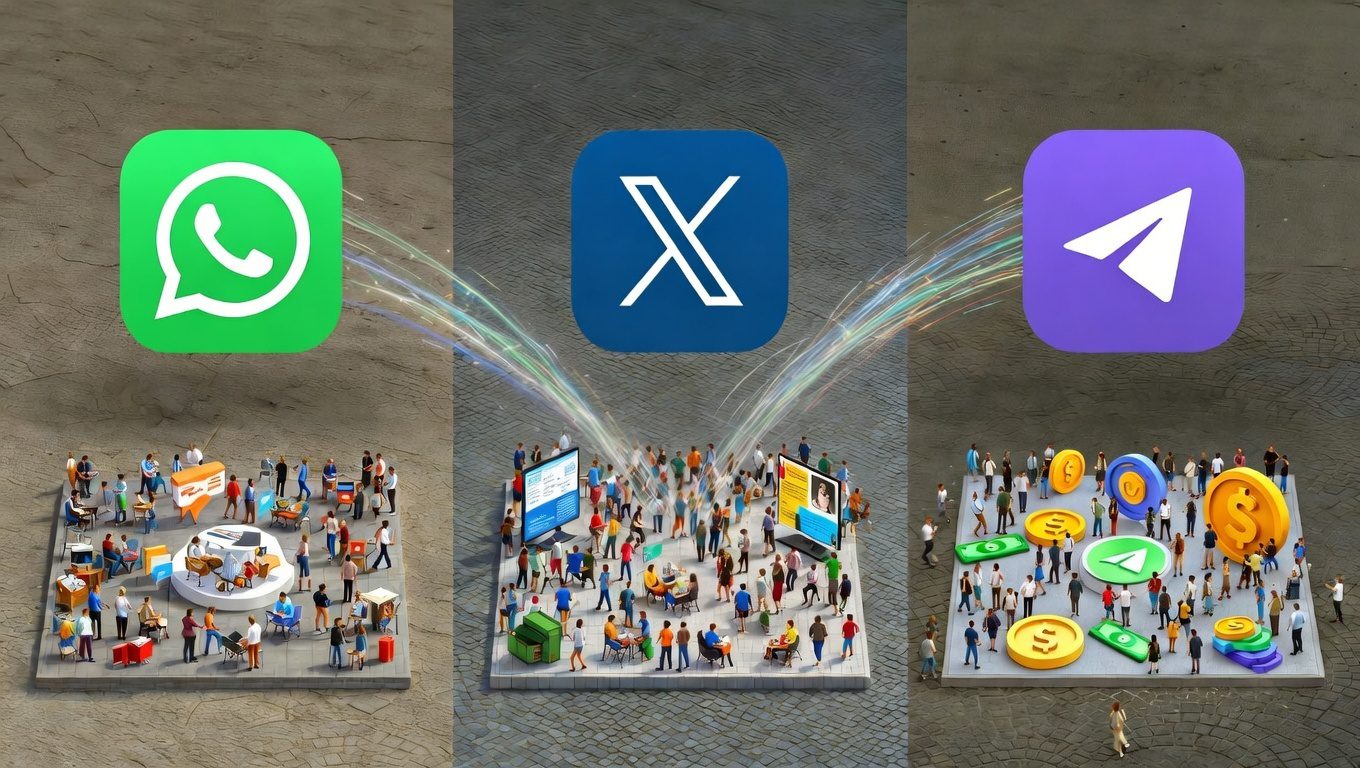
WhatsApp, X and Telegram are today's public square. Where we find out about everything, including information and gossip. In the public squares of cities and towns five hundred years ago, everything in circulation was found there. Everything that wanted to circulate had to go to the public square. From gossip to merchants.
Of course, speeches clashed in the public square seeking to persuade, and so did merchandise. Also what would become the condensation of everything in circulation: money. The nest of capitalism is the public squares. It is in the surroundings of public squares, in what was taking shape as great cities, that financial exchanges were erected. That is, where money and merchandise in circulation were pocketed — in a sense, held — especially future circulation. From there, a division of spaces of circulation: large circulation of small amounts in the public square; and little circulation of large amounts in the mercantile exchanges.
Money in a chat
The great virtue of those public squares was initially being the funnel through which everything in circulation for many kilometers around passed. There was no longer any need to go to the ports to learn from travelers — those in circulation — what was circulating. It was the travelers who went to the public squares if they wanted to hear about other travelers, about other journeys. The new Marco Polos no longer stayed in ports or in the palaces and castles of nobles, but went from square to square. The public square became the place of the displaced, of those who circulated without having a square.
Later, it was considered that they disdained society, its people and reality with indifference — those who stopped appearing in the public square. Mainly artists and scientists. They isolated themselves in what centuries later was drawn as an ivory tower. They withdrew from circulation. They justified their flight from circulation as distance from a noise that prevented them from coming into contact with supposed essences.
It is possible that being in the public square is distracting. Even that it entails a notable daily effort. But noise is the essence. It is possible that a certain silence is required to produce intellectually. The problem is when the silence of universities and university people, for example, resembles the silence of the monasteries of the Middle Ages, when walkers had already stopped knocking at their doors.
The public squares of the World
The monasteries preserved the essences of the world, including its spirituality, at the cost of distancing themselves from the world, taking in those who withdrew. Today, some university centers and university people seem to be in monastic regression, bearing in mind that it was the monasteries that returned to the world and to intervention in the public square that became the germ of the Universities. Today, intellectuals, scientists, artists, etc. removed from social networks and their noise are displaced people. They are the ones who have left the noisy and compromising presence in the public square of social networks, protected by the reinforced concrete wall — there is not enough ivory for so many! — of the bureaucratic public square.
It is through noisy places, crossed by millions of voices — such as X, Telegram or Wp — that almost everything circulates, as in those original public squares of a Middle Ages already pregnant with modernity and, therefore, with its end. They are deterritorialized public squares. They have shed the burden of territory. They are the public squares of the World.
Almost everything circulates through the new public squares of the World, because the circulating medium par excellence is missing: money. But this lack seems set to be resolved very soon. As announced a few days ago Observatorio Blockchain, applications such as WhatsApp, Telegram and X are about to transform their chat interfaces into global wallets powered by blockchain technology and stablecoins.
Money in a chat
Each of these applications, in its own style and manner. But all strategically focused on facilitating the exchange of money between users — like bizum— but without the intermediation of traditional banks. The risk for these traditional banks, if they do not wake up, is to end up as isolated from reality as the old monasteries. Well, all companies will have to accelerate to be operationally present in these new public squares. No longer only as presenters of catalogs or receivers of incidents or complaints, but ready for immediate buying and selling. Their customers are there. Their gossipy, grumbling or even impertinent customers circulating their messages, ideas, reflections, photographs, noises and money.
Like any temporal frontier, what separated the Middle Ages from the Modern Age was blurred. More a process than a time. However, a process in which the size and extent of what circulates, as well as the distances of its circulation, took a fundamental leap.
Instant circulation of avatars
Compared with Modernity, the medieval era was a stagnant time. As stagnant as the current moment will seem to our successors. Especially after the push toward instant circulation of messages, information and money. For the instant circulation of travelers in the new public squares, closer than it seems, see the metaverse. For now, let us leave it at instant circulation of avatars. They will go with the money.