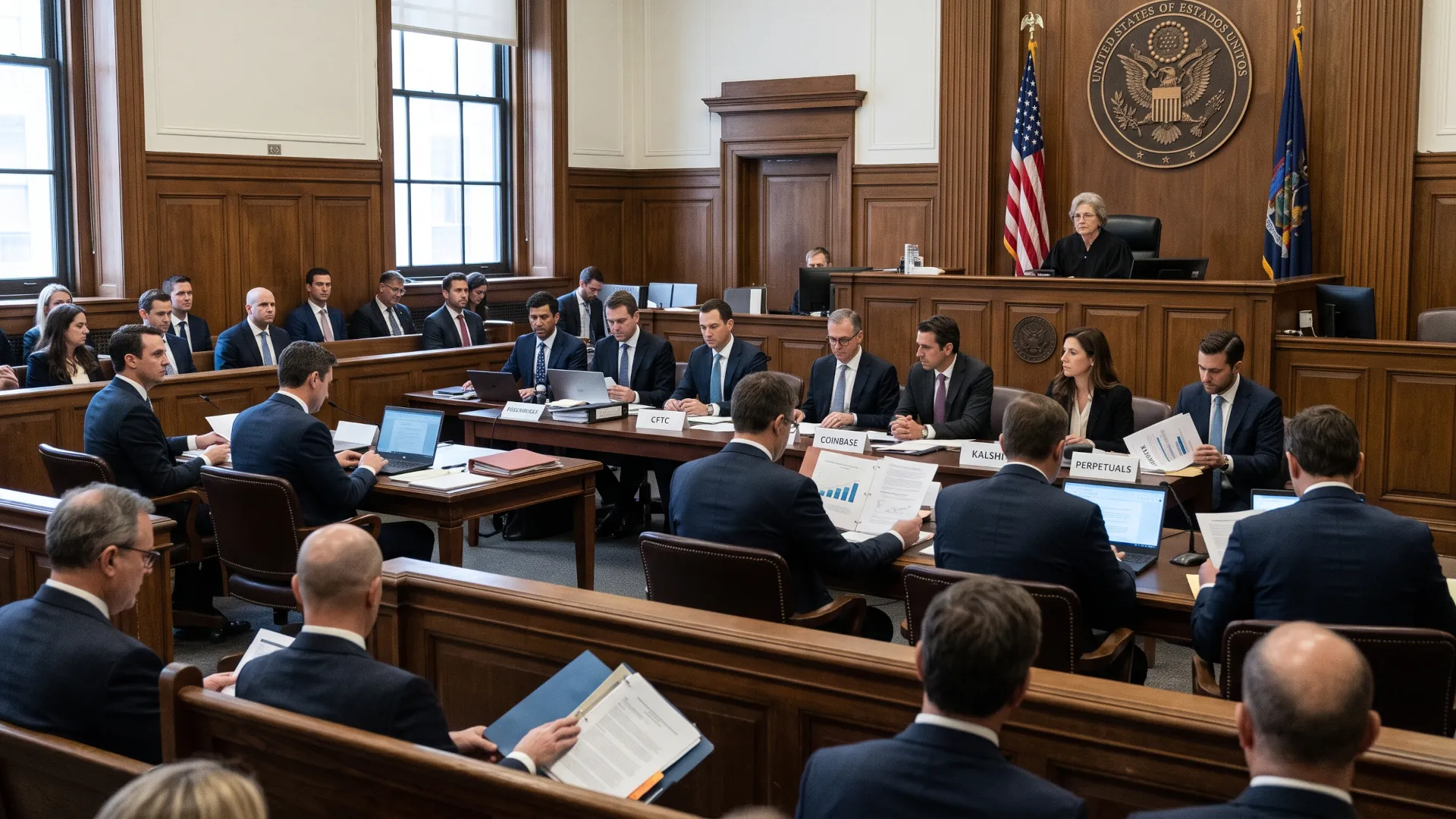
What the SEC has done is build a regulatory space to test what happens when some of the technologies that made DeFi possible begin to be applied to shares of U.S. companies.
At Observatorio Blockchain we have summarized the 60 pages of the order in 20 points to understand what the SEC has actually just authorized.
-
1. The SEC creates a new type of market for tokenized shares
The main novelty is the creation of the so-called Tokenized Securities Venues (TSV), which could be translated as tokenized securities trading platforms. These will be markets where buyers and sellers can trade tokenized versions of certain U.S. shares via blockchain. The SEC allows these markets to use automated market makers (AMMs) and liquidity pools, two mechanisms we had until now associated mainly with decentralized finance.
-
2 A tokenized share will still be a share
The SEC draws a fundamental distinction between tokenizing a share and creating a cryptoasset that simply replicates its price. The exemption only covers certain U.S. market shares represented by tokens. They may be tokenized by the company itself, by someone acting on its behalf or by an independent third party. Products that provide only synthetic exposure to a share's price are excluded. That is, a token that tracks a company's price does not become a tokenized share for the purposes of this exemption.
-
3. The token holder must retain the rights of a shareholder
The SEC requires that the tokenized share provide the same rights and privileges as the equivalent traditional share. Such as the right to receive the same dividends, exercise the same voting rights and receive the same share of the company's residual assets in the event of liquidation. Therefore, tokenization cannot be limited to copying a share's price. The token must preserve the rights associated with ownership of that share.
-
4. DeFi AMMs come to U.S. shares
This is one of the most important technological novelties of the order. On traditional exchanges, buyers and sellers enter buy and sell orders that are organized in an order book. TSVs will be able to use another system: automated market makers or AMMs. An AMM is a computer program, usually made up of smart contracts, that allows assets to be bought and sold using the reserves existing in a liquidity pool. The algorithm automatically determines the terms and price of trades based on the assets available in that pool.
-
5. What is a liquidity pool?
It is like a common reserve of assets that keeps the market running. Instead of necessarily waiting for another person who wants to sell exactly when someone wants to buy, the buyer can execute the trade against the assets deposited in the pool. The participants who contribute those assets are called liquidity providers.
The SEC considers these providers essential to the operation of the new model, because without committed liquidity, the AMMs' automatic pricing and execution mechanisms cannot work as designed.
-
6. The SEC allows the use of public blockchain
The smart contracts used by these markets must be public, auditable and deployed on a public, permissionless blockchain (the blockchain network does not need prior authorization for someone to access the information or interact with it according to its rules).
The SEC considers that using public networks and auditable smart contracts will allow participants and third parties to verify how trades work and detect possible vulnerabilities.
-
7. Open blockchain does not mean a market open to anyone
The blockchain infrastructure may be public and permissionless, but access to tokenized share markets will be permissioned, that is, authorized. TSVs will have to explain what criteria they use to admit participants, how they approve the wallets that can operate and what procedures they use to verify people's identities. They must also explain when they may deny or limit access, among other reasons to comply with U.S. economic sanctions and anti-money laundering and counter-terrorism financing obligations.
-
8. Small investors and large institutions will be able to participate
The SEC does not limit the new market exclusively to large professional investors. The order provides that participants may include retail investors, institutional investors and registered financial entities, including financial intermediaries that can execute securities trades for clients and also carry out certain trades on their own account.
This means the experiment is not designed only for crypto companies or users specialized in DeFi.
This is one of the central legal elements of the exemption. The SEC allows TSVs that meet the conditions set out in the order to be temporarily exempt from the definition of exchange, that is, of stock exchange or securities market, for the covered activities.
This means they will not be subject to exactly the same regulatory framework as a U.S. national exchange or certain alternative trading systems, known as ATSs. The SEC itself acknowledges that these TSVs will not have the same books and records requirements, inspections and other forms of oversight applicable to those traditional markets. Precisely for this reason it introduces numerous additional conditions aimed at controlling risks.
-
10. Companies will be able to prevent a third party from tokenizing their shares for these markets
The SEC grants significant power to listed companies. If the party tokenizing the shares is a third party independent of the company, the TSV must notify the issuer of the traditional shares in advance. From receipt of that notification, a period of at least 30 days begins before trading can start.
If the company objects within the established period, the TSV will not be able to offer those tokenized shares. The SEC mentions among companies' possible concerns the difficulties of correctly maintaining the shareholder register and possible price differences between the liquidity pool and the share traded on the traditional market.
Trading platforms will not be able to use this regime to carry out primary offerings or initial securities offerings. That is, a company will not be able to rely on this exemption to carry out a kind of stock market listing directly through a blockchain pool. The rule focuses on trading securities that already exist and that meet the conditions set by the SEC.
-
12. The SEC limits how much these markets can initially grow
The SEC does not allow tokenized markets to reach any size from day one. It divides shares into two categories, Tier 1 and Tier 2, using the classification that already exists in the U.S. system to manage situations of extraordinary volatility. For Tier 1 shares, each TSV may trade a maximum of 75 different securities and may not exceed 0.25% of the average daily volume traded during the previous month in each share. For Tier 2 shares, the limit rises to 250 securities and up to 2.5% of average daily volume.
-
13. The algorithms that set prices will have to be explained
The SEC requires platforms to explain how their pools and pricing mechanisms work. The order mentions as an example the formula x·y=k, used by some AMMs. You do not need to know financial mathematics to understand the principle. In a pool there are two assets. When users buy one of them, the available quantity changes and the algorithm automatically adjusts its price. If they sell, the opposite movement occurs.
-
14. Tokenized shares could trade 24 hours a day
The order expressly contemplates the possibility of these markets operating 24 hours a day, seven days a week. This opens the possibility for a tokenized share to be traded on blockchain outside normal exchange hours.
-
15. Markets will have to explain where they get external prices from
A blockchain market does not necessarily operate in isolation from the rest of the financial system. TSVs will have to explain whether they use external data and how they incorporate it through so-called oracles. An oracle is a mechanism that brings information from the outside world onto a blockchain. In this case it could provide smart contracts with information on prices existing in other markets.
The SEC requires identifying the providers of that data and explaining, among other things, whether it is used to control periods of volatility or prevent manipulation.
-
16. The SEC wants to know who can modify smart contracts
TSVs will have to explain who can update, modify, suspend, cancel or halt the blockchain applications they use. They must also provide the smart contract addresses and describe the networks, protocols, wallets and other applications involved in the market's operation. The SEC wants to know not only what the code does, but also who retains power over that code.
-
17. Typical DeFi risks also reach securities oversight
The SEC pays particular attention to technological risks that until a few years ago barely appeared in securities market regulation. TSVs will have to report on risks such as loss of private keys, compromised wallets, smart contract errors, cyberattacks, oracle manipulation, network congestion or phishing attacks.
They must also address MEV, a term used to describe the value that certain participants can extract by modifying or exploiting the order of transactions within a blockchain. Among these risks, the SEC mentions practices such as front-running or sandwich attacks, where an operator tries to profit from knowing or anticipating another user's trade.
-
18. Liquidity providers also receive an exemption
The second major exemption in the order affects certain firms that provide liquidity to these markets. The issue is important because U.S. law distinguishes between an investor who buys and sells securities on its own account and a dealer, which professionally carries out certain securities buying and selling activities as a business.
The SEC itself acknowledges that providing liquidity to a pool does not by itself make someone a dealer, but certain additional activities can raise legal questions. That is why it creates a temporary exemption for certain firms that provide liquidity to AMMs within TSVs.
These firms must operate with their own capital and may not hold client assets in custody under this exemption. In addition, they will have to disclose that they are not registered as broker-dealers and explain the payments, tokens or other incentives they receive for providing liquidity.
-
19. Five years do not mean the rules are untouchable for five years
The exemption began on September 17, 2026 and expires on September 17, 2031, but the SEC expressly states that it may modify both the duration and other aspects of the exemptions before that period ends if it considers doing so necessary or appropriate for the public interest and investor protection.
Therefore, the five years represent the maximum horizon currently envisaged, not a guarantee that all conditions will remain unchanged until 2031.
-
20. The SEC raises the possibility of making the experiment permanent
The SEC explains that it will closely monitor how the exemptions work and has opened a public consultation on their future. Among the questions it raises is whether the exemption for tokenized share markets should become permanent.
It also asks whether the current limits should be modified, what impact this trading may have on the liquidity and prices of traditional shares and what effects overnight trading could have on market quality. The SEC asks the same question regarding the exemption granted to liquidity providers, whether it should become permanent and under what conditions.
A blockchain laboratory for Wall Street
The SEC order thus outlines something more complex than an authorization to tokenize shares, since it allows experimentation with an architecture from DeFi, with public blockchains, smart contracts, AMMs and liquidity pools, within the U.S. securities market.
The SEC also acknowledges that these platforms will not be subject to exactly the same framework as national exchanges or traditional alternative trading systems, which is why it introduces specific conditions to try to preserve transparency, market integrity and investor protection.