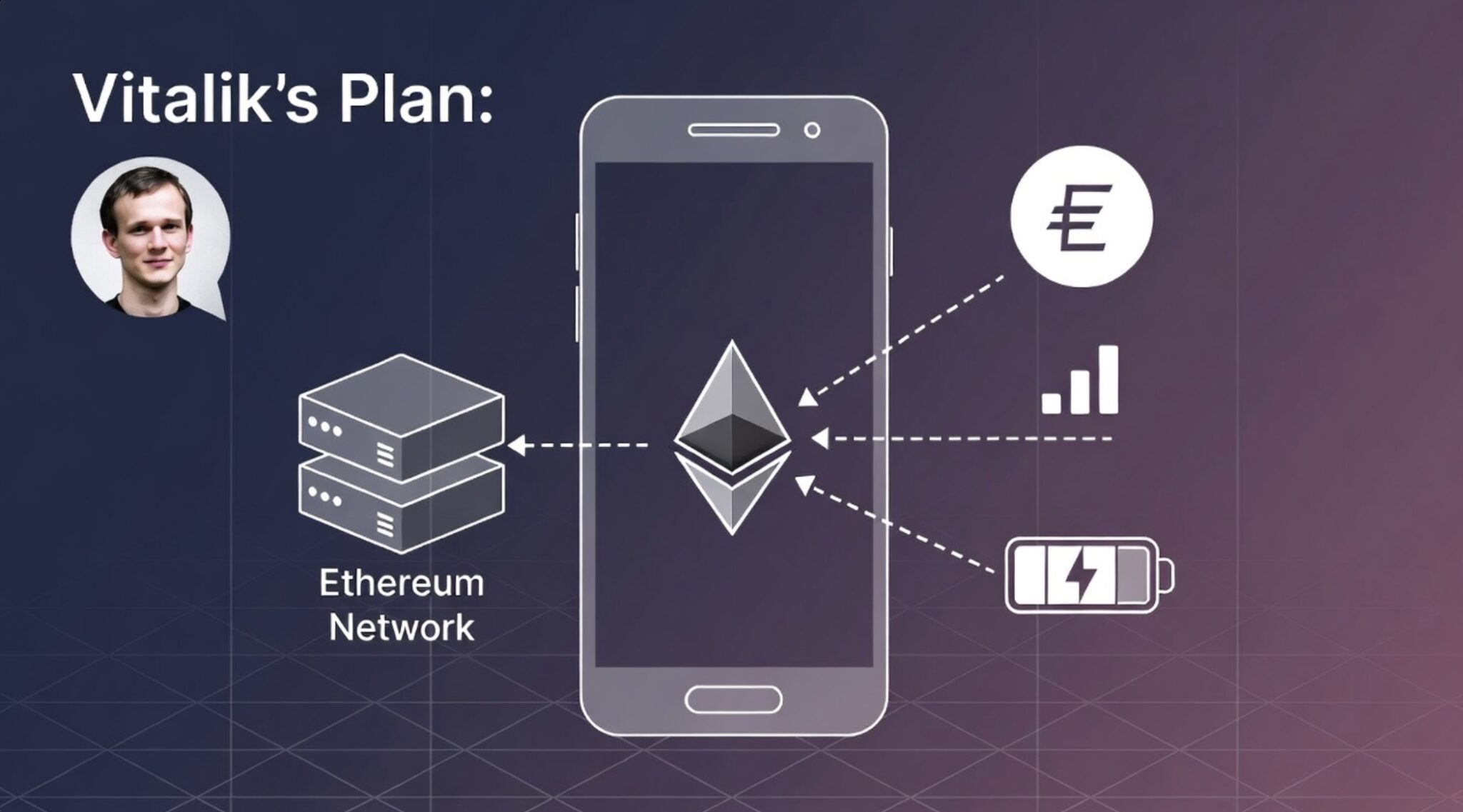
Vitalik's plan for you to use Ethereum on mobile without using data or battery
Vitalik Buterin, creator of Ethereum, has today presented a roadmap to rebuild the network's execution layer. The developer's proposal aims to transform the platform into a global supercomputer with processing capacity up to 64 times greater than the current one. The plan includes deep structural changes to speed up transactions and drastically reduce costs for the user.
The first major pillar of this reform is the FOCIL (Fork-Choice Inclusion Lists) system. With this mechanism, 16 validators will be chosen at random in each block and will have the power to force the inclusion of specific transactions. This measure eliminates the risk that large block builders could veto payments, guaranteeing that Ethereum is a network where no one can censor another for political or commercial reasons.
Ethereum on mobile
Buterin proposes gradually retiring the current Ethereum Virtual Machine (EVM) to adopt RISC-V, a modern computing standard. This upgrade includes what he defines as an "internal GPU" (vectorized math), which allows lists of data to be processed simultaneously. For the user, this means an almost instantaneous response from the network and a radical reduction in gas fees for complex operations.
Smart accounts and the end of complications
The roadmap also prioritizes Account Abstraction through the new "Frame Transactions". The goal is for digital wallets to allow access to funds to be recovered if the key is lost and for fees to be payable in any stablecoin. This change seeks to make using an application on Ethereum as simple for the general public as using any traditional financial application.
Finally, the transition to Binary Trees will optimize the organization of information on the blockchain, reducing data weight by 75%. This technical improvement is the key for any mobile phone to be able to verify the security of the network without draining its memory or battery. With all these measures, Buterin wants Ethereum to become in this year 2026 an invisible, powerful and, above all, fully accessible from mobile infrastructure
Covadonga Fernández is founder and director of the newspaper Observatorio Blockchain. She has worked with various companies developing crypto/blockchain projects, such as Singular DTV, a Switzerland-based platform and a pioneer in decentralizing the film industry, which led her to take part in the 2019 San Sebastián Film Festival. That same year she also took part in the Bern International Film Innovation Festival (Switzerland), with a presentation on linguistic plurality in blockchain. In 2022 she took part in the Acción Cultural Española edition with an article on Metaverse and Culture. In 2017 she wrote the chapter on Blockchain and Journalism in the book: «Blockchain: The Industrial Revolution of the Internet», published by Grupo Planeta. A year earlier, in 2016, she created the first Meetup on Blockchain and Journalism. That same year she also created the Blockchain Media site, to track the decentralization process of the cultural and creative industries. In 2020 she co-organized an event on how blockchain could help the cultural and creative industries, where the money received from sponsors was tokenized and speakers received payment in NFT format. Before founding Blockchain Media and Observatorio Blockchain, Covadonga worked at Grupo Z and the newspaper ABC; she was communications director of the Madrid Chamber of Commerce, a journalism professor at Universidad Carlos III de Madrid and chair of Telemadrid. Winner in the Outreach category at the 2024 Financial Innovation Awards and honored by Alastria at the 2025 Blockchain Awards