This is Vitalik's plan for AI to pay for your work
Vitalik Buterin, creator of Ethereum, has issued a stark warning about the direction AI is taking. According to Buterin, the current development of AI risks becoming a blind race that could end up relegating human beings to a forced "retirement," stripping them of their power in the face of technological structures that are impossible to control. To avoid this scenario, Buterin proposes integrating AI with blockchain technology. The goal is to create a future where AI is not a centralized entity that devours, but a tool that fosters freedom and human empowerment.
Ethereum as the economic layer of AI
Although Buterin's post focuses on network architecture, his proposal has a hopeful application for the sectors that AI is hitting hardest. By turning Ethereum into the "economic layer of AI," the system Buterin proposes could be transferred immediately to the rescue of professions already in crisis because of AI.
For writers, journalists and artists, Buterin's proposal could mean that AIs make automatic cryptographic payments for every query or data call. This means content would no longer be plundered to train models. Every time an AI uses a professional's work to generate a response, a direct micropayment to the author would be executed. Thus, the creator could become a paid supplier for AI companies.
For translation professionals and analysts, the use of "local AI" and privacy tools (ZK-proofs) would allow them to work with the power of AI without having to hand over their intellectual property to large corporations. Professionals would retain full control over their method and their data, avoiding being replaced by the very tool they use.
ERC-8004 standard
For programmers, designers and data architects, Buterin's proposal introduces the ERC-8004 standard, a reputation tool that works like a designation of origin for talent. This standard would make it possible to cryptographically certify human authorship, distinguishing expert work from synthetic content. By linking each deliverable to a verifiable digital signature, professionals not only protect their intellectual property but also recover their market value, since the client can verify that they are paying for real human ingenuity and not for an automated process. It would be a mechanism for the personal signature to become an economic asset once again.
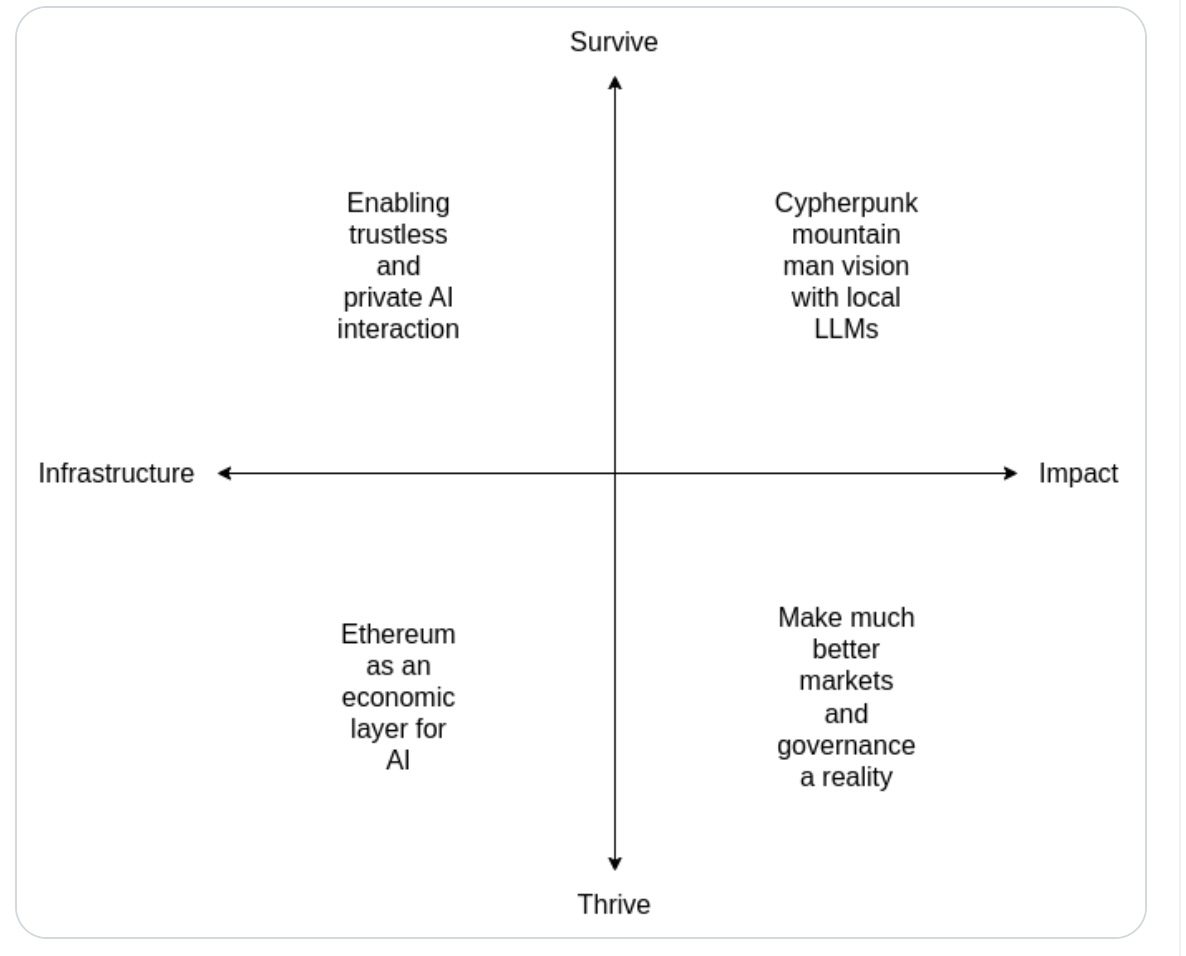
Vitalik summarizes his vision in a chart that defines the balance between technical infrastructure and its social impact. In this quadrant for individual survival, the concept he calls "Mountain man vision. Cypherpunk with local language models," in the workplace translates into the use of AI as self-defense. For a lawyer or a copywriter, this means no longer depending on Google or Microsoft tools. By using local language models (LLMs), professionals can process confidential information or create original content without their data being absorbed by the corporate "cloud."
The quadrant of the economic layer (Infrastructure + Thrive) is based on using Ethereum as the financial base for AI
A sustainable and fair revenue model
In what he calls «Ethereum as an economic layer for AI," the practical application would be for the network to act as the base where machines pay for what they consume. If an AI needs a verified data point or a quality text from a journalist, the system is designed so that the economic transaction is automatic. This allows content creators, who are the ones who really "feed" AI, to have a sustainable and fair revenue model.
On the other hand, the concept of "Enabling private AI interaction without the need to trust third parties" would allow professionals who handle sensitive data to interact with powerful AI models in a fully secure way. This prevents the professional's expert knowledge from being "stolen" by the model during the query, guaranteeing that humans retain their competitive advantage and the integrity of their intellectual property.
Finally, his proposal to "Make much better markets and governance a reality" translates in the workplace into the use of AI to create more equitable work ecosystems. For professionals, this means having better mechanisms to organize DAOs (decentralized organizations) or digital guilds. These structures would make it possible to negotiate collectively against Big Tech, scaling human decision-making with the support of AI.
The chart shows how Vitalik does not see technology as something that simply "happens," but as something that must be oriented toward defending the individual and creating economic value so that humanity is not left behind.
New framework for intellectual property
Likewise, Buterin's proposal comes at a critical moment for the reformulation of intellectual property laws worldwide. While parliaments debate how to regulate machine training, Ethereum's infrastructure could offer a technical solution where the law sometimes does not reach.
By implementing such digital tolls, the shift would be from a copyright model defended in slow, costly and unequal lawsuits to a model of programmable intellectual property. Under this scheme, legal compliance would not depend on the goodwill of Big Tech, but on code that prevents AI from accessing or processing information if there is no prior economic transaction. It would be the architecture that makes it possible to apply the new data protection and copyright regulations in the digital era.
Instead of allowing AI to be an engine of labor exclusion, Vitalik's roadmap offers Ethereum's infrastructure so that human ingenuity can remain at the center of the digital economy. With his plan, blockchain becomes the security system that guarantees human work continues to have a price and a purpose in the age of AI.
Covadonga Fernández is founder and director of the newspaper Observatorio Blockchain. She has worked with various companies developing crypto/blockchain projects, such as Singular DTV, a Switzerland-based platform and a pioneer in decentralizing the film industry, which led her to take part in the 2019 San Sebastián Film Festival. That same year she also took part in the Bern International Film Innovation Festival (Switzerland), with a presentation on linguistic plurality in blockchain. In 2022 she took part in the Acción Cultural Española edition with an article on Metaverse and Culture. In 2017 she wrote the chapter on Blockchain and Journalism in the book: «Blockchain: The Industrial Revolution of the Internet», published by Grupo Planeta. A year earlier, in 2016, she created the first Meetup on Blockchain and Journalism. That same year she also created the Blockchain Media site, to track the decentralization process of the cultural and creative industries. In 2020 she co-organized an event on how blockchain could help the cultural and creative industries, where the money received from sponsors was tokenized and speakers received payment in NFT format. Before founding Blockchain Media and Observatorio Blockchain, Covadonga worked at Grupo Z and the newspaper ABC; she was communications director of the Madrid Chamber of Commerce, a journalism professor at Universidad Carlos III de Madrid and chair of Telemadrid. Winner in the Outreach category at the 2024 Financial Innovation Awards and honored by Alastria at the 2025 Blockchain Awards