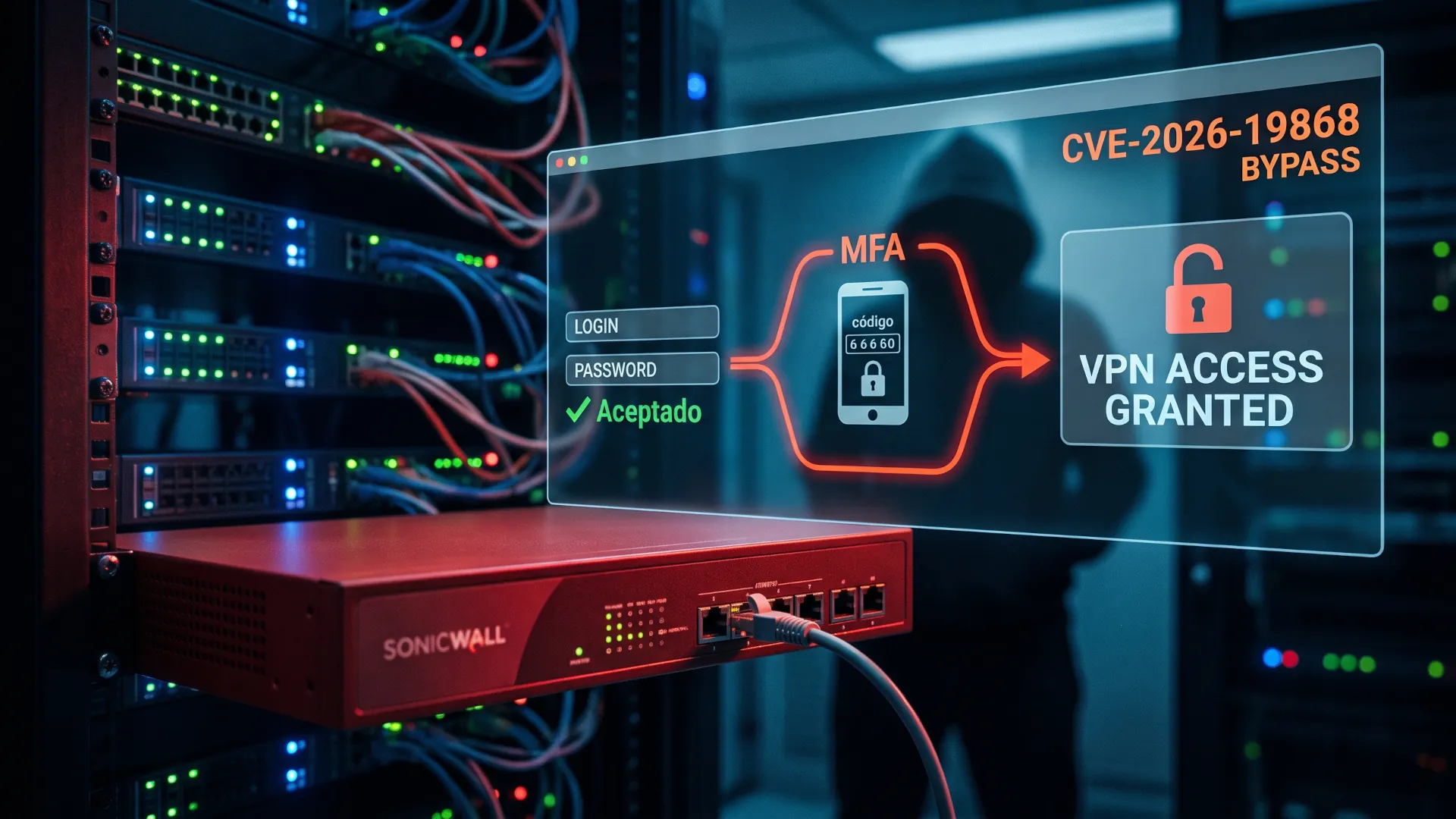
A SonicWall firewall with SSL-VPN and SAML enabled can let in an attacker who only has an account password. The second factor is not needed: if the device allows another authentication method besides SAML, that alternative path bypasses the identity provider and with it all the MFA the company had layered on top. The identifier is CVE-2026-19868. It affects Gen7 and Gen8 devices with firmware 7.3.3-7015 or earlier and 8.2.2-8015 or earlier. SonicWall published the fixed versions, CISA added the vulnerability to its exploited catalog on November 6, and U.S. federal agencies have until November 20 to close it.
The SonicWall advisory for CVE-2026-19868 confirms there was an investigation into potential exploitation, but it offers not a single indicator of compromise, nor the number of organizations affected, nor what the attackers did after getting in. That silence is the most uncomfortable data point of the week.
An MFA bypass on a VPN concentrator is the passport ransomware groups have been looking for for years so they don't have to talk to the helpdesk. SonicWall carries that history: its SSL-VPNs were already targeted by Akira affiliates in 2025, and in 2026 ReliaQuest documented attacks against CVE-2024-12802, another flaw in the same family that also bypassed the second factor. Anyone running a Gen7 in production with SAML enabled and users with alternative credentials should treat this weekend as an open window and not as just another Patch Tuesday notice.
What exactly fails
The error is in the identity check, not in the encryption. When the SSL-VPN accepts several authentication methods at once, a user with valid credentials for any of the alternative methods can complete the login without going through the SAML flow.
SonicWall describes it as a failure to enforce authentication: the device checks that the password is correct and forgets to check that the step required by SAML has also been completed. The second factor stops being a barrier and becomes a recommendation.
The identity provider logs show nothing because there was no signed assertion to log. The login happened on the firewall, through a path the IdP never saw. For a response team, that blindness is worse than the breach itself.
It is not a bypass without credentials. The attacker needs a valid password for some alternative method, and that is where the market for stolen VPN credentials comes in, which has been running smoothly for years. The result is that the flaw turns into decoration a control that made those credentials useless.
Who is exposed and who is not?
The condition that decides everything is how the SSL-VPN is configured, not the device model. If all users are required to go through SAML and no alternative method remains enabled, there is nothing to bypass. If the configuration allows local username and password for certain groups, the bypass is one login away.
The affected devices are Gen7 and Gen8, physical and virtual, with firmware 7.3.3-7015 and earlier or 8.2.2-8015 and earlier. The fix arrives in 7.3.4-7013 and in 8.2.3-8015. Gen6 versions do not appear in the advisory, although their support cycle has already ended and SonicWall recommends moving to Gen8 instead of stretching the hardware.
The same firmware fixes six other vulnerabilities that no one has flagged as exploited. That detail helps prioritize the work: if the patch is applied only because of the MFA CVE, a package of flaws that has not received the same public attention is left unclosed. The pattern is not new: Palo Alto firewalls accumulated a similar chain and the defense layers of a small business rarely cover the alternative authentication paths.
Acting to protect yourself
Updating does not erase what already happened. The first sensible step is to cross-check SSL-VPN logins against identity provider logins and look for sessions that appear on one side and not the other. Any access that works on the firewall without its SAML assertion is suspicious by definition.
The second step is to rotate credentials. If an attacker got in, the password they used is already compromised, and so is any other password stored on the device behind that session. The third, review what was touched: open sessions, established tunnels and modified configuration objects.
The CISA alert sets November 20 as the deadline for U.S. federal civilian agencies. That date works just as well as an internal deadline for any company with a Gen7 exposed to the internet and users who can still log in with a password.
It is best to prioritize by exposure and not by site size. A firewall at headquarters with SAML locked down matters less than one at a small branch with an exception from three years ago that no one remembers approving.
MFA, the great savior
The second factor has been sold for years as the layer that makes a stolen password useless. This case shows the flip side: when authentication is spread across several paths, MFA only protects the path that requires it. The others remain open, and almost no one audits the others.
VPNs are the perfect setting for that disorder. They are configured once, inherited from previous administrators and accumulate exceptions for the vendor, for the intern and for the laptop that cannot install the client. A flaw that exploits exactly that accumulation has a scope that no inventory reflects accurately.
SonicWall will publish technical details later or never publish them at all; its two previous advisories in the same family did not come with IoCs either. In the meantime, the only defensible version of the incident is the one that can be verified in the logs themselves.
What remains to be known
It is still unknown how many organizations were reached and for what purpose, and that data will probably never arrive through official channels. Identity provider analytics can fill part of the gap for those who have retained logs: a VPN session without its corresponding assertion is the cleanest trail this flaw leaves.
For the rest, the lesson is more boring and more useful. Every authentication method enabled on a concentrator is a door, and MFA only covers the ones it goes through. Reviewing which doors were left open for convenience costs an afternoon and saves you from explaining in a month why the second factor was not watching.