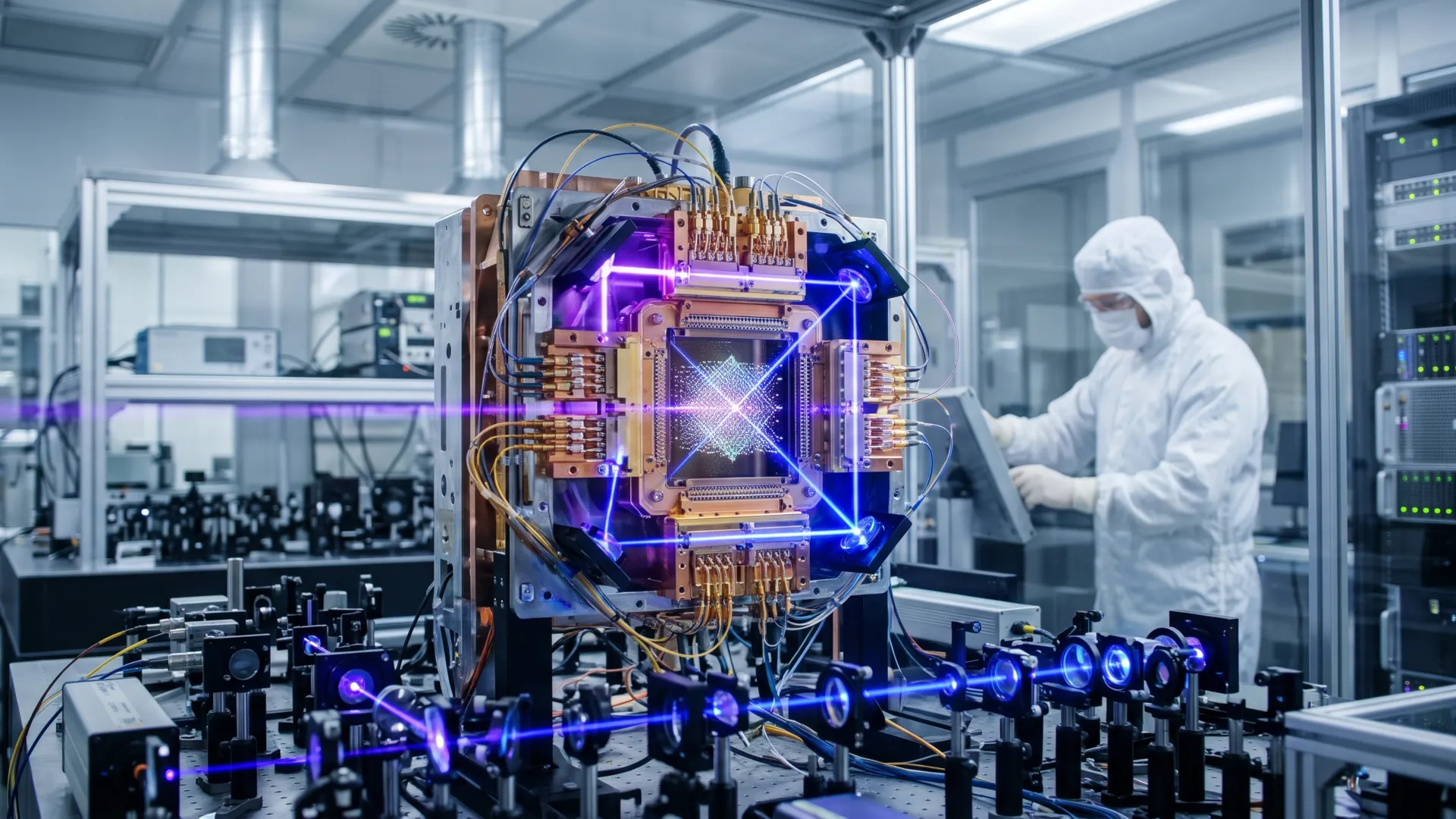
Five errors in a million operations: that is the figure Quantinuum attributes to Helios, its trapped-ion computer. It should be read carefully, because it does not refer to physical gates or to individual logical gates: it refers to how often a qubit that is already protected by error correction fails. The company announced it on October 19, 2026, with a logical fidelity of 99.9995% in its press release.
The figure does not stand alone. Quantinuum presents it as ten times better than its own September 2026 record, achieved with a different code on the same hardware, and a hundred times better than the best result published by another modality, which it attributes to Google Quantum AI and its superconducting system. These are the company's figures, not an independent laboratory's, a distinction that matters when comparing announcements from manufacturers competing for the same kind of contract.
What changes the map is not the percentage but the slope behind it. Each time the team increased the code distance, the logical error fell by around a factor of 12. That curve separates a laboratory demonstration from a machine capable of threatening cryptography, and in March 2026 Google estimated the bill for breaking ECDSA-256 at fewer than 1,200 logical qubits, so the useful question is how many physical qubits are needed behind each one.
The difference between physical and logical error
The two-qubit physical gate on Helios fails once every thousand attempts, two hundred times more than the five per million in the headline. The real work of error correction lives between those two figures.
Correction consists of indirectly measuring whether the state has drifted, repeating the check many times and correcting with the result, so that a group of physical qubits behaves like a single, far more reliable logical qubit. The code spreads the information across several qubits, which is why an isolated failure in one of them is not enough to corrupt the result to be preserved.
The experiment used a color code, one of the field's classic schemes, with distances 3, 5 and 7 on Helios's 98 qubits, and evaluated the state after twenty rounds of correction. Distance measures how many physical qubits the protection lattice spans: the greater the distance, the more ways to detect a fault and the more qubits spent per logical qubit to be preserved.
| Measured on Helios |
Error rate |
Plain reading |
| Two-qubit physical gate |
1 × 10⁻³ |
fails one in a thousand times |
| Logical memory at distance 3 |
5 × 10⁻⁴ |
five failures per ten thousand rounds |
| Logical memory at distance 5 |
4 × 10⁻⁵ |
one per 25,000 |
| Logical memory at distance 7 |
5 × 10⁻⁶ |
five per million |
| Two-qubit logical gate at distance 5 |
7 × 10⁻⁵ |
seven per hundred thousand uses |
Read in order, the table tells a progression and also a ceiling. The jump from distance 5 to 7 cuts the logical error by a factor of eight, but Helios could only host one distance-7 logical qubit at a time, so what was demonstrated is the memory of a single qubit, not a processor with several logical qubits conversing.
The slope matters more than the point
The factor of 12 per step is the part of the announcement physicists watch most closely. Previous demonstrations by other laboratories stayed near a factor of two when enlarging the logical qubit, and the final tally comes out of that slope: with a 2, enormous distances are needed to reach useful rates, whereas with a 12 the error plunges as layers are added.
There is a detail that rarely appears in press releases. Trapped ions have a particular failure mode, leakage into states that are neither zero nor one, and the team measured a suppression of 6.5 times per step, below the 12 for logical error but enough to clear the break-even point comfortably.
The practical consequence is pure arithmetic. If each logical qubit needs dozens of physical ones, an algorithm requiring a thousand logical qubits eats tens of thousands of ions, and there the limit stops being fidelity and becomes manufacturing capacity. Robin Blume-Kohout, co-director of Sandia's quantum performance laboratory, noted in the release itself that a logical qubit almost a hundred times better than its components makes fault tolerance conceivable with fewer than a million physical qubits.
From rest to computation
Storing a state is only half the problem, and the easy half. Operating on it degrades the figure: two distance-5 logical qubits executing a simple operation failed about seven times per hundred thousand uses.
The logical gate result sits an order of magnitude above the five per million for memory, and any useful algorithm chains thousands of gates of that kind. The record describes the system at rest, not at work.
Another piece is missing that this announcement does not address. The gates that make a quantum computer universal consume magic states, a resource that must be produced with precision similar to the rest, and on October 15, 2026 Google published in Science that magic state cultivation works on its Willow processor with an error reduction of about 40 times and a logical fidelity of 99.99%, according to its technical blog.
The cryptography calendar
The link to cryptocurrencies is indirect and somewhat uncomfortable. The paper Google Quantum AI published in March 2026 calculates that Shor's algorithm adapted to the secp256k1 curve needs fewer than 1,200 logical qubits and fewer than 90 million Toffoli gates, and that those circuits would run in minutes with fewer than half a million physical qubits on a superconducting architecture, according to the work itself.
Lined up, the numbers both frighten and calm. Helios has 98 qubits, the estimated bill is around half a million physical qubits and the reliability needed to chain 90 million gates remains unproven.
The same paper warns that the first fast machines would enable on-the-fly attacks on transactions in the public mempool, the scenario where post-quantum migration stops being maintenance and becomes urgency, as Zcash already raises by wanting to start 2027 with resistant signatures.
There lies the asymmetry that matters. A distance-7 logical qubit is a laboratory prototype; a wallet whose public key has been in view for years is a target that needs no error correction, only computing time. And the margin is not decided by physics alone: Vitalik Buterin argues that AI could break crypto security before quantum computing does.
The fine print of one's own record
The headline should be toned down. The measurement comes from the manufacturer and no peer review has validated the result, so the 99.9995% is today a one-sided figure. Two nuances absent from the headline: the best number was obtained in memory, not in computation, and Helios only held one distance-7 logical qubit at a time.
The field, moreover, does not move in a single direction. A group at the University of Science and Technology of China published on October 23, 2026 in Nature Physics an autonomous error correction that also crosses the break-even point in trapped ions, with a coherence of 78.5 milliseconds. It is another path and a reminder that the Colorado record may be outdated within weeks.
The date remains. Quantinuum places Apolo, its universal fault-tolerant machine, in 2029, and the release itself includes the obligatory legal notice: the results were obtained in experimental environments and may not be replicable at larger scale.
The list of roadmaps this field has seen delayed is long, and none became a contractual calendar with customers waiting for machines that could not yet be built. With that track record, 2029 works as a direction rather than a ticket.
The distance between an announcement and day-to-day reality
An error correction announcement is measured in months and a signature migration is measured in years. Changing the scheme with which a network signs its transactions is not updating a library: the replacement must be chosen, written into several clients, nodes coordinated and wallets convinced, while old addresses keep showing their public key.
That is why the 99.9995% matters less for what it demonstrates than for what it anticipates. If the suppression factor holds and the number of physical qubits per logical one falls, the day an attacker with a state budget can try stops being science fiction, and whoever holds bitcoin or ether in an old-school address has less margin than the laboratories' calendar suggests.