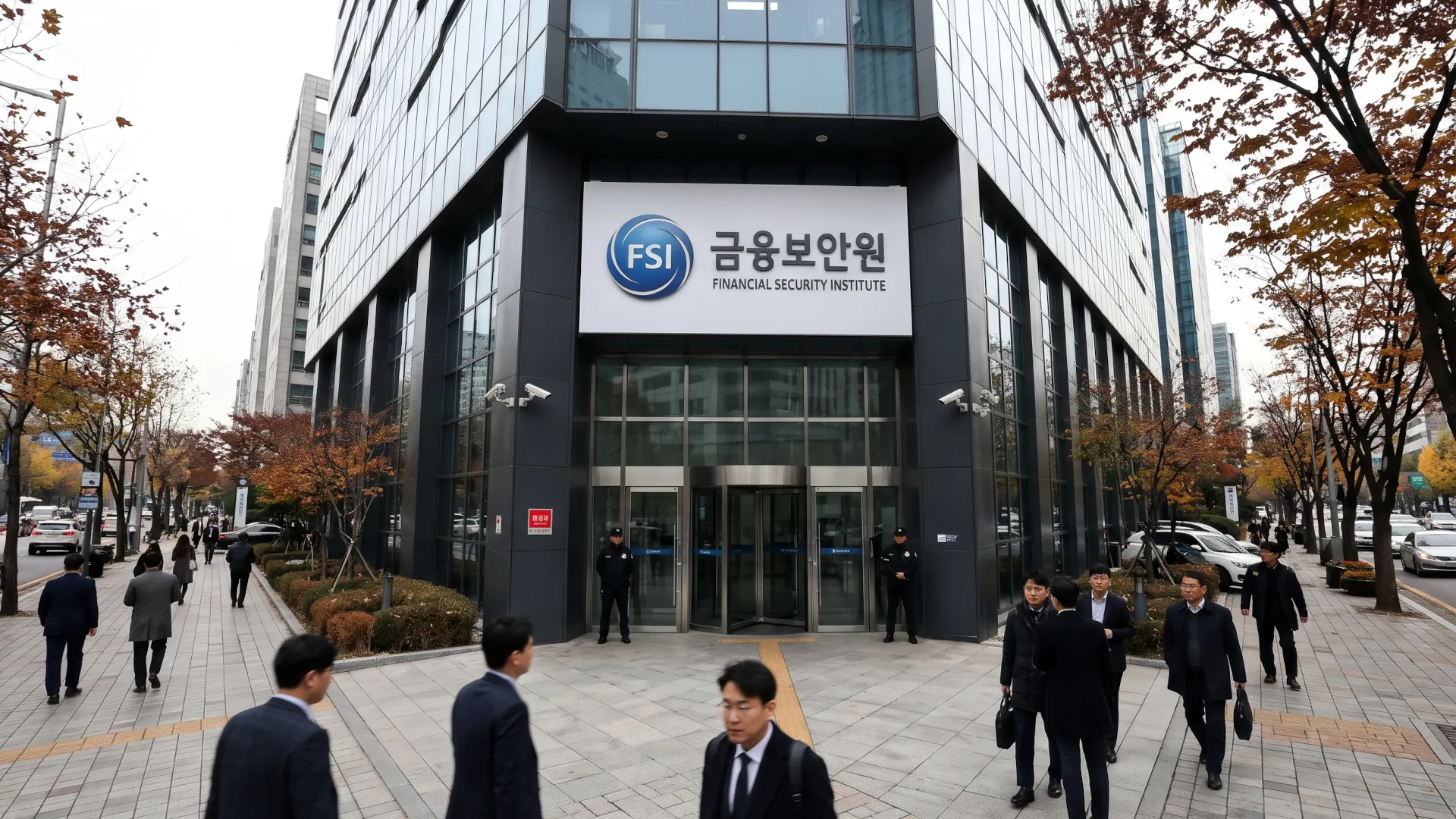
South Korea's Financial Security Institute, the public agency that audits the cybersecurity of banks and brokerages, detected on Monday, November 9, 2026, unauthorized external access to the system where entities submit their assessment forms. Technicians shut down the site at 14:19 Seoul time and reported the incident to the Financial Services Commission (FSC) and the KISA agency. Four days earlier, on November 5, FSC chairman Lee Eog-weon had gathered industry representatives at the institute's own headquarters to demand reinforcements.
The official tally as of November 11 is small in volume and ugly in meaning. We are talking about some 200 administrative forms, more than 300 personal records within them, with names and dates of birth, and just over 350 user records for the system, with partially masked mobile numbers. Almost all correspond to employees of financial entities with assessment duties. The 48 affected entities are regional agricultural cooperatives and credit unions, along with one forestry cooperative, and not a single large commercial bank appears.
The body assesses some 3,000 entities this year and stated in its first version that the compromised server hosted neither vulnerability analyses nor architecture diagrams. A day later, that point lost its basis.
An auditor with 3,000 entities on its list
The FSI is not a bank or a brokerage. It is the technical body that identifies vulnerabilities in financial entities' systems and monitors threats; when something blows up, it investigates the breach. Its continuous assessment system is the gateway where those entities upload the forms that underpin the audit, from credit information consent models to compliance documentation.
That was the compromised server. The official explanation puts at around 3,000 the entities whose credit data protection protocols go through those assessments in 2026, and insists that the affected platform is an external document exchange channel, not the body's internal network.
The distinction is not a textbook technicality. A form is an administrative document with a date, a name and sometimes a signed consent. A vulnerability analysis result is something else: it says what fails, where and with what it is exploited. The first official version placed the damage in the boring category and left the latter outside the attacker's reach.
What the institute said first
The November 11 tally set the figures the body confirmed and added two details that frame the case. The attack was concentrated on the mutualist segment and did not touch the large commercial banks. In addition, the system does not process retail customer transactions and resident registration numbers did not appear in the leaked material.
| What was leaked |
Volume |
Scope |
| Administrative forms |
about 200 |
Credit information consent forms |
| Personal records |
more than 300 |
Employee names and dates of birth |
| User records |
more than 350 |
Names, masked mobile numbers and emails |
| Affected entities |
48 |
Agricultural cooperatives and credit unions |
| IP addresses of the attack |
236 |
All South Korean, with no prior overlap |
Most of the personal data belongs to employees of the entities that were processing the assessments, not to customers. That is the part the institute emphasized and the reason the trickle of affected people was handled by phone, entity by entity, from the night of November 10.
The twist that came the next day
A later account, from November 12,breaks that reading: the attacked server did store security information, including configuration diagrams of the systems of major national financial institutions and parts of the vulnerability analysis assessments. The institute admitted that the data was there and maintained that it did not leak because it shut down the machine at the start of the attack.
The corrected version makes two things clear. The real scope of the breach is not settled, because the agency itself says the investigation is ongoing. The defense worked only halfway: the rapid shutdown prevented exfiltration of the diagrams, but it did not stop the attacker from reaching the folder where they were. Kwak Jin, a cybersecurity professor at Ajou University, compared the risk to leaving the floor plan of a house in plain sight, because it makes it easier to know where to get in and which server is worth hitting.
A fake account with regulator permissions
The attack path should unsettle any regulator. A follow-up analysis describes a fake account with the same privileges as the Financial Supervisory Service (FSS), created by exploiting a flaw in the institution's authorization process. No real FSS account was compromised. The attacker did not get in through an exotic backdoor, but through a poorly checked box in the allocation of permissions.
That pattern is not unique to Korea. The privilege audit required by India's CERT-In for AI agents points to the same hole: accounts that inherit broad permissions and that no one reviews as often as they review passwords.
The 236 IP addresses used in the attack are all South Korean, according to the same report, and none match previous intrusion attempts. The Seoul Metropolitan Police opened an investigation through its cybercrime unit at the institute's request, and the FSC sent an inspection team to the headquarters on Wednesday, November 11, with FSS staff assisting.
Four days between the warning and the breach
The timeline is awkward. On November 5, Lee Eog-weon gathered the entities at FSI headquarters to talk about cybersecurity innovation and leave an unambiguous warning: his office would hold chief executives legally accountable for serious management failures and would not tolerate practices that worsened the impact of an incident, such as neglecting known risks or relying on superficial inspections.
Four days later, the body that organized that meeting was shutting down its own assessment system. There is no indication that the attacker reacted to the meeting or that the breach stems from the same weaknesses flagged there. The coincidence does not prove a causal chain, but it does measure the distance between a regulator's rhetoric and the real resilience of its infrastructure.
The sector does not emerge unscathed from that contrast either. The affected mutuals depend on a shared platform administered by the regulator, and when that channel fails the damage is spread across dozens of small institutions.
Why does the blueprint matter more than the 300 records?
A handful of names and dates of birth can be contained with alerts and fraud monitoring. A map of how an entire country's security assessments are structured cannot be contained with anything of the sort. Anyone who has seen the diagrams knows which controls the entities declare and how their networks are organized, and with that they can prepare an attack that passes as compliant.
That is the real value of the incident. The volume leaked is smaller than that of any recent corporate breach; the interest lies in the position of the issuer. An attacker who understands the assessment process can choose the form nobody reviews or the permission that is inherited by default. The breach does not hand over customers, it hands over the criteria by which it is decided who is protected.
As for attribution, the case remains open. The institute has not identified the attacker and the fact that the IPs are domestic does not settle the question, because a Korean address can be a compromised intermediary machine. South Korea also lives with the Kim Yo-jong's public refusal regarding the Binance theft, an episode that should not be conflated with this case.
The sector that audits itself
The FSI promised to review its security management framework and to compensate those who suffer real harm. The concrete measures do not yet exist, and the ones that matter are unglamorous: separating supervisory privileges and treating the shared platform as critical infrastructure.
The lesson for the rest of the financial sector, including crypto, is that the risk surface has shifted to vendors and permissions. A flaw in an exchange's mobile app, such as the sandbox escape that Binance disclosed on November 11, or a poorly validated authorization checkbox in the auditor produces the same effect: someone gets in where they shouldn't, and the industry finds out late what was inside. The prestige of auditing others does not protect you from being audited.