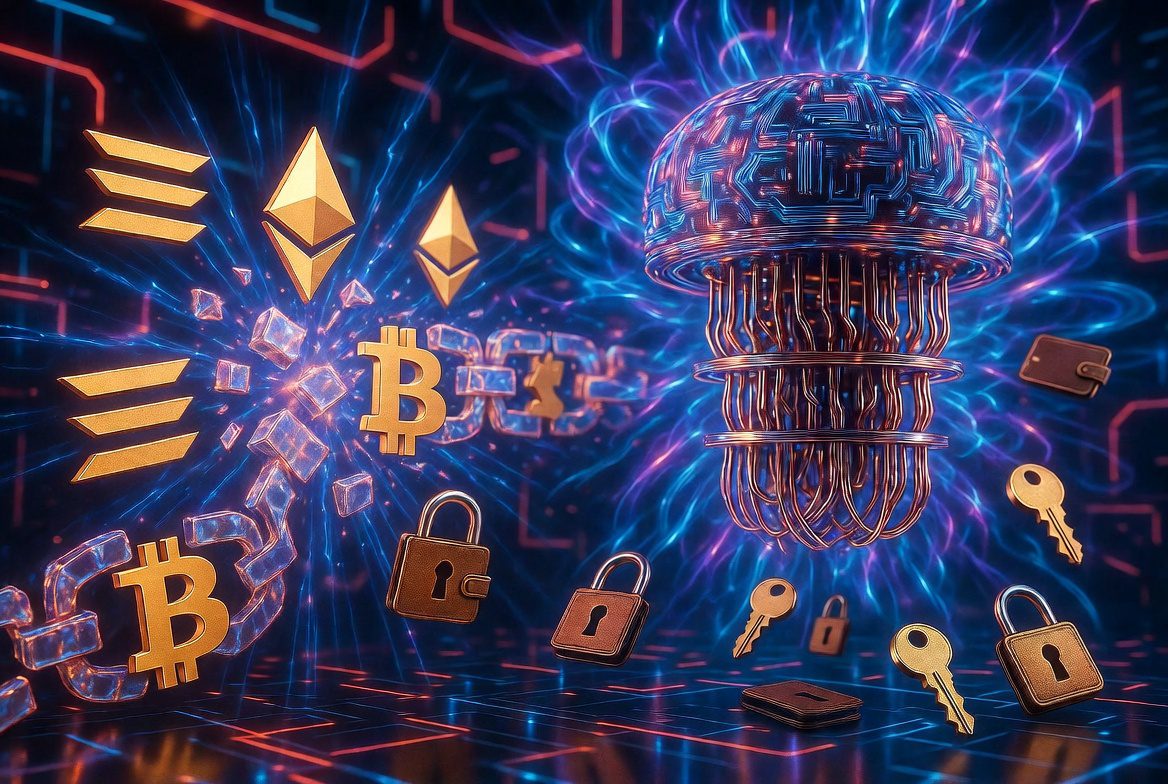
Quantum computing could become one of the biggest technological and security challenges for the crypto ecosystem. That is the warning from Citi in its report "How Far Are We from Q-Day?", in which the financial institution notes that Bitcoin, Ethereum and Solana are among the main networks exposed to the future impact of quantum computers.
According to Citi, the threat does not directly affect the blockchain as distributed infrastructure, but rather the public-key cryptography used to validate transactions, protect wallets and guarantee the authenticity of digital signatures. The report explains that a sufficiently advanced quantum computer could use Shor's algorithm to derive private keys from public keys exposed on the chain, something practically impossible with current classical computing.
25% of existing bitcoins
The bank estimates that approximately 25% of existing bitcoins would already be potentially vulnerable because their public keys have been revealed onchain. The document calculates that between 4.5 and 6.7 million BTC, currently valued at between $500 billion and $600 billion, could be exposed to quantum attacks in the future.
The vulnerability particularly affects old Pay-to-Public-Key (P2PK) addresses, reused wallets, Taproot outputs and historical bitcoins whose public keys have already been exposed. Citi also recalls that many of those BTC belong to Bitcoin's early years, possibly including some of the coins associated with Satoshi Nakamoto.
The report highlights that the problem arises when a public key becomes visible on the blockchain. From that moment on, a sufficiently powerful quantum computer could calculate the corresponding private key and sign fraudulent transactions to move the funds. Although there are currently no machines capable of doing so, Citi believes the sector must prepare in advance because the transition to quantum-resistant systems will be slow and complex.
Ethereum and Solana, more exposed
Ethereum and Solana appear even more exposed than Bitcoin. According to the report, more than 65% of Ethereum's current supply would be vulnerable, while on Solana practically the entire supply would be potentially exposed in the long term.
Developers' plan to save Bitcoin from the quantum threat
Citi explains that many modern blockchains expose public keys more frequently during normal network operation, thereby increasing the attack surface against future quantum computers. The institution stresses that the quantum threat to blockchain is not related to data encryption, but to the digital signatures used to prove ownership and authorize transactions.
In this scenario, an attacker capable of reconstructing private keys could steal cryptocurrencies, forge transactions, impersonate digital identities and compromise exchanges, custodians and DeFi platforms. Citi warns that the problem would have systemic implications for the entire blockchain ecosystem and not only for individual users.
Users will have to move their funds manually
Despite this, the report considers that Bitcoin has a relative advantage over other networks because only a portion of its coins is currently exposed. However, it also faces a major problem: the slowness of its governance and the difficulty of implementing rapid changes to the protocol.
Why Anthropic's AI is today more lethal for the crypto sector than the quantum attack
The institution notes that migration to post-quantum cryptographic signatures cannot be done automatically. Users will have to manually move their funds to new quantum-resistant addresses, leaving especially vulnerable the lost bitcoins, abandoned wallets and funds whose owners no longer have access to the keys.
Citi highlights that the main blockchains are already working on cryptographic systems resistant to quantum computers, using technologies such as CRYSTALS-Dilithium, Falcon and SPHINCS+. Bitcoin is studying new addresses and scripts through soft forks, Ethereum is exploring hybrid models of digital signatures and account abstraction, while Solana has already carried out tests related to post-quantum verification in high-speed environments.
This is Vitalik's roadmap to shield Ethereum from the quantum apocalypse
Although most experts consider the arrival of a cryptographically relevant quantum computer unlikely during this decade, Citi maintains that the risk is already shaping the strategic planning of governments, banks and technology companies. The report concludes that the race toward post-quantum cryptography has already begun and that blockchains will have to adapt long before the definitive arrival of the so-called "Q-Day".