SEVERAL DEFI PROTOCOLS ARE BEING HIT BY A DNS HACK
DNS, the Internet's guide
DNS (Domain Name System) acts as the "contact book" of cyberspace, translating easy-to-remember website names (such as observatorioblockchain.com) into the numerical IP addresses that computers need to communicate with each other. It is the backbone that allows us to interconnect the Internet and browse it easily, doing all that work behind the scenes, including, of course, serving as the channel for sending that hateful advertising to our browser.
But we must add another, more worrying point to that. Historically, DNS has been a vulnerable protocol, often operating without encryption and allowing internet service providers (ISPs) to track users' activity or, worse still, allowing attackers to redirect traffic to phishing sites through cache poisoning attacks. This is not new; in the crypto world, things like this have already happened. Cases such as Squarespace or Curve Finance remind us that even in crypto these attacks are devastating.
Improving DNS security
That is why adopting modern DNS resolvers that implement encryption protocols such as DNS-over-HTTPS (DoH), DNS-over-TLS (DoT) and the emerging DNS-over-QUIC (DoQ) is essential to guarantee the integrity of browsing. These tools not only encrypt queries, but also act as a preventive firewall, blocking access to domains known for distributing malware or hosting command-and-control (C2) infrastructure for ransomware groups.
In this regard, NextDNS has positioned itself as the gold standard for families and individual users thanks to its simplified interface that hides powerful filtering machinery. It allows the creation of custom configurations where specific protections against "typosquatting" (domains that imitate well-known brands with spelling errors) can be enabled, as well as blocking of recently registered domains, a common tactic in short-lived phishing campaigns. NextDNS's ability to analyze queries in nanoseconds using real-time threat intelligence makes it possible to intercept attacks before the browser even downloads the first byte of malicious content.
Adguard DNS, the self-hosted option
On the other hand, AdGuard DNS offers a robust solution for those already familiar with its ad-blocking ecosystem. Its competitive advantage lies in a globally distributed server infrastructure that prioritizes low latency, something critical for cryptoasset trading where every millisecond counts.
In addition, its control panel allows visual management of the traffic of all the devices in the home, from Smart TVs to IoT sensors, which often lack their own security software and are the weakest link in the network. But the best part is that Adguard DNS can be deployed self-hosted, giving you absolute control over your DNS resolution.
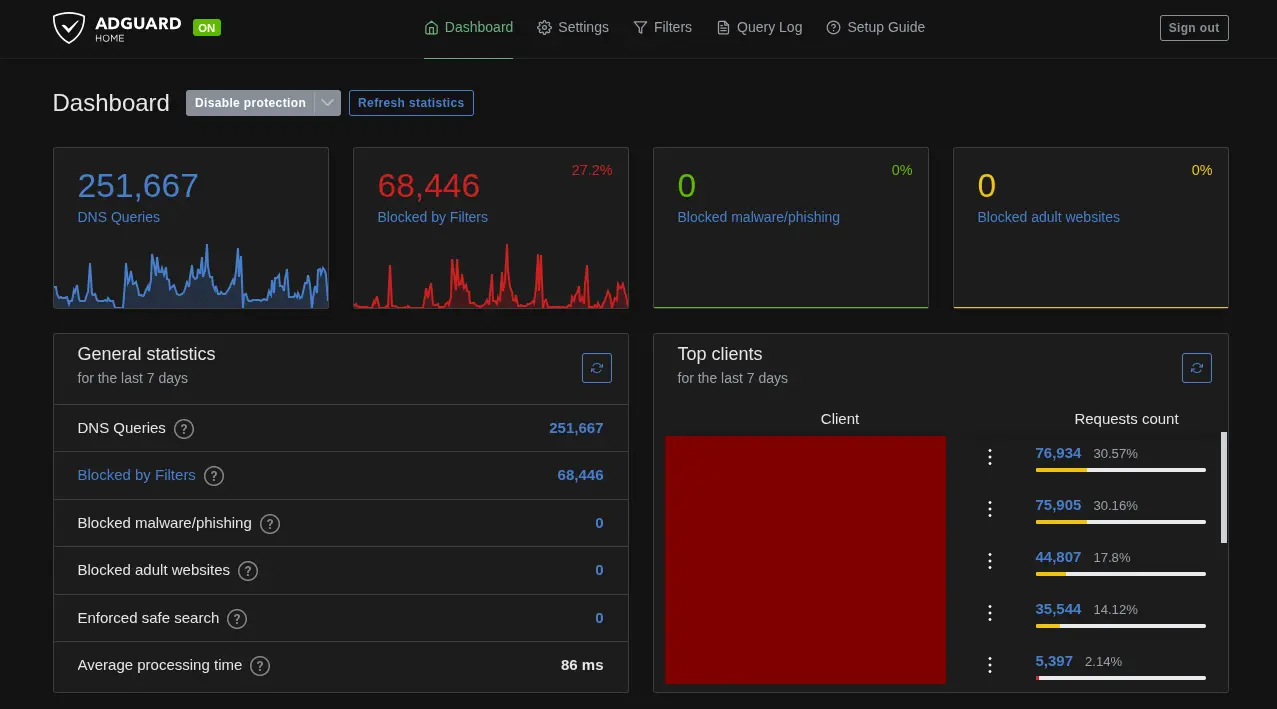
In both cases, it is enough to change your home router's DNS to these services (both offer complete guides for doing so) and start seeing the difference, and if you are a bit more handy, you can adjust security to the point where visiting Netflix or playing Minecraft can only be done at certain times, on your children's devices.
The bunker for digital assets: Hardware Wallets
The real security of cryptocurrencies has always been inseparable from the concept of self-custody. Security breaches at centralized exchanges and the sophistication of malware capable of intercepting seed phrases on computers and mobile phones have turned hardware wallets into the only reliable defense against the theft of funds. These devices operate under the principle of total isolation or "air-gapping", where private keys never leave the secure chip and transaction signing is performed in a trusted execution environment (TEE).
The technical evolution of these devices has led to the integration of chips with EAL6+ (Evaluation Assurance Level) security certification, which guarantee resistance against direct physical attacks, such as laser fault injection analysis or side-channel attacks aimed at extracting information through the chip's power consumption.
WHAT WALLETS ARE AND HOW TO USE THEM TO GET STARTED IN CRYPTOCURRENCIES
Options to keep in mind
In this regard, the Ledger Nano S Plus continues to be a benchmark thanks to its Secure Element chip and its proprietary BOLOS operating system, which isolates each individual digital asset application.
One of the most critical innovations introduced is support for Clear Signing. In the past, users signed transactions seeing only an unreadable hexadecimal hash; the Clear Signing standard allows the device to translate the smart contract data and display on the secure screen exactly what is happening: "Send 1.5 ETH to address X" or "Give platform Y permission to spend Z tokens". This is vital to combat malicious approval scams that have drained millions over the past year.
For its part, the Trezor Safe 3 appeals to trust through total transparency. Being completely open source, both the hardware and the software can be audited by any independent security researcher. The inclusion of Infineon's Optiga Trust M chip adds a layer of protection against physical extraction of secrets, a vulnerability that affected older models of the brand. In addition, its support for Shamir Backup allows the recovery phrase to be split into multiple parts (for example, 3 of 5), eliminating the single point of failure that having a single sheet of paper with the 24 words represents.
But in today's digital threat landscape, credential theft remains the entry vector for 80% of advanced attacks. Password reuse is a critical negligence, but even complex passwords are vulnerable if the service storing them does not implement a zero-knowledge architecture.
In that case, a modern password manager is not just an encrypted database; it is a security agent that assesses the health of credentials, monitors leaks on the "Dark Web" and facilitates the transition toward a passwordless future through Passkeys support.
Your digital identity, your personal vault
Here, the runaway winner is Bitwarden (or its fully free version, Vaultwarden), which has established itself as the preferred option for technical professionals due to its total transparency. Being open source, its encryption algorithms and synchronization protocols are under constant public scrutiny, which makes it possible to detect and correct vulnerabilities much earlier than in proprietary software.
Its architecture allows self-hosting, which means that a user or company can run their own instance of the manager on a private server, ensuring that their password vault never touches a third party's infrastructure.
CYBERSECURITY TRENDS 2026: POST-QUANTUM CRYPTOGRAPHY UNDERWAY
But what if the threat or the source of censorship owns the infrastructure that gives you Internet? In that case, a Virtual Private Network (VPN) has gone from being a niche tool to an essential component of the security ecosystem. A VPN not only hides the IP address, but also encrypts all outgoing traffic, protecting it from inspection by ISPs, governments or malicious actors.
And although in its early days having a VPN was synonymous with "Slow Internet", the reality has changed a lot. Thanks to the use of lightweight protocols such as WireGuard, VPNs are now able to run at the same base speed as your connection or even improve it slightly, by avoiding throttling and other actions on the traffic passing through that network. This eliminates the latency that previously discouraged users from keeping protection permanently active.
In this case, Mullvad VPN, headquartered in Sweden, is governed by a principle of radical minimalism that redefines privacy: it is one of the few services that requires neither an email nor personal data, assigning the user a random account number as their only identity.
Its infrastructure stands out for absolute transparency as a pioneer in the adoption of WireGuard, offering open-source applications that undergo external security audits on a recurring basis. To shield the connection, Mullvad uses RAM-only servers and a "multihop" system that allows chaining servers in different jurisdictions, ensuring that traffic is practically impossible to trace back to its origin. Privacy designed from start to finish, especially since you can even pay with privacy-focused cryptocurrencies such as Monero.
EUROPE BANS SORA, THE VIDEO AI, IN A WORLD WITHOUT DIGITAL BORDERS
The second lock: Multi-factor authentication (2FA) and TOTP
But even with the best password practices, single-factor authentication is digital suicide. Multi-factor authentication (MFA or 2FA) has become the minimum requirement for any digital service.
However, not all 2FA methods are equal. Codes sent by SMS are vulnerable to "SIM Swapping" and to interception on networks, which has led to the unanimous recommendation to use TOTP (Time-based One-Time Password) code-generating applications or physical security keys.
In that case, Aegis Authenticator represents the maximum-security option for Android users. Its philosophy is "local-first", which means that the token database resides only on the device and is encrypted with AES-256-GCM.
It allows automatic backups to a location of the user's choice (such as a personal Nextcloud server or an SD card), encrypting the output file with key derivation algorithms such as scrypt. Its ability to organize tokens into groups and assign them custom icons makes it ideal for users who manage dozens of accounts across different digital asset protocols.
Evolution of threats and what to expect in the future
As technology advances, cybersecurity has ceased to be a series of products and become a strategy of operational resilience. The integration of AI, for example, is not only helping attackers create polymorphic malware that changes its code to evade detection, but is also enabling defenders to analyze anomalous traffic patterns.
To that we add the threat of quantum computing, which although still at an institutional development stage, is already influencing today's decisions. The "harvest now, decrypt later" strategy means that attackers are stealing encrypted data today in the hope of decrypting it in a few years. That is why adopting tools that already implement post-quantum cryptography (PQC) algorithms is essential at this moment.
WHITE NOISE ARRIVES: ANONYMOUS COMMUNICATION, WITHOUT CENSORSHIP AND WITHOUT INTERMEDIARIES
But with all that, the human factor remains the most vulnerable link. Companies and individual users must understand that digital threats are always there and we do not see them if we do not use the right tools. Faced with that, prevention is best, and this set of tools can help you a great deal in that task.
After all, digital security in this cyberworld is not about being unreachable, but about being such an expensive and difficult target that the attacker decides to look for an easier victim. The combination of a secure DNS, a robust hardware wallet, a password manager, a VPN and a TOTP authenticator constitutes a security pentagon necessary to survive and thrive in today's cyberspace.