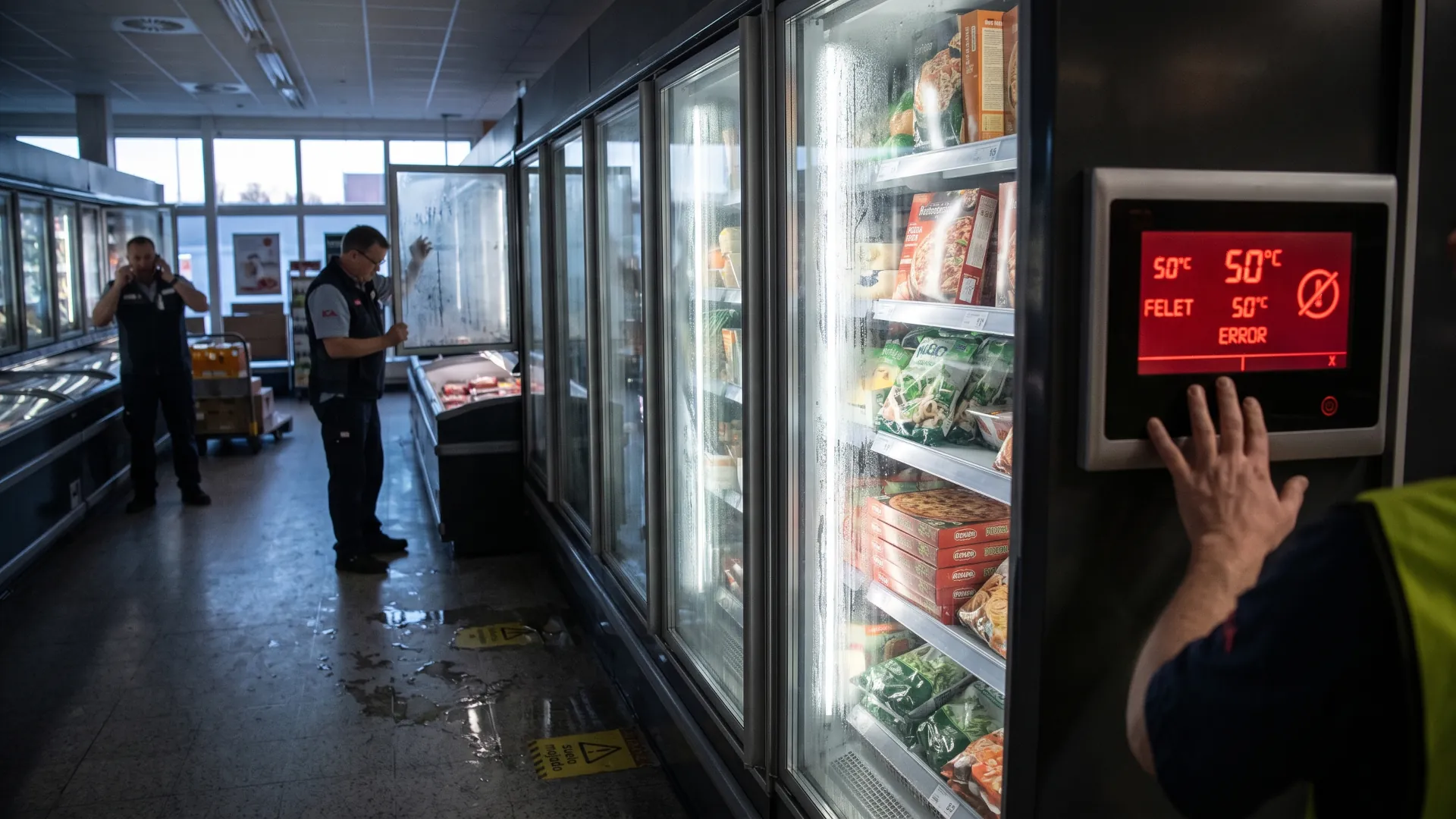
Around 115 supermarkets in six European countries woke up on Monday, November 2, with their freezers out of control. Someone had changed the temperature remotely, in some cases to as much as 50 degrees, and had switched off refrigeration equipment or triggered defrost cycles that no one had scheduled. Store employees in Sweden, Belgium, the Netherlands, Luxembourg, Ireland and Estonia found spoiled product and panels that would not accept commands.
It was not an unlucky software glitch. It was an intrusion into the systems that manage refrigeration, and the coincidence of dates and method points to something more coordinated than a sum of isolated incidents. The affected chains include ICA and Coop in Sweden, Ahold Delhaize, Carrefour, Spar Colruyt and Intermarché in Belgium, SuperValu in Ireland and Selver in Estonia.
The figure that fits worst with the idea of a minor scare is the temperature. An ICA manager told Swedish television that the settings had been moved overnight to 50 degrees and that he could not change them. When the thermostat stops obeying, the problem is no longer IT: it is lost inventory, staff without tools and customers facing empty shelves.
A night with the panels in red
The warnings began before dawn. Ahold Delhaize sent messages to store managers at around four in the morning, and some locations resorted to refrigerated trucks to try to save their stock. Coop confirmed seven stores affected out of more than eight hundred, with cases ranging from equipment that was completely shut down to a system that began generating heat.
In Belgium the scope was uneven. Carrefour spoke of fifteen stores affected out of some seven hundred, all in Flanders and Wallonia, with no hypermarkets among them. Intermarché reported a similar figure, Spar Colruyt about five, and in the Netherlands at least seventeen butcher shops and neighborhood stores were counted with the same problem.
The pattern of damage is not random. The affected equipment depends on a remote control system to function normally, and anyone who gets into that system can do more damage than a thief with a crowbar. There is no need to force anything; it is enough to change a value on a screen shared by dozens of locations.
The supplier that appears in almost all the speculation
Belgian investigative reporting pointed to Sabcobel as the supplier of the refrigeration systems in a good number of the affected premises. Its director, Stephan Moelans,linked the incident to the same vulnerability that was used in similar attacks in France last month. That sentence is the most important in the entire case, because it turns an isolated incident into a campaign.
If the vector is the same and the supplier is shared, the problem is not the security of each chain separately. It is the security of a third party that manages critical infrastructure for many companies at once. That model concentrates efficiency and also concentrates risk, just as happened with the software providers that dragged thousands of clients down in a single day.
The food sector has been outsourcing cold-chain control for years for a sensible reason: maintaining a network of sensors and PLCs requires specialists that a mid-sized chain cannot keep on staff. The trade-off is that the provider becomes a single point of failure, and its security level becomes the security level of all its customers.
When the attack is not after money, but chaos
Most incidents of this type are read as extortion attempts. Here there is, for now, no ransom note and no demanded sum. What there is is pure sabotage with a direct cost in perishable product and an indirect cost in reputation, because a supermarket that throws away perishable goods loses trust very quickly.
That profile changes the response. Faced with data kidnapping, the decision is to pay or restore. Faced with sabotage, the priority is to regain physical control of the system and verify what else was touched. An attacker who can adjust temperatures can also review access logs, staff schedules or equipment telemetry.
In the European context, the episode fits into a series that already includes attacks on logistics, ports and municipal services. Everyday infrastructure, the kind that does not appear on critical target lists but feeds cities, has become an accessible target. Its security is often that of a web panel with a shared password.
The link nobody audits
The supply chain of industrial systems has a structural visibility problem. A company buys a refrigeration system, the integrator installs a controller, the manufacturer maintains a remote access portal, and nobody has a complete picture of who can touch what. When something fails, each party points to the next and the clock keeps running.
European cyber-resilience rules push to close part of that gap, but their timetable is measured in years and these campaigns move in days. In the meantime, there are cheap measures: segmenting the network of refrigeration equipment, requiring strong authentication on control panels, limiting remote access to known addresses and logging every configuration change with name and time.
Contracts are also worth reviewing. If the provider has permanent, unsupervised remote access, a door nobody watches is being given away. An inventory of third-party access and a quarterly review of it cost less than a night of product lost across a hundred stores.
Regaining control of the thermostats does not close the incident. You have to decide what product can be sold, what is thrown away and how the loss is documented for insurance. In categories such as frozen and chilled, a few hours out of range are enough to turn valid inventory into waste, and traceability of that disposal is mandatory in several countries.
There is also the review of contracts with the refrigeration provider. If the agreement does not set security obligations, notification deadlines and audits, the chain assumes a risk it cannot control and discovers the gap when the shelves are already empty.
What lies ahead for industrial refrigeration
The question the sector should be asking is not how much the next wave will cost, but how many providers share the same portal without anyone knowing. Concentration is convenient and profitable, and it is also the reason a single failure can shut down the freezers of six countries in one night.
There is a detail worth not losing sight of. The attacks on French refrigeration last month and this second European wave show someone testing the same blow with variations. It is the behavior of someone who has found a profitable surface and still has no reason to look for another.
With 115 stores affected and no statement explaining who is behind it, the investigation looks more like closing a door than understanding a motive. Refrigeration equipment will stay connected to the internet because it saves money, and that decision is not going to be reversed. What can change is who can talk to it and with what credentials.