The Cosmos (ATOM) ecosystem finds itself in the midst of a severe existential crisis brought on by the departure of key projects, declining user interest and statements from prominent figures who consider the ecosystem practically inert.
More specifically, we are seeing how fundamental projects and networks in this environment are shutting down or migrating to other architectures, which has generated intense alarm among users and developers. A situation that has sparked a deep debate between those who predict the end of the app-chain model and those who argue that it is simply a market readjustment similar to the one experienced in previous cycles.
Recall that the Cosmos architecture was originally designed under the thesis of creating a network of sovereign, interconnected blockchains. However, the high costs of maintaining dedicated infrastructure and the fragmentation of liquidity have jeopardized the long-term sustainability of this model. Thus, a project that was said to hold the key to scalability is now at its lowest point.
But it is not the only one in that situation; 2026 threatens to take many projects out of circulation for similar reasons, repeating the market cleanup of 2021. As in any other market, in crypto only the strongest survive, just as in the wild.
The transition from market capitalism to technological feudalism
The decline of Cosmos (ATOM) and the lessons to be learned
But before expanding across the ecosystem, let us review the Cosmos case. The crisis the Cosmos ecosystem is going through manifests as a multidimensional phenomenon in which perceived technical obsolescence and financial fragility have set off a domino effect across its infrastructure.
This decline is driven by the loss of confidence among prominent development figures, such as Christopher Goes, co-founder of Anoma, who recently said that "Cosmos is dead", since the network can no longer compete with the liquidity and support of giants like Ethereum or Solana, which has led to a state of terminal development.
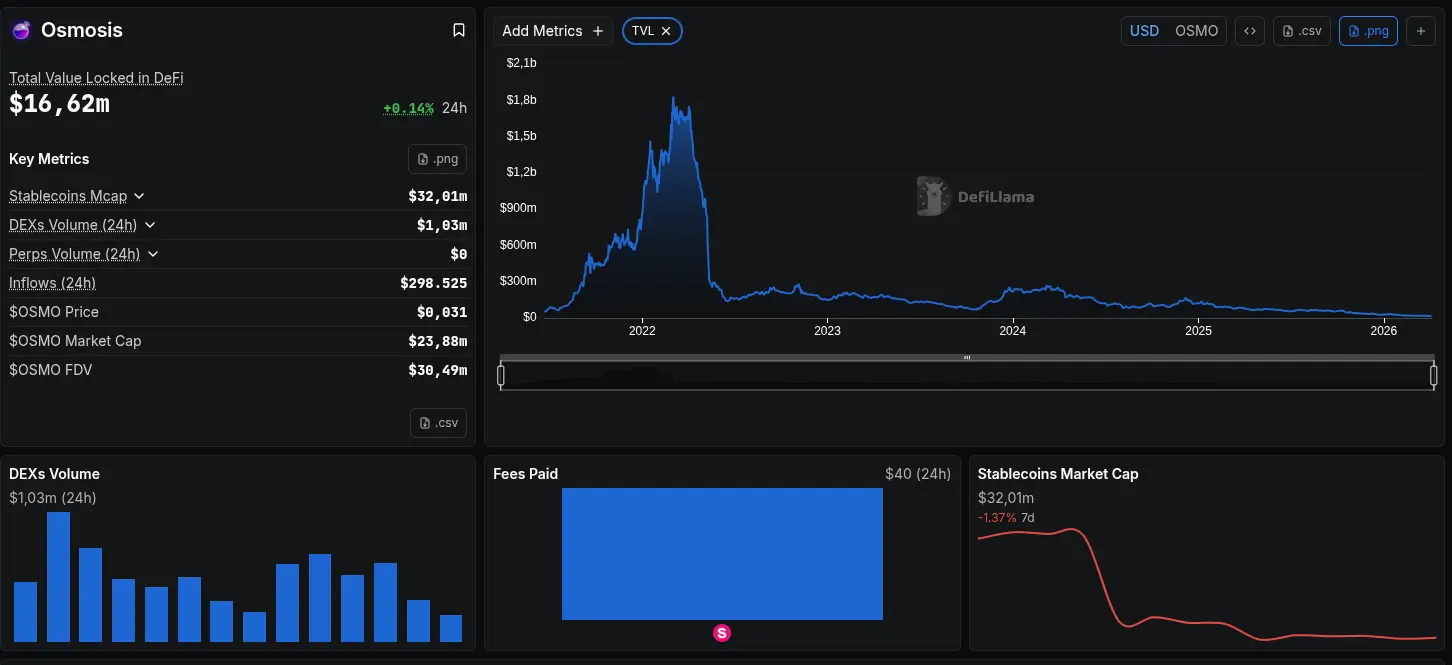
Other projects such as Penumbra, Osmosis and Noble have gone months without development, and their use within the Cosmos network is practically nonexistent. And we can use any metric to see it. For example, Osmosis's TVL (a DEX) barely exceeds 16 million dollars, far from its peak in 2022, when the project reached 1.7 billion dollars.
And that is death in DeFi, because with that level of liquidity you are unable to compete with the rest of the ecosystem's giants.
Closing the door
Precisely, this lack of competitiveness has forced the restructuring or closure of fundamental pillars of the ecosystem, again highlighting the cases of Penumbra, Osmosis's maintenance mode and Noble's technological migration to more profitable environments.
To this picture we can add the cessation of critical services for end users, such as the Leap Wallet, whose disappearance scheduled for May 28, 2026, removes a user-friendly access gateway and forces retail investors into a complex relocation of their assets.
Riot sells 289 million dollars in Bitcoin to bet on the AI business
But the problem extends even to the core of the network. In fact, there the problem becomes existential because validators, responsible for processing transactions and guaranteeing security, face operating costs that far exceed their current revenue.
Upon losing economic viability, these sovereign nodes begin to disconnect, which not only reduces the protocol's decentralization but also increases the risk of technical vulnerabilities and consensus failures, creating a negative feedback loop that drives away both the investment and the innovation needed for a possible recovery.
Market cleanup
The Cosmos crisis has generated an overflow effect that calls into question the viability of other similar ecosystems, affecting specialized networks such as Sei and Tezos.
In the case of Sei, its focus on commercial speed is threatened by a migration of developers toward monolithic networks, while Tezos faces an operational dilemma by maintaining extremely high security costs compared with its actual use and its limited capacity to generate a vibrant DeFi environment. This lack of commercial traction and the difficulties in offering intuitive user interfaces, an area where Osmosis used to stand out, are eroding the credibility of any protocol that tries to operate outside the dominant ecosystems.
On the other hand, veteran assets focused on privacy and governance such as Dash and Decred show growing vulnerability, since low activity on their networks makes maintaining their validator nodes financially unsustainable for independent operators, forcing a talent drain toward platforms with greater liquidity such as Solana or Ethereum.
The new version of x402 boosts instant payments on the web
The first victims?
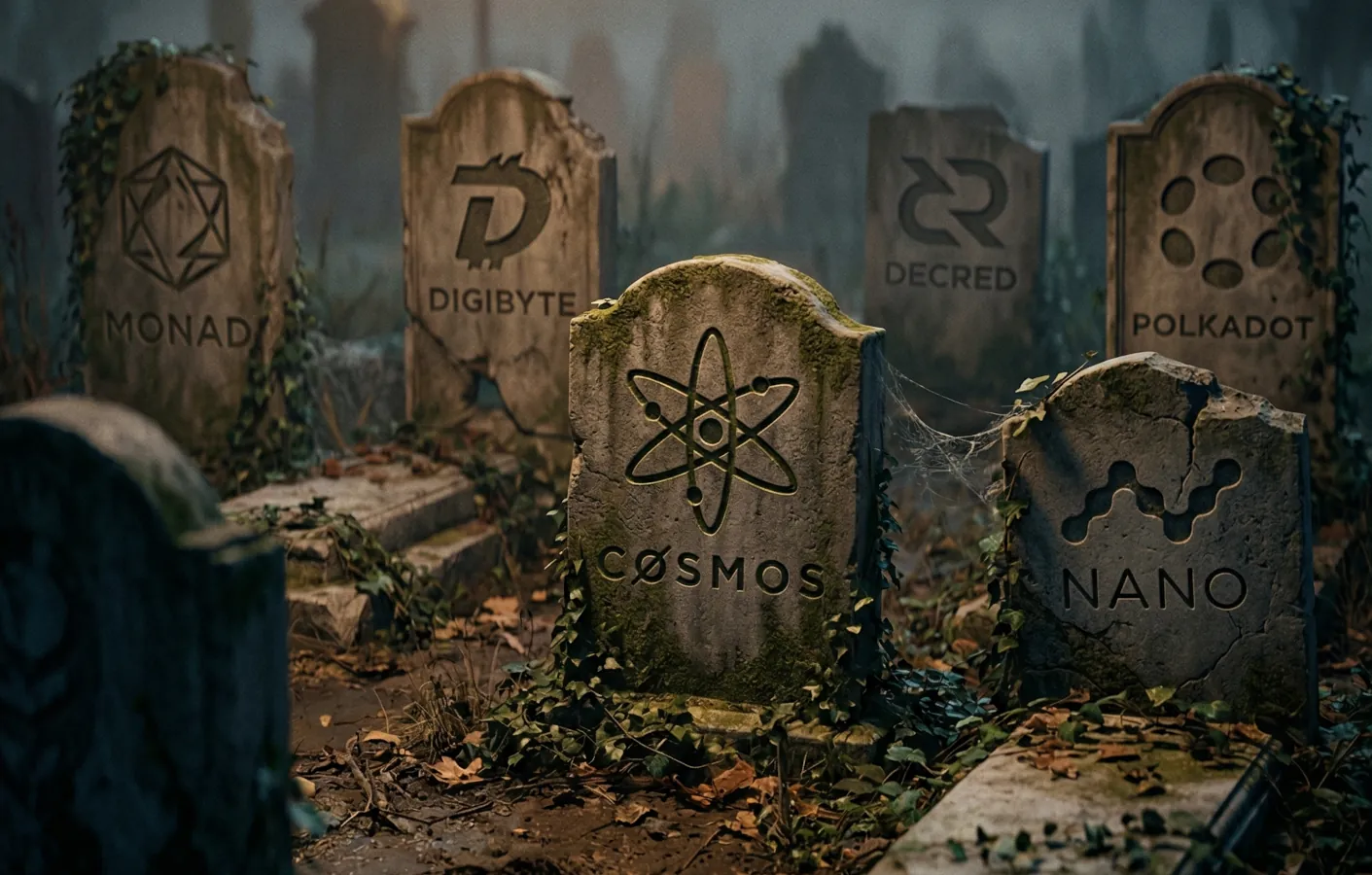
The truth is that over the past year, the crypto Top has changed impressively, but the "market cleanup" message is reinforced. "Promising" projects such as Polkadot, ICP, Algorand, Aptos, Flare, XDC Network, Stacks, BSV, Bittorrent, KAIA, Monad, ImmutableX, Celestia, NEO, Helium, Theta Network, Thorchain, Akash, MultiverseX, Livepeer, Qtum, Berachain, RavenCoin, DigiByte, Astar, Nano, Mantra, Flow, Plume, Enjin Coin, Skale, Chromia, Wanchain, Moonbeam, Syscoin, Telos, EVMOS, are in the red and technically dead.
So if the market situation continues in 2026, many of these projects will end up definitively forgotten. And you don't have to look far to understand that. For example, Berachain is a project built on Cosmos; the fall of Cosmos will undoubtedly drag it to its end. But at this moment, the project has been frozen for more than 8 months.
Ethereum recovers 2,000 dollars after the foundation's staking
DigiByte, Nano and Algorand were TOP 10 projects, and now they are forgotten. DigiByte, for example, reached its highest market capitalization in 2021, 2.17 billion dollars; now it barely reaches 81 million dollars. The case repeats with Algorand, which went from 12 billion in 2021 to a market capitalization of 1.1 billion now and still falling, and Nano is more of the same (from 4 billion in 2018 to 50 million currently).
The technical legacy: an inheritance that outlives the market
However, it would be a mistake to ignore that the DNA of these projects today underpins much of the global crypto infrastructure. Technologies born in this environment, such as the Cosmos SDK and the CometBFT consensus engine (formerly Tendermint), have enabled the birth of today's giants such as dYdX and Celestia, proving that software is far more resilient than asset prices.
Likewise, the IBC (Inter-Blockchain Communication) protocol has established itself in 2026 as the gold standard for interoperability, being adopted even by networks outside the original ecosystem to connect with Ethereum and Solana. In this sense, even if specific projects disappear, their innovation remains. We could therefore say that we are witnessing creative destruction, where code survives to feed the next generation of more efficient and profitable networks.