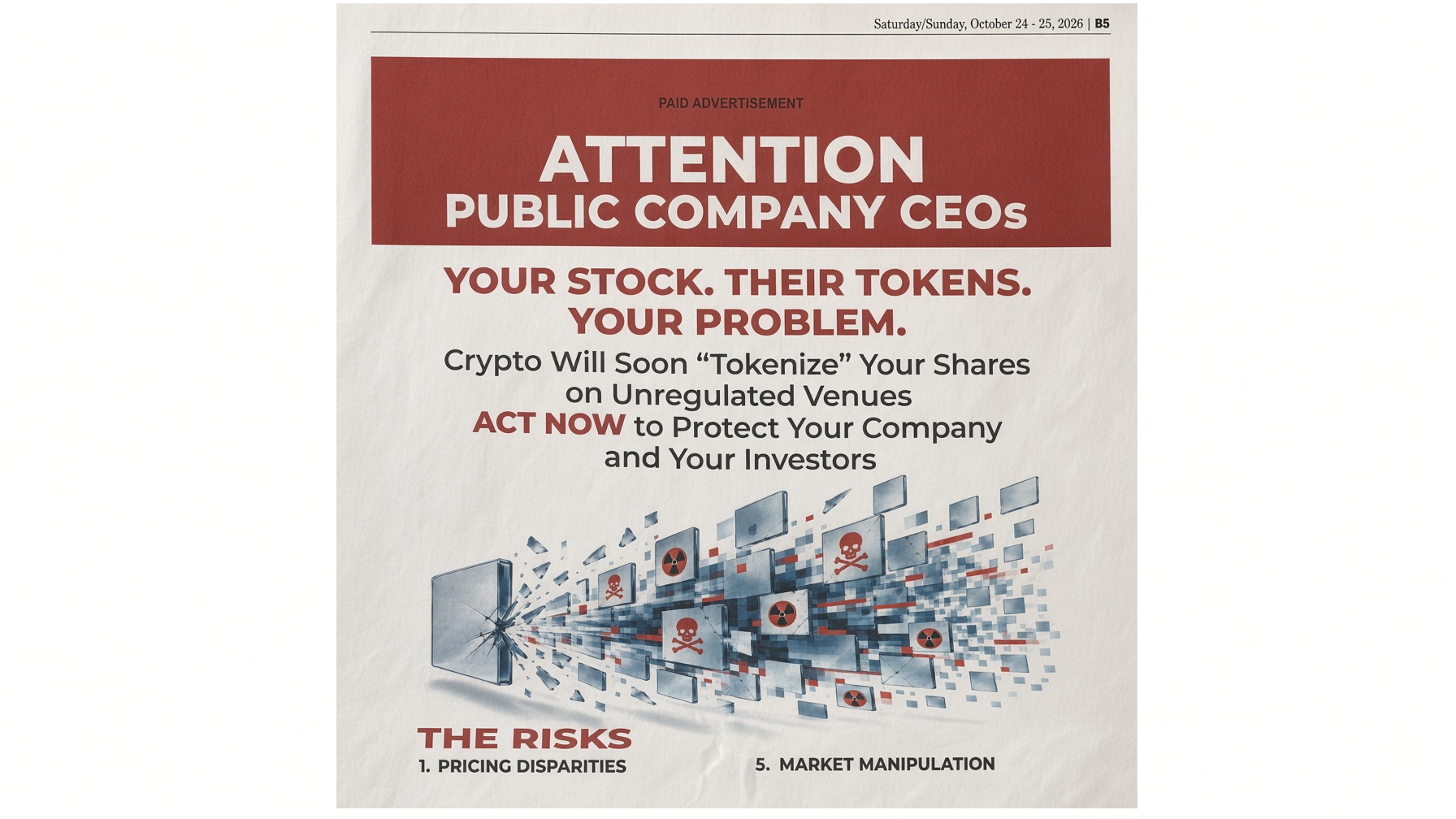
A total of 50 companies oppose the trading of tokenized versions of their shares on OKXICE, the project of OKX and Intercontinental Exchange (ICE), parent company of the New York Stock Exchange. Nvidia, Nike, Costco, Micron and Reddit are among the latest additions to the list. The objections affect tokens created by third parties for that market under the SEC exemption.
The growing opposition of issuers has opened a discussion between two entrepreneurs competing to bring shares onto blockchain. They are Mike Cagney, co-founder and executive chairman of Figure, and Carlos Domingo, co-founder and CEO of Securitize. Their differences concern price formation, liquidity and the possibilities of using the securities to obtain financing. They also reflect the business models each company is developing.
Cagney's argument for questioning the appeal of OKXICE is that a new market must offer advantages over existing exchanges. He criticizes the execution of trades through automated market makers, known as AMMs, and questions the possibilities of trading with financing and lending shares on the platform.
The executive advocates that companies issue shares directly on blockchain and that their holders can trade them, lend them or use them as collateral in decentralized finance (DeFi). His proposal aligns with OPEN, Figure's network on Provenance Blockchain. The company has developed an infrastructure for native blockchain shares that combines trading through an order book with lending and financing services through Democratized Prime. It also envisages conversion between blockchain shares and securities traded on the traditional market.
63 tokenized shares open 24/7 markets with OKX and NYSE
Figure's goal is to attract companies that issue securities on its network and investors who use those services. In other words, Cagney proposes as an alternative to OKXICE the model his own company markets. The entrepreneur argues that self-custody would also allow the income from lending shares to reach their holders, instead of remaining in the hands of the intermediaries that manage that loan.
Securitize's interest in OKXICE
Domingo, for his part, has a direct commercial link to the development of those new markets. Securitize launched its tokenized shares offering on October 8 and announced that it expected to add them to OKXICE and to NYSE's future digital platform. Both initiatives would broaden the trading channels for its products.
Its offering has a different structure from the native issuance that Figure promotes. According to Securitize's documentation, each token represents a right over securities held through Securitize Markets. The holder does not appear as a registered shareholder of the underlying company until they carry out the planned conversion. Buying that token and registering directly as a shareholder are, therefore, different situations.
From his X account, Domingo questions the consistency of Cagney's criticisms. He reproaches him for the fact that Figure has issued a separate class of shares to trade without being subject to certain US stock market rules and that it now criticizes the prices other tokenized share platforms might offer.
Domingo is referring to Reg NMS, the rules governing the US stock market, and to the NBBO, the reference that captures the best bid and ask prices available on the country's exchanges. According to his argument, Cagney has also defended a model that departs from those rules.
How to compete on price and liquidity
Cagney rejects that there is any contradiction and points out that FGRS, Figure's native blockchain share, is traded through an order book and is convertible into the traditional market security, and vice versa. According to his argument, that connection links prices and facilitates the connection between the liquidity of both markets.
The technical difference lies in how trades are executed. An order book brings together buy and sell offers with specified prices and quantities. An AMM allows assets to be exchanged through liquidity pools and automated price-setting mechanisms.
Domingo rejects the idea that all AMMs must necessarily deliver worse results. He mentions variants such as PropAMMs and argues that execution quality will depend on the design and on the liquidity providers.