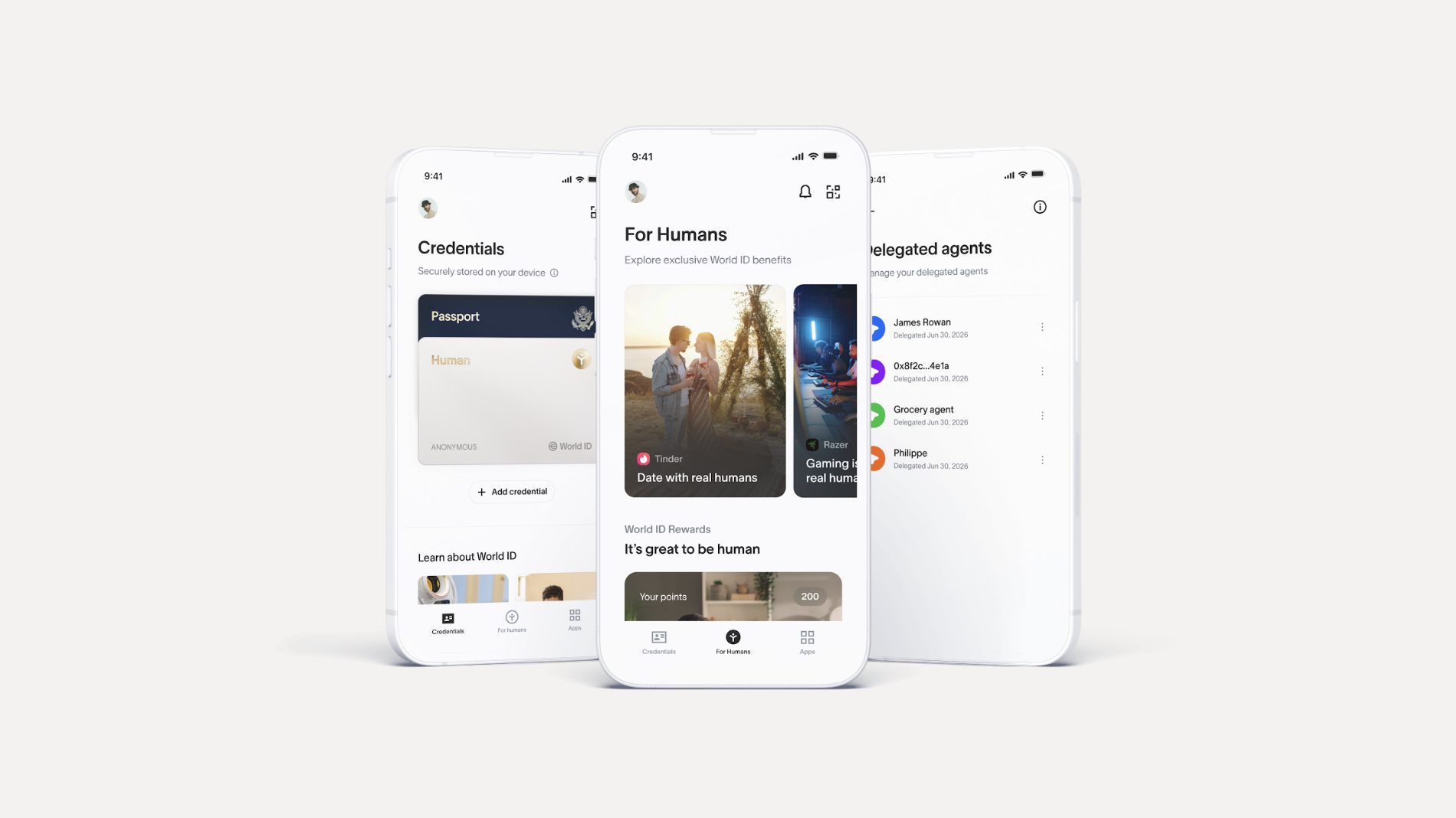
The company World, formerly known as Worldcoin, has partnered with everyday platforms such as Tinder, Zoom and DocuSign, as well as professional tools like Okta and Vercel, to integrate its proof-of-humanity system into both daily digital interactions and the emerging AI agent economy.
The goal of the firm founded by Sam Altman is to create a universal trust layer on the internet. Through these integrations, World aims to guarantee that behind every social media profile, every participant in a video conference or every signature on a digital contract, there is always a real, verifiable person.
Human badges
In the case of Tinder, the technology allows users to obtain a verified human badge, which helps reduce fake profiles and improves trust in interactions. After being tested in Japan, this feature is already rolling out in the United States. In parallel, World is also entering the entertainment world with Concert Kit, a tool that will allow artists to offer exclusive tickets and experiences to verified fans. Its first use will be on the tour of American singer Bruno Mars.
EGM and Kantar face the challenge of measuring an audience that is no longer only human
The company has also brought this technology to Zoom, where the integration will make it possible to confirm that the person appearing in a video call really is who they say they are, combining biometric verification and real-time checks. The company says Zoom is the first communication platform to offer the Deep Face integration directly in its meetings product.
This integration, according to World, provides a hardware-backed foundation of trust through triple verification. These are the cryptographically signed image captured when the person originally verified on an Orb, a real-time selfie with liveness verification (Face Auth) taken on the person's device, and the live video that the other participants see. When all three match, the result is a confirmation, with high certainty, that the person on the call is who they say they are: a real verified human. The integration analyzes only video, not audio.
Reinforcing trust on the internet
For its part, DocuSign will use World ID to ensure that those who sign digital documents are real humans. Through World ID, signers can confirm specific attributes about themselves, proving that they are people and not bots.
According to the company, World's new features are part of the new generation of World ID, unveiled yesterday in San Francisco. The company says its goal is to reinforce trust on the internet, in a context where AI makes it easier to create fake identities and manipulated content. Its system makes it possible to prove that one is human without revealing one's identity, offering a privacy-focused solution designed for an increasingly automated digital environment.
On the other hand, World has reached agreements with two companies to guarantee that, on an internet dominated by automated processes, it can always be verified that a real person is overseeing critical decisions. In the case of Vercel, the leading platform used by developers to create and deploy modern websites and applications, it has launched a new toolkit (Workflow SDK). Thanks to this alliance, programmers can now easily integrate the concept of "human in the loop."
Human oversight
This means that any AI agent or automated process can be configured to stop and request mandatory human validation before continuing. Each intervention is permanently recorded, creating an auditable history that proves a person took part at key moments.
World also collaborates with Okta, the technology giant specializing in identity and access services that thousands of companies use to manage the login of their employees and customers. Both companies are collaborating on the development of Human Principal, an innovative security system designed for applications and digital services to accurately identify whether a real person is overseeing the actions of an artificial intelligence agent.
This technology allows developers to apply customized security rules and policies depending on who is operating, ensuring that actions executed by AI always have the backing and oversight of a human.
Token price drop
To facilitate this interaction, the system uses cryptographic proofs that simplify the user experience. Through this method, a person only needs to verify once to obtain a digital credential linked directly to their device. This certificate works as a universal key that allows navigating and operating across different compatible services and platforms without the friction of having to repeat identification processes or constant logins.
In this ecosystem, World ID acts as the technology partner to guarantee privacy in proof of humanity at scale. By integrating as a validation method, it makes it possible to confirm that the operator is a human and not a malicious program, thus protecting the free tiers of AI tools against abuse by bot farms.
Despite the significance of these alliances, the value of the WLD token is falling 11% at this hour, standing at 0.27 dollars. The market reaction reflects the contrast between the platform's adoption success and the selling pressure on an asset that has more than 3.27 billion units in circulation.