Ubuntu 26.10 beta debuts Linux 7.3 and GNOME 51 on your PC
Trying the latest from Ubuntu always has a touch of autumn ritual about it. Canonical yesterday, October 13, published the beta of Ubuntu 26.10 (codename Stonking Stingray) with the Linux 7.3 kernel and the GNOME 51 desktop fresh out of the oven. The final version ships tomorrow, October 15, and this beta is the last call to hunt bugs before millions of machines receive the update.
The most striking thing is not what you see, but what you don't see. The system's basic utilities, the ones that have been copying files and listing directories since time immemorial, now run on an implementation written entirely in Rust. The change promises fewer memory errors in components that every program uses daily. Add to that the Mesa 26.2 graphics stack, which debuts support for the newest hardware.
This version should not be confused with its bigger sister. Ubuntu 26.04.1 LTS, published recently, is the safe bet with years of support ahead, while 26.10 is the intermediate stop that brings the new stuff in exchange for only nine months of maintenance. Those who want stability will choose the former and those who want a glimpse of the future will try the latter. Both coexist without stepping on each other and cover different audiences.
A beta with a new kernel and a new desktop
Canonical published the Ubuntu 26.10 beta yesterday, October 13, just days before the final version. The codename Stonking Stingray accompanies an edition that condenses the latest in free software into an installable image. The beta arrives at the point in the cycle where no more features are added and only bugs are chased.
The Linux 7.3 kernel heads the list of debuts. Each kernel version adds drivers for newly released hardware, and 7.3 is no exception, with better coverage for modern laptops and demanding peripherals. Anyone who bought a machine this year will notice the difference when booting the live image, because more components work without tricks from the first minute.
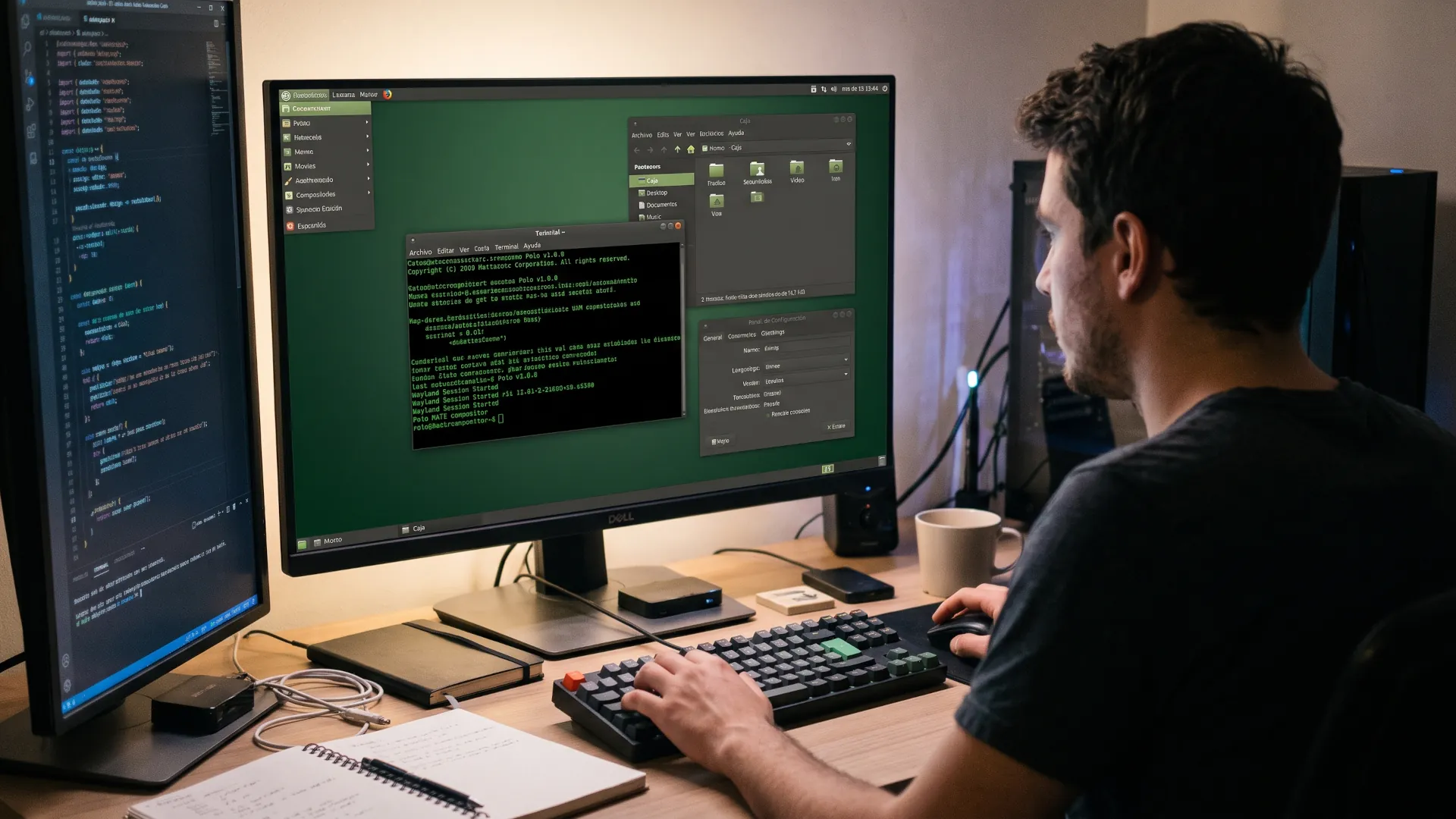
A look at the Ubuntu 26.10 beta, getting ready for the final release this October 15
The GNOME 51 desktop provides the visible face of the release. The new version polishes animations and reorganizes settings with the project's usual care, as well as refining support for touchscreens and fractional scaling. Ubuntu applies its own customization layer on top, with the side dock and the Yaru theme that its users recognize instantly.
The Mesa 26.2 graphics stack completes the trio of big novelties. Mesa translates the 3D commands of games and applications into instructions that AMD and Intel open source cards understand. Having it up to date means more frames and fewer artifacts in recent titles, something especially noticeable to those who game on Linux.
Rust even in the basic utilities
The deepest change in this beta lives under the floor. The coreutils, the toolset that includes copying and moving along with listing and counting, now use by default the uutils implementation written in Rust. The system no longer depends on the classic C tools for its most basic tasks.
Rust brings its famous memory guarantee to components that run millions of times a day on every server. An error in cp or in ls can corrupt copies or hang entire scripts, so hardening those utilities reduces a whole family of failures.
The coreutils switch to Rust by default in this version, with no half-measures between old and new. That decisiveness avoids duplicating maintenance and makes clear that Canonical is serious about the change.
The move is part of a broader oxidation of the distribution. With this, Canonical deepens the adoption of Rust in Ubuntu's base system, alongside new features such as voice transcription with local models. Ubuntu has spent several cycles replacing critical components with equivalents in that language.
The reasonable doubt about compatibility remains. Canonical assures that the Rust utilities replicate the behavior expected by decades of scripts, and the beta exists precisely to discover the corners where something differs. Anyone maintaining delicate automations would do well to test them now, when there is still time to report and fix.
What changes compared with the 26.04.1 LTS
The comparison with Ubuntu 26.04.1 LTS clarifies who each edition is aimed at. The LTS offers five years of support and minimal changes, designed for businesses and for those who don't want surprises. The 26.10 offers nine months of life and everything new, designed for enthusiasts and developers. Choosing wrong here means reinstalling early or getting bored.
The following table summarizes the key differences between both versions so you can decide at a glance which one to install according to your profile and your tolerance for change before downloading any image.
Aspect
Ubuntu 26.04.1 LTS
Ubuntu 26.10 beta
Release
August 2026
Beta October 13, 2026
Kernel
Previous stable 7 series
Linux 7.3
Desktop
GNOME 50
GNOME 51
Base utilities
Classic mixed
Rust uutils at 100%
Graphics
Previous Mesa
Mesa 26.2
Support
Years, ideal for stability
9 months, ideal for the curious
The LTS already has its own article on this site, with the details of its 7-series kernel and its GNOME 50. Those looking for a machine that simply works for years will find their answer there, while those reading these lines eager to try the latest already know where to look.
Trying it without breaking your system
A beta is tested with a safety net, never on the system that puts food on the table. The safest way is to write the image to a USB drive and boot in live mode, which lets you stroll through GNOME 51 without touching the disk. All changes are lost on shutdown, and that is precisely its virtue for a first contact.
The second method is the virtual machine. VirtualBox and GNOME Boxes run the beta inside a window of the current system, with the only drawback of somewhat lower graphics performance. To check the 7.3 kernel and the Rust utilities it is more than enough, although games won't perform as they would on bare metal.
The boldest can dedicate a separate partition with dual boot. The Ubuntu installer detects other systems and proposes the free space, but it is wise to have a backup of important data before accepting. A power cut halfway through the installation spares no one, neither in beta nor in final.
Write the image to USB and try live mode without touching your disk or your files.
Set up a virtual machine to review the kernel and utilities in complete safety.
Reserve a partition with a prior backup if you want dual boot and real performance.
Report every bug on Launchpad with the exact steps to reproduce it.
What's left until the final on October 15
The beta freezes features and opens the bug hunt. Canonical published the image so the community can report regressions in installers and drivers before the definitive release. Every report with reproducible steps saves developers hours of work in the decisive week.
The calendar favors the RISC-V curious. The final version will bring the official desktop images for that architecture on October 15, as announced by the Foundations team on the Ubuntu forum. Testing the beta on a compatible board helps that debut arrive in better shape.
The official flavors follow their own pace alongside the main edition. Kubuntu and Xubuntu publish their betas with the same foundations and their usual desktops, so those who prefer KDE or Xfce also have an image to download. All share the kernel and base, and only the user experience changes.
Report bugs that are actually useful
A beta only improves if bugs arrive described with precision. A useful report includes the exact version of the image, the steps to reproduce the error and the expected behavior versus the one obtained. With those three data points a developer reproduces the problem in minutes.
Ubuntu centralizes those reports on Launchpad, its veteran tracking platform. Before opening a new one it is worth searching for duplicates, because ten identical reports consume the time that should go into fixing. A good title saves more work than a long paragraph.
System logs provide the proof that is missing when words are not enough. Attaching the relevant output and the exact model of the affected machine makes it possible to distinguish a general bug from a hardware quirk. The fewer back-and-forth messages the report needs, the sooner the patch arrives.
The window to influence is short and closes with the final. Every bug confirmed this week can make it into the image published on October 15, while those that arrive late will wait for updates. Testing today and writing it up well is the most direct way to improve the Ubuntu you will use tomorrow.
Anyone who has never reported a bug will discover that the process teaches as much as the result. Reading logs and isolating causes trains a judgment that serves for any distribution. The beta is the perfect excuse to learn that discipline with a safety net.
An intermediate stop that sets the course
Ubuntu 26.10 does not intend to stay installed for years and yet it matters. Intermediate versions are the laboratory where the new kernel and the Rust utilities mature before entering the next LTS. What is tested today in Stonking Stingray will arrive polished to millions of desktops and servers within a few cycles.
The practical recommendation is simple to apply. Stay on 26.04.1 if your machine supports serious work, and dedicate a USB or a virtual machine to the beta if curiosity gets the better of you. The final ships tomorrow and then will come the moment to decide with your own data. Testing today is voting for tomorrow's Ubuntu.