The global economic outlook stands at a crossroads that many analysts have described as the most significant risk event of the decade. The unbridled euphoria that characterized 2023 and 2024, driven by the promise of an industrial revolution led by artificial intelligence, has begun to collide with the brutal realities of physical infrastructure, energy limits and, fundamentally, the impatience of capital markets.
What was perceived as a healthy correction in early 2025, driven by the emergence of the Chinese model DeepSeek, has evolved in 2026 into a crisis of confidence that threatens to destabilize not only the technology sector, but the very foundations of global financial stability.
What the markets are experiencing is not simply a fluctuation, but a structural failure in the investment thesis that held that growth in capital expenditure (Capex) would automatically translate into a proportional increase in productivity and corporate revenue. Now, basically, the industry faces the "$600 billion question": where has this massive gap gone between what tech companies are spending on AI infrastructure and what they are actually getting as direct return from end users?
Because this disconnect has created a "revenue hole" that, according to the most rigorous mathematical models, has gone from being a marginal concern to an existential threat to the valuations of the world's largest companies. And seeing what happened in 2001, many are already asking whether we are facing the bursting of the AI bubble.
The mirage of infinite growth
Let us take for a minute the scale of investment in AI infrastructure in 2026, which has reached levels that surpass any previous technology cycle, including the construction of the railway in the 19th century and the telecommunications boom of the late 1990s.
Projections indicate that the main hyperscalers, such as Alphabet, Amazon, Meta, Microsoft, Oracle and Nvidia, will account for almost 25% of total Capex in the U.S. market in 2026. This massive spending has tripled in just three years, from $150 billion in 2023 to a figure estimated to exceed $602 billion in 2026, with 36% year-on-year growth according to consensus from firms such as Goldman Sachs and CreditSights. Some more aggressive forecasts, such as those of Goldman Sachs, suggest it could reach $700 billion to align with historical peaks in technology investment.
A limited expansion
However, the growth in spending has not been accompanied by an equivalent expansion in the net profit margins of AI applications. Most of these investments are being allocated to the physical construction of data centers and the acquisition of high-performance graphics processing units (GPUs). This pattern suggests a phase of "massive over-provisioning" similar to the excessive deployment of fiber optics in the late 1990s, where only a minimal fraction of installed capacity was used in the years immediately following the collapse. The systemic risk is compounded by the fact that this spending is increasingly being financed through external debt rather than internal operating cash flows, with hyperscalers issuing up to $140 billion in bonds annually according to Bank of America.
An example of this behavior is already clearly visible in the markets. Oracle, a technology giant that has led this strategy alongside OpenAI, is now going through a downgrade in its credit rating outlook, as its metrics remain stretched to support the current level of investment. In fact, its shares have fallen more than 37% from their recent peaks, closing at around $167 as of January 30, 2026, despite the immense investments. Morgan Stanley has issued warnings and said that if this continues, its margin for error is minimal, although analysts maintain buy recommendations with average targets of $300, citing a backlog that suggests real demand in cloud revenues (34% year-on-year growth).
The obsession of the U.S. administration
Of course, this situation is not new; it has been dragging on for some years now. Back in 2022, indices such as the Nasdaq 100 showed a sharp drop in value, compared with companies reporting unmatched profits. It seems illogical, but this first crash was closely related to the enormous boost that the U.S. government's COVID-19 aid gave to its citizens, the enormous inflation this generated and then the FED doing damage control by raising interest rates.
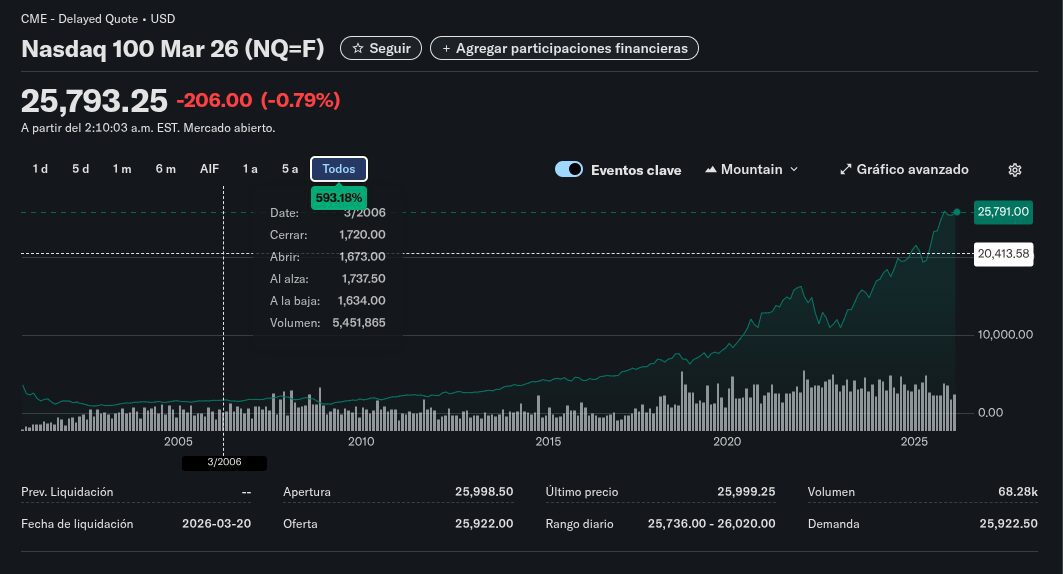
But this took it from a self-financed model to one dependent on debt markets, which introduced a critical vulnerability. If interest rates remain high, due to persistent inflation, the cost of servicing the debt could suffocate companies before their projects reach profitability.
Basically, the money injection the companies received was toxic; they have tried to absorb it by reinvesting or looping (investing in each other), but most have been unable to reach a break-even point. Hence the first crash we see in the chart above, in 2021.
Facing an explosive cocktail
However, the explosive cocktail is still active. In fact, it has become more dangerous. Global inflation continues, companies report million-dollar profits and investments, but beneath it all, confidence is shattering. In fact, Moody's Ratings already warns that if the Big Tech and AI bubble bursts, $500 billion would disappear from the market in the blink of an eye. The rest will be done by market chaos and the FED's reaction.
This is where the current U.S. administration of Donald Trump's obsession with forcing interest rates down comes into play and becomes clearer. Because in that scenario they could open an escape valve for this event. Since lowering rates would reduce pressure on indebted companies and keep liquidity in the technology sector. However, the risk is that if rates are lowered before inflation is under control, it could generate a worse inflationary spiral.
At its January 28, 2026 meeting, the Federal Reserve kept interest rates in the 3.5% to 3.75% range, with a 10-2 vote, in which two members favored a 0.25-point cut. The institution's chair, Jerome Powell, described the economy as solid and noted that there was no urgency to cut rates, despite the public pressure exerted by Donald Trump on the central bank. Market projections point to one or two additional cuts in 2026, possibly starting in June, with inflation moving around 2.9%–3%. Trump has already nominated Kevin Warsh as the next Fed chair to replace Powell.
And here the big question is: save the companies and preserve jobs by generating inflation, or simply let the whole house of cards fall, control inflation and let unemployment soar significantly?
But if you think this crisis of confidence in artificial intelligence has been limited to Silicon Valley's servers, it is worth clarifying that this is not the case. In the crypto market, the first signs of a reality that many refused to accept are already beginning to be seen. Bitcoin and the crypto ecosystem continue to behave as a beta asset, with high sensitivity to technology cycles, rather than as the uncorrelated safe haven that was projected for years.
AMID THE MARKET SLUMP, THE U.S. PRESENTS A BILL TO ACCUMULATE BITCOIN
The fall of Bitcoin
The relationship between the Nasdaq's decline and bitcoin's plunge, which has retreated from its highs of $125,000 to around $83,000 as of January 30, 2026, is explained by three critical factors:
- Tech-Crypto correlation: The large institutional funds that entered Bitcoin ETFs en masse in 2024 and 2025 manage their portfolios under "risk-on/risk-off" models. When AI Capex begins to be seen as cash burn with no return (the famous "revenue hole"), these funds first liquidate their most volatile assets to cover margins on their corporate debt positions.
- The threat of open-source AI: The success of efficient models such as DeepSeek in early 2025 demonstrated that $600 billion is not needed to achieve cutting-edge results. This deflated the tokens of "AI-Crypto" projects (such as Near Protocol or ICP), which suffered drops of between 15% and 20% in days, dragging the rest of the market down by sympathy.
- The liquidity dilemma: If the Trump administration manages to force the FED to cut rates, cryptocurrencies could experience a violent rebound due to excess liquidity. However, in the short term, fear of a "triple bubble" (AI, debt and crypto) has caused a massive rotation of capital toward physical gold and silver, leaving bitcoin in a dangerous technical support zone near $75,000, its current production cost.
Crossfire
Basically, the crypto market is caught in the same crossfire as Big Tech. On the one hand, it desperately needs money to be cheap again to sustain its valuations, but it fears that this same liquidity will be the fuel for an inflation that ends up destroying global purchasing power.
Although it is worth noting that cryptocurrencies, especially those with real utility and substance, can withstand this event. Cryptocurrencies such as bitcoin or ethereum are not going to disappear, but they will suffer harshly the consequences of all these events. Hence miners are rapidly diversifying their options, or giants like Tether are not only buying bitcoin like never before, but are buying gold at an accelerated pace.
The giants of the ecosystem sense that a financial earthquake is coming, the clock keeps ticking and all that remains is to wait for it to happen.
Counterpoints
To balance the perspective, not all indicators point to an immediate collapse of the technology and artificial intelligence sector. Some analysis firms maintain relevant growth forecasts. For example, Forrester estimates that global technology spending could increase 7.8% in 2026, to around $5.6 trillion, with AI as the main driver.
Along the same lines, S&P Global believes that the technology investment cycle could still remain solid until the end of 2026, although it does not rule out a subsequent slowdown. Other analysts place the possible adjustment further out, even in 2027, and point to risks such as the so-called "data walls" in the most advanced AI models. That is, limits on the quality and quantity of useful data, but they also point out that business returns could improve if corporate adoption accelerates.
Prediction markets likewise reflect that division of opinion. On Polymarket, the probability assigned to a tech bubble bursting in 2026 is at relatively low levels, around 19%. Major asset managers such as BlackRock also maintain that the sector's current fundamentals are sounder and more diversified than those of the dot-com bubble of the early 2000s.