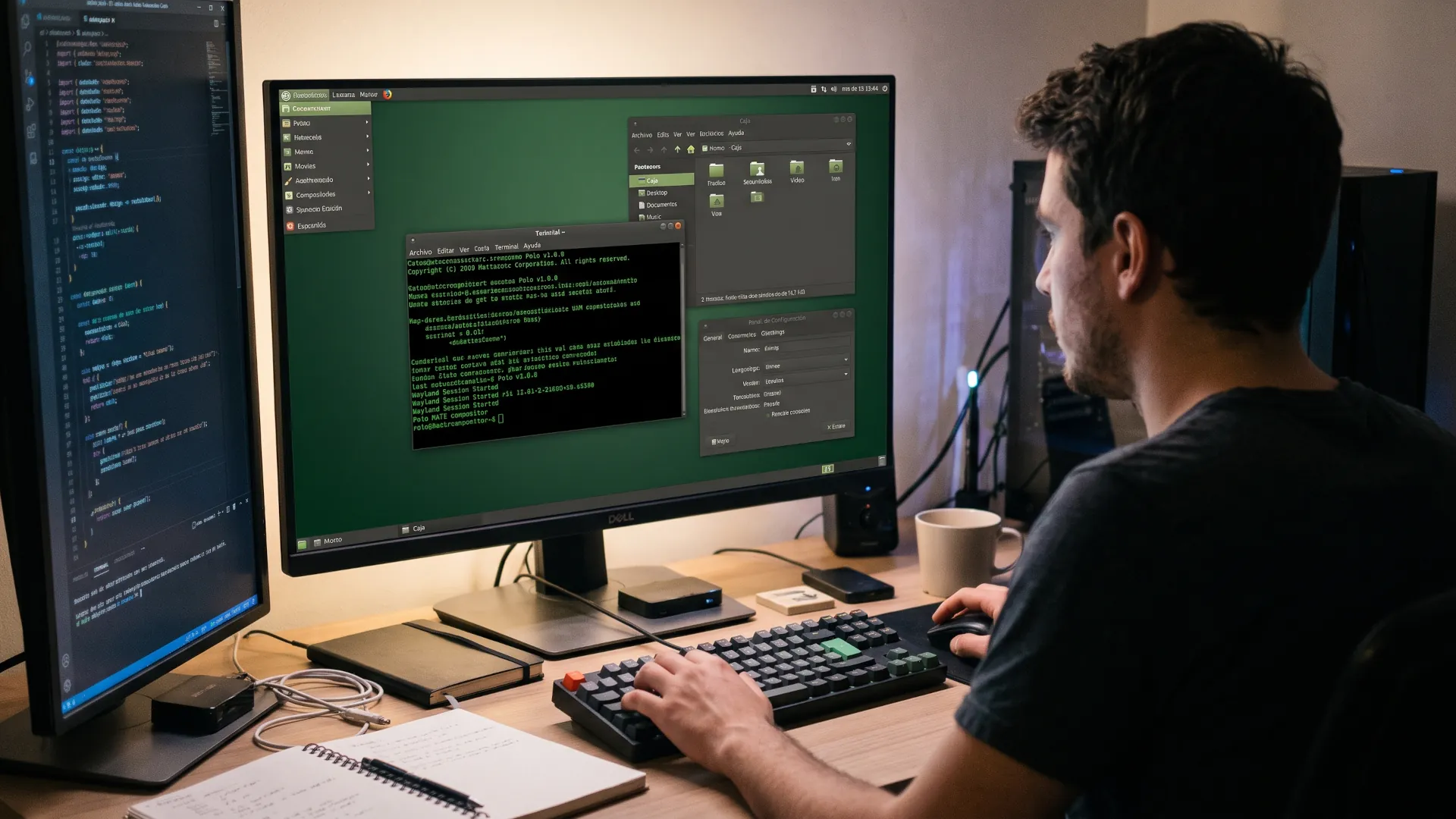
A solo programmer built a C compiler with the help of artificial intelligence and got it to boot Linux. The story takes us to early October 2026, when the KCC project appeared on Hacker News with a headline that seemed exaggerated and sparked debate for days, according to the original thread. The stated cost of the experiment was $100 a month in calls to a model, with no autonomous agents and no team behind it.
A compiler is the program that translates the code people write into instructions the processor understands. The C language remains the foundation of the Linux kernel, so compiling the kernel with a new compiler is like asking a student to translate an entire novel without losing the meaning. If the translation has errors, the system won't boot or will behave strangely the first time it is pushed hard.
KCC already compiles its own code, passes a good part of the standard tests and boots a real kernel, as summarized by Vikrant Sharma's blog on October 2. A week after the announcement, it is worth explaining what its author built, where the limits are and why this case says more about programming with AI than many abstract debates.
What exactly is KCC and who made it?
KCC is a compiler for C17, the modern version of the language, developed solo with a language model as copilot. The author worked through the classic phases: first the preprocessor that expands macros, then the parser that understands the grammar and finally the generator that emits 64-bit x86 code. The repository, published as kcc on GitHub, documents that progress step by step in the changelog.
The approach is described as literate programming, a technique where code and explanation live in the same document so another person can follow the reasoning. It is written in ARM64 assembly, an austere decision that forces you to understand every low-level detail. That combination of a modern tool for generating drafts and classic discipline for reviewing them is what defines the project.
The economic figure is what got the most attention in the comments. One hundred dollars a month in API costs puts the experiment within reach of a hobbyist with a card and curiosity, far from lab budgets. It does not include the author's hours, which were many, but it lowers the barrier to entry into a field that used to demand months of manuals.
How do you prove a compiler works?
Saying it compiles is not enough, because even toy compilers translate simple examples. The serious test combines three levels that KCC already partly passes. First it self-compiles, meaning it compiles its own source code and the result compiles it again, which rules out gross translation errors.
Then come the conformance tests, which measure what percentage of the standard it respects. The reports speak of around 80 percent passing on the usual suites, a modest figure for production but notable for an individual project. It means most everyday constructs work, even if dark corners remain to be polished.
The third test is compiling real, demanding programs. KCC has already processed SQLite, the embedded database that lives in millions of phones, and the classic DOOM, as well as the Linux kernel itself. Each one stresses a different area, from delicate optimizations to inline assembly that few novice compilers can digest.
| Test |
What it demands of the compiler |
Status in KCC |
| Self-compilation |
Translating itself without breaking |
Achieved |
| C17 conformance |
Respecting the standard in rare cases |
Around 80 percent |
| SQLite and DOOM |
Real code with tricks and macros |
They compile and run |
| Linux boot |
Assembly and struct rules |
Kernel that boots |
Related article: Ubuntu brings Rust to the heart of Linux with its coreutils
Why is booting Linux the crown jewel of the test?
Compiling the kernel is a cruel exam because the kernel is not normal C. It mixes complex macros that generate code, GCC-specific attributes, inline assembly to talk to the hardware and strict rules about how structures are aligned in memory. A toy compiler usually founders on the first of those four, so reaching boot demonstrates surprisingly broad coverage.
Booting does not mean KCC can replace GCC or Clang tomorrow in serious distributions. It means it handles the cursed parts of the language, the things that break almost every weekend project. For people who program systems, that difference between hello world and a kernel that boots is what separates the prototype from the instrument.
It is worth remembering when this happened, because context helps calibrate. The thread was published on October 1, 2026 and the summaries arrived on the 2nd, with the code already available to inspect. We are not talking about a lab promise for two years from now, but about a repository anyone can download and try today.
What role did the language model play?
The author used the model as a pair programmer, not as an autonomous factory. He asked it for code fragments, clarifications on corners of the C standard and help hunting segmentation faults, those errors where the program touches memory it shouldn't. The human decided the architecture, reviewed each phase and rewrote whatever came back subtly wrong.
That nuance annoys both sides of the debate, which is usually a good sign. Those who fear AI will replace programmers see a counterexample here, because without judgment about compilers the project does not advance. Those who believe AI is useless for serious software see another, because the pace of iteration multiplies when someone tirelessly proposes drafts.
What the repository does not publish is just as interesting. The prompt logs are missing, as is how many times the model invented a register name or proposed an incorrect x86 encoding. That messiness of the process would help others repeat the path without tripping over the same stones. Hopefully future experiments will document their dead ends too.
An experiment that still falls short
Partial conformance implies that one in five demanding cases may fail in subtle ways. In C, a subtle error does not always break the build; sometimes it produces a binary that fails months later in production. That is why the 80 percent figure should be read as a starting point and not as a seal of quality.
Nor do we know its behavior under aggressive optimizations, where modern compilers gain speed by reordering operations. Nor the quality of the error messages, which is what helps a beginner most. Nor support for architectures other than 64-bit x86, which is where phones and efficient servers live.
Healthy skepticism applies to the economic figure too. One hundred dollars in API costs does not measure the author's hours or prior experience, and repeating the project without a systems background would cost much more time. The headline sells cheapness, but the merit remains human and considerable.
Related article: NixOS, Silverblue and MicroOS, immutable Linux explained
A homegrown compiler that invites you to build
KCC is not going to dethrone GCC this decade, and its author does not intend it to. Its value lies in showing that a single curious person, with a modest monthly budget and a model as an assistant, can raise real infrastructure all the way to booting Linux. That image, a kernel booting from a compiler born at home, sums up well the moment programming is living through in October 2026.
If you feel like following the case, clone the repository, compile it and try its examples before trusting headlines. Run the included test suite first and note which cases fail on your machine, because that list is your learning map.
When, a few years from now, someone asks when programming with AI stopped being a trick, projects like this will appear in the answer. Not for replacing anyone, but for giving a person back the ability to build large tools.