Bazzite, the great Linux distro for those who love gaming
The landscape of entertainment-oriented operating systems has undergone a profound transformation with the consolidation of Bazzite, a Fedora-based distribution with an atomic and immutable design. Designed to offer an experience similar to Valve's SteamOS 3, but while maintaining the versatility of a general-purpose computer, this system has positioned itself as the de facto standard for running video games on latest-generation hardware and handheld devices.
A distro unique in its conception
The name of Bazzite pays tribute to the mineral of the same name, bazzite, a cyclosilicate mineral of beryllium and scandium, quite rare in nature. The name, beyond being a scientific curiosity, follows a convention inherited from Fedora's atomic desktops based on mineralogy.
In any case, Bazzite was born as a limited initiative by developers Kyle Gospodnetich and RJ Trujillo, who were looking for a customized Fedora image optimized for gaming and compatible with the Steam Deck console without disabling its read-only file system.
In its initial phase, Bazzite ran Steam in isolation inside containers managed by Distrobox, in order to guarantee secure and trouble-free execution of the software. With that idea in mind, formal development of Bazzite began on December 12, 2022, with the first commit in Gospodnetich's repository.
But the project's maturation accelerated after its integration into the Universal Blue infrastructure on February 9, 2023, benefiting from cloud-based continuous integration and deployment methodologies and from the collaboration of figures from Red Hat, Fedora and Canonical.
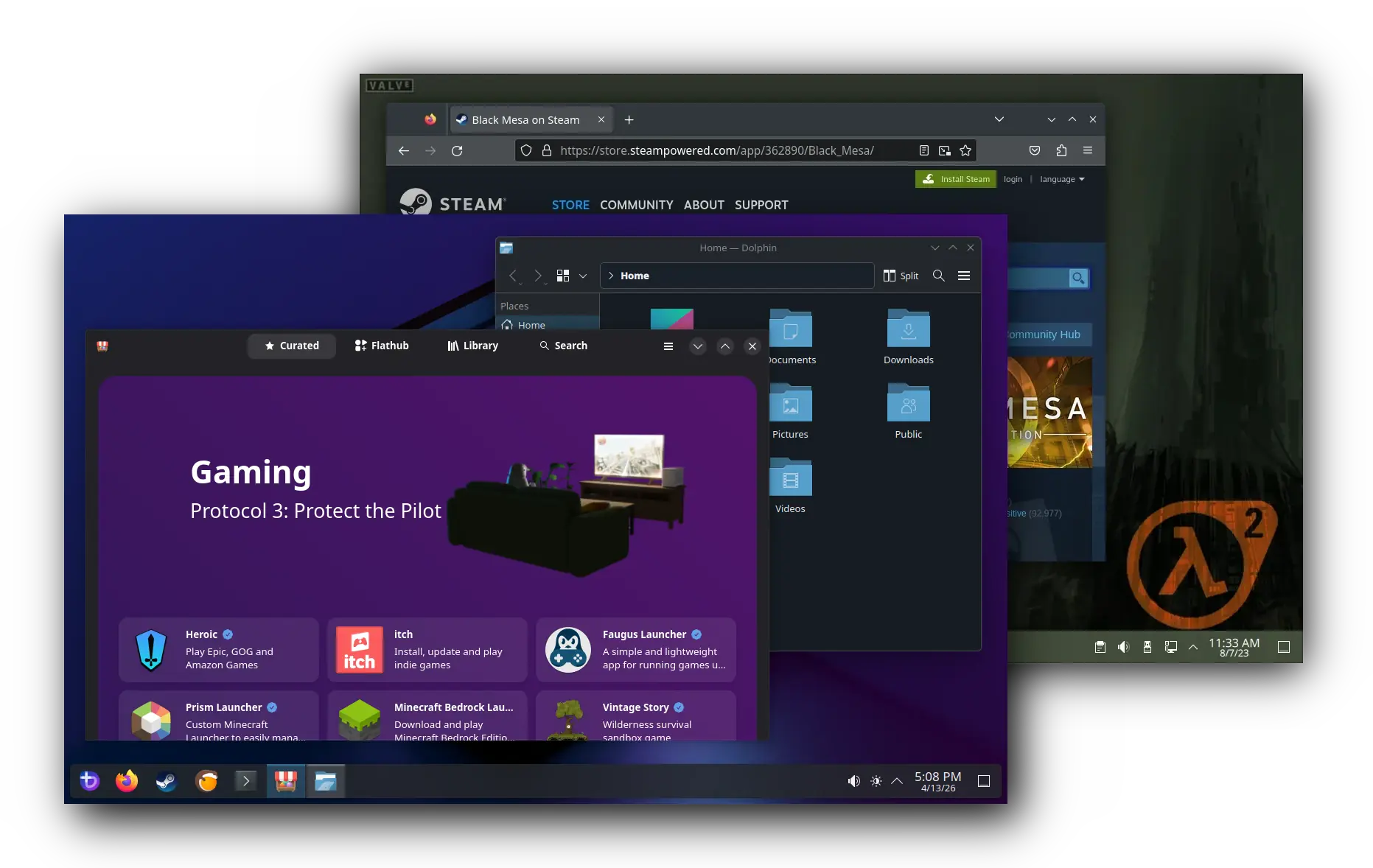
Bazzite with the KDE desktop, the most widely used version of the distro
Designed for high performance
Bazzite's technical core rests on the immutability provided by Fedora's rpm-ostree system, where the root file system is mounted in read-only mode to protect essential libraries. Updates are applied atomically in the background, and each image is digitally signed with Cosign to guarantee its cryptographic integrity.
This ensures that Bazzite is a distro that always works, setting aside those situations where some change could leave the system unusable. It also avoids situations where the user, out of ignorance, could delete important system files and leave it unusable, not to mention that this provides a level of security that few distributions have by default.
Custom optimized
But beyond all this, Bazzite also incorporates low-level optimizations specifically aimed at mitigating latency and maximizing graphics performance. This is designed to give you the best gaming experience, but it also serves for local AI use, for design and audiovisual production, processes that can benefit from these optimizations, among which the following stand out:
CPU scheduler (BORE): Dynamically adjusts priorities based on interactivity bursts for desktop environments, minimizing input latency. This is perfect for handling high-volume data.
CPU scheduler (LAVD): A scheduler developed by Igalia. It comes configured by default on the Steam Deck and drastically reduces frame-time stuttering. Basically, it focuses on giving you the best possible graphics experience.
Kyber I/O scheduler: A read and write prioritization algorithm for the disk that prevents game performance degradation while downloads run in the background.
ZRAM (4GB LZ4): Performs real-time memory compression, virtually doubling memory swap efficiency under heavy texture loads.
RyzenAdj service: Thermal control and power limit daemons that enable safe profiles for AMD hardware on laptops and handheld consoles. Perfect for getting the most out of your computer without making it overheat excessively.
The ecosystem is complemented by modular software management through Flatpak for user applications, and includes Distrobox integrated environments by default for advanced workflows, allowing native Debian or standard Fedora binaries to run transparently without contaminating the main system.
The excellent experience offered by Bazzite has led to a massive migration of users from Microsoft Windows. Above all, because of the current discontent with Windows, which stems from the end of Windows 10 support, invasive telemetry, interfaces saturated with ads, instability and performance loss.
Bazzite capitalizes on this by offering an out-of-the-box experience with images optimized for specific hardware (variants for NVIDIA cards for gaming and AI, for ASUS laptop or Steam Deck users) that include proprietary drivers and full support for the Mesa 3D stack from the first boot. This makes the whole process of installing and enjoying the equipment easier: you just install and you're ready to enjoy it.
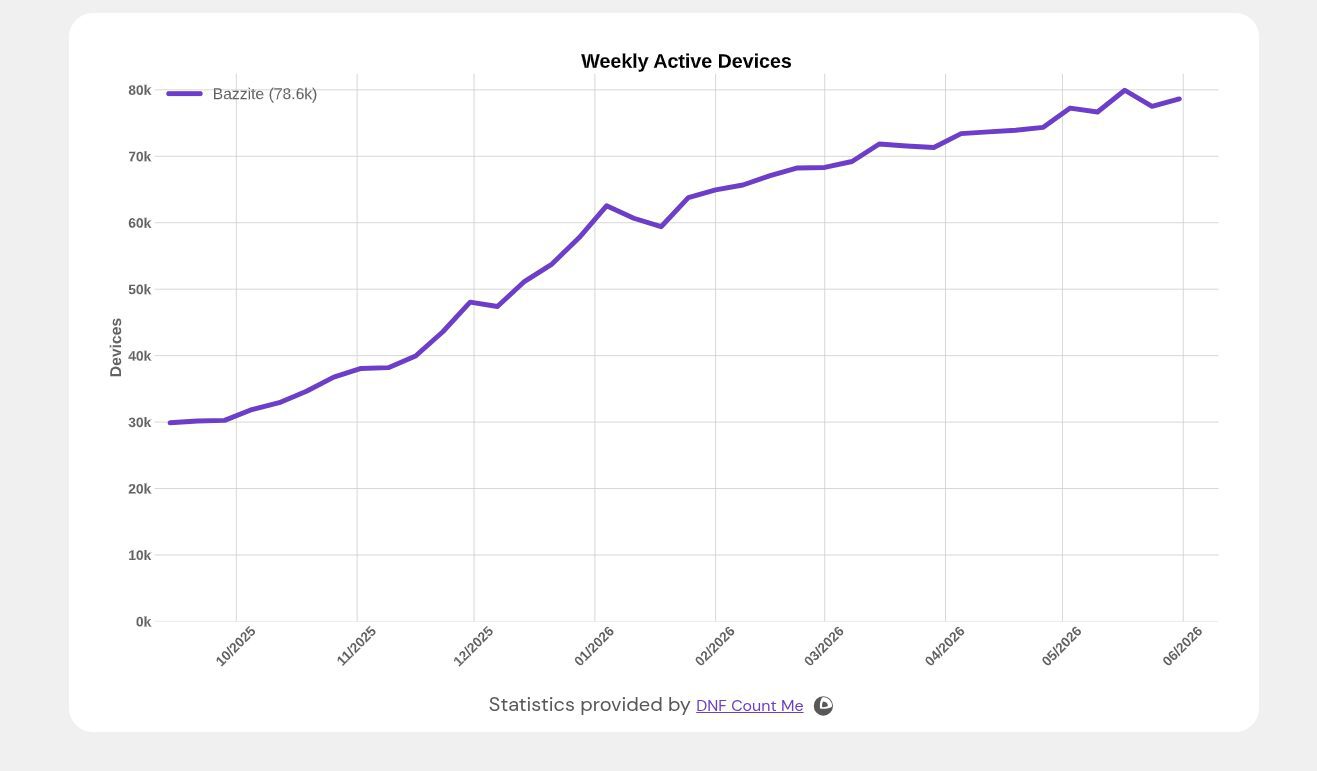
But how many users are we talking about? Well, at the time of writing these lines, Bazzite already has more than 80 thousand weekly active users, at least those who have publicly agreed to be counted. And the network statistics (counting downloads, updates and so on) show consumption of about 2 PB of data per month, which puts the number of users above 200 thousand and rising.
Bazzite weekly active users
Taking its rightful place
And it's no wonder, Bazzite has been a great success in offering a very demanding sector, such as gamers, a Linux distro that lets you enjoy your library without having to complicate things much in order to play. But at the same time, it has not forgotten those who work and need to get the most out of their PC's resources, and in that, they have been totally successful.
While there are still things to improve (such as kernel-level anti-cheat support, something video game companies must work on), Bazzite is one more example of how the PC sector is transforming, moving from Windows to Linux, as more and more people realize that the transition is easier than it seems.