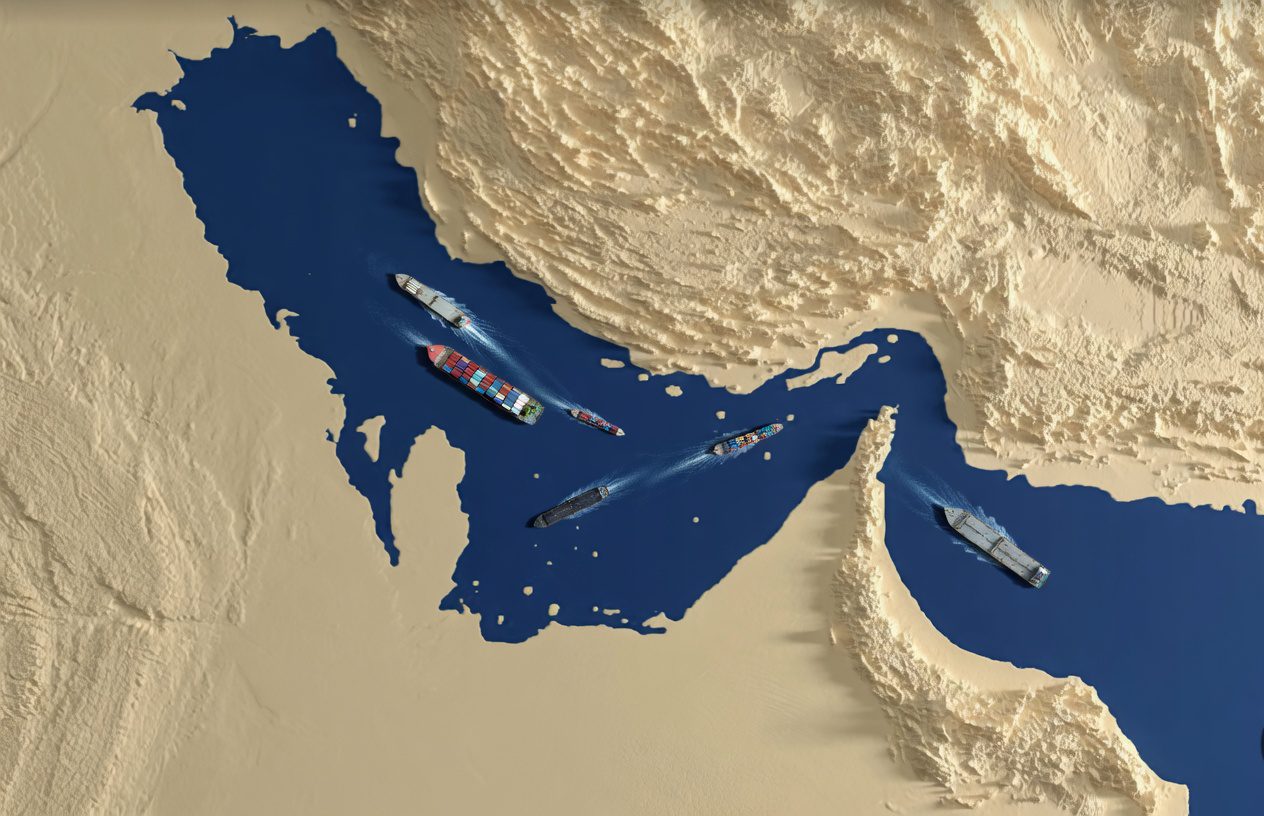
At the time of writing this post, negotiations between the United States and Iran to reach a peace agreement have been suspended, with passage through the Strait of Hormuz cited as one of the main obstacles to be resolved. This is one of the most sensitive strategic points in world trade, through which close to 20% of global oil passes, making any disruption to its transit an issue with immediate impact on the world economy.
In fact, every slightest indication about the progress of those negotiations between the two countries has a significant ripple effect on commodity prices and global stock market quotations. In this context, various reports point to a phenomenon as controversial as it is unusual: the charging of "tolls" on large vessels by Iranian authorities, in some cases via cryptocurrencies. A payment riddled with paradoxes, since, while illegal, it keeps world trade moving.
Million-dollar figures
Sources in the maritime sector describe a procedure far removed from any international regulation. As they approach the controlled zone, tankers receive instructions by radio: mandatory routes, security protocols and, in certain cases, payment demands to authorize transit.
Blockchain in wartime: cyberattacks on the Iran-Yemen axis
These fees can reach million-dollar figures —around 1.5 or 2 million dollars per vessel— and are presented as a condition for guaranteeing safe passage in an environment marked by a military presence, the risk of mines and constant surveillance. What is most striking is not only the charge itself, but the method: the use of cryptocurrencies as a payment channel. In particular, stablecoins (Tether) are cited, for their greater stability due to their peg to the US dollar, along with Bitcoin as such instruments.
The choice of digital assets is no coincidence. Iran, subject to international sanctions for years, has limited access to the global financial system. Transfers in dollars or euros can be blocked or easily traced through banks and networks such as SWIFT.
Cryptocurrencies, by contrast, allow transactions without banking intermediaries, faster and outside the direct control of Western governments. In practice, this translates into payments that can be completed in minutes, compared with the hours or days a traditional transfer might require — if it is executed at all.
Moreover, the use of digital currencies pegged to the dollar, known as stablecoins, reduces volatility risk, something crucial when handling million-dollar figures.
In this way, cryptocurrencies, which US President Donald Trump defended during his election campaign, appear to be turning against him and his war strategies. Even though it must be acknowledged that at the height of that election euphoria the geopolitical value of cryptocurrencies was already being argued, along with the necessary goal of controlling them in line with the country's interests. It seems we have moved from the election war over cryptocurrencies to the cryptocurrencies of war.
Bitcoin or Tether
According to various maritime operators, the cryptocurrency payment sequence follows a set protocol. To illustrate, let us take the example of a large tanker carrying about two million barrels of crude approaching the passage zone controlled by Iran. That is, a cargo whose value, now more volatile than ever, stands at around 170 million US dollars.
From that moment on, it receives instructions by radio or official maritime channels. The authorities indicate a mandatory route, passage conditions and a possible "fee" to be paid. The quotation marks are because it is illegal, which has led to this practice being denounced as an act of piracy. Such strategic passages are protected by rules guaranteeing freedom of navigation.
The vessel is told the amount to pay, which can range between one and two million US dollars. This instruction is accompanied by that of the asset in which the transaction must be made: Bitcoin or Tether, receiving a digital address (wallet). The captain consults with the shipping company, which ultimately decides whether to accept the conditions, in coordination with insurers and legal teams.
Payments in under five minutes
If the shipping company agrees, it makes the transfer from its own cryptocurrency funds or by acquiring them on specialized markets. The transaction is sent and verified within minutes. Once confirmed, passage is authorized and, in some cases, an escort or safe corridor is assigned. A payment of 1.5 million dollars can be completed in under five minutes with relatively low fees, especially if fast networks are used.
Refusing to make the payment does not appear to be a viable option, which is why this is described as piracy. The consequences can range from prolonged delays to the detention of the vessel. A stalled tanker can generate losses of between 50,000 and 200,000 dollars a day, not counting contractual penalties or the impact on the supply chain. In more serious scenarios, the authorities can intercept the vessel, force it to divert or even detain it. All of this amid a serious conflict, where diplomats would give priority to other developments.
Convergence of technology, economics and military power
A key factor must be added to this: insurers may refuse to cover incidents if they consider that the captain has ignored instructions in a risk zone. Beyond the specific case inscribed in the current conflict between the United States and Iran, the use of cryptocurrencies in this type of situation reflects a broader shift in global dynamics. Digital assets are consolidating not only as financial tools, but also as instruments in geopolitical disputes.
In the Strait of Hormuz, the convergence of technology, economics and military power paints a scenario where traditional rules blur, and where paying in cryptocurrencies may paradoxically be the fastest — and least costly in terms of fees — option for keeping world trade moving. Yet in paying, one is also financing the continuation of the war itself, by transferring resources to one of the belligerents.
No pay, no passage
If vessels do not pay, they do not pass. If they do not pass, vessels and the world economy are blocked. Or if they pay, the likelihood that the war persists increases, by strengthening one of the belligerents, and therefore the destruction of lives and property continues, along with the great expanding noise over the world economy. But the room for shipping companies not to pay is very slim. As narrow as the geographic feature itself. Let us trust that the negotiation reaches a safe harbor.