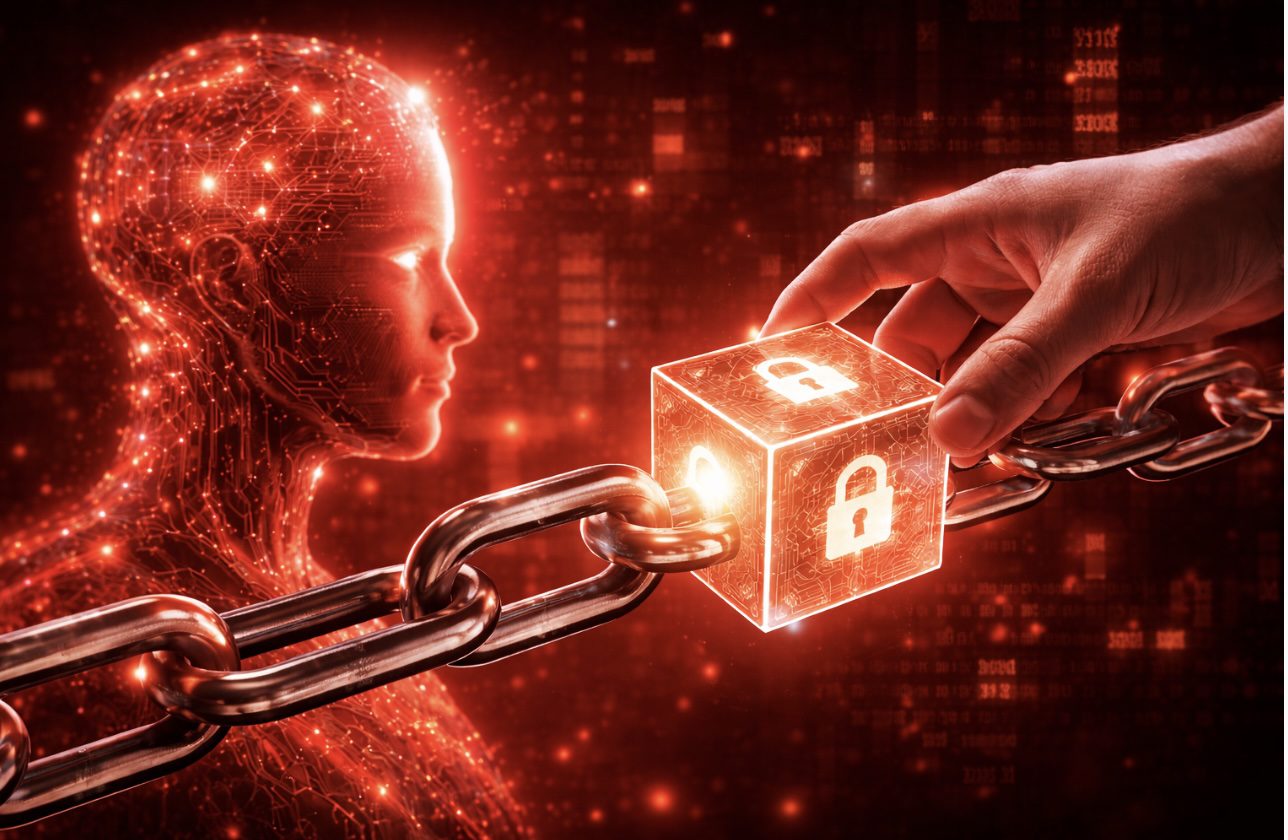
We trust that artificial intelligence will take the world to a new stage. At the same time, there is distrust of artificial intelligence. It is distrusted as an entity that slips out of our control or that has its own interests, opposed to ours, and that ends up imposing them. Because, to do so, it is intelligent.
There is distrust of its everyday use. Shot through with errors. It is distrusted as one can only distrust that new professional who arrives at your home stumbling in to fix goodness knows what. But, let's admit it, intelligence has almost always been distrusted, whether natural or artificial. Let's also admit that the closest thing to artificial trust is Blockchain. We can only trust an artificial intelligence that has the artificial trust of Blockchain.
With the extensive infiltration of artificial intelligence into daily life, our way of relating to technology has changed. Not so long ago, an apparatus's error was mainly that it did not work. If it had any error, it did not work. However, artificial intelligence works by making mistakes. We assume that its way of working is by making mistakes.
Although it may seem paradoxical, we have naturalized artificial intelligence. We demand that every technical and therefore artificial element or instrument come equipped with its "natural intelligence." An intelligence that, once naturalized, makes mistakes. As AI itself makes mistakes. An artificial intelligence with which frauds are committed. In fact, the design of frauds has become one of the main purposes of artificial intelligence. We have reasons to distrust artificial intelligence.
2025, the year blockchain, AI and data merged into a single economy
In its relationship with humans, artificial intelligence has its limits in the trust they can grant it. An artificial intelligence is demanded that would control the potential deviations of artificial intelligence. But that artificial intelligence would also be an object of distrust. Everything is expected of artificial intelligence. We are no longer amazed by what until recently could seem magical to us. Everything is expected, except that it inspire trust in us.
The technology user does a little as the consumer has been doing for many years with respect to advertising: trusting relatively, as much as one can trust an interested message whose goal is to convince us. An attitude that not only does not prevent consumption, including the consumption of advertising, but makes consumption work and markets improve. Distrust of artificial intelligence does not make us stop using it.
Blockchain is born of distrust. It is artificial trust against the natural distrust of what, for example, economic authorities will do with respect to the money supply in circulation. It is artificial trust that ensures that previously made agreements are executed automatically.
Can there really be artificial trust? Really, no. Trust lies in society and, therefore, in human beings. Trust lies in whoever has it or needs it. Now, one thing is to place it in other human beings or even institutions — natural trust to varying degrees — and another is to place it in mechanisms or processes or, ultimately, in machines and algorithms. Trust has to do with ego projections onto alter's decisions.
What changes is the form that this alter takes in artificial trust. And that alter, with Blockchain, is someone whose decision we know if such and such an event occurs, if the conditions agreed and recorded on the blockchain are met. It may not be something we can properly call artificial trust; but it is an instrument that facilitates our natural trust. Perhaps the counterweight we need against distrust of artificial intelligence.
In postmodern times, it is not a matter of believing or not believing, not even of faith… but of limited trust and extended trust with Blockchain. Before, what was limited was information. For that reason, for the unavailability of the entirety of information, the Nobel Prize winner and expert in organization and decision theory, Herbert A. Simon, spoke of bounded rationality. But it can be a limited trust that uses the extension of Blockchain to expand itself.