Ripple Prime opens RWA markets 24/7 and the book stays thin
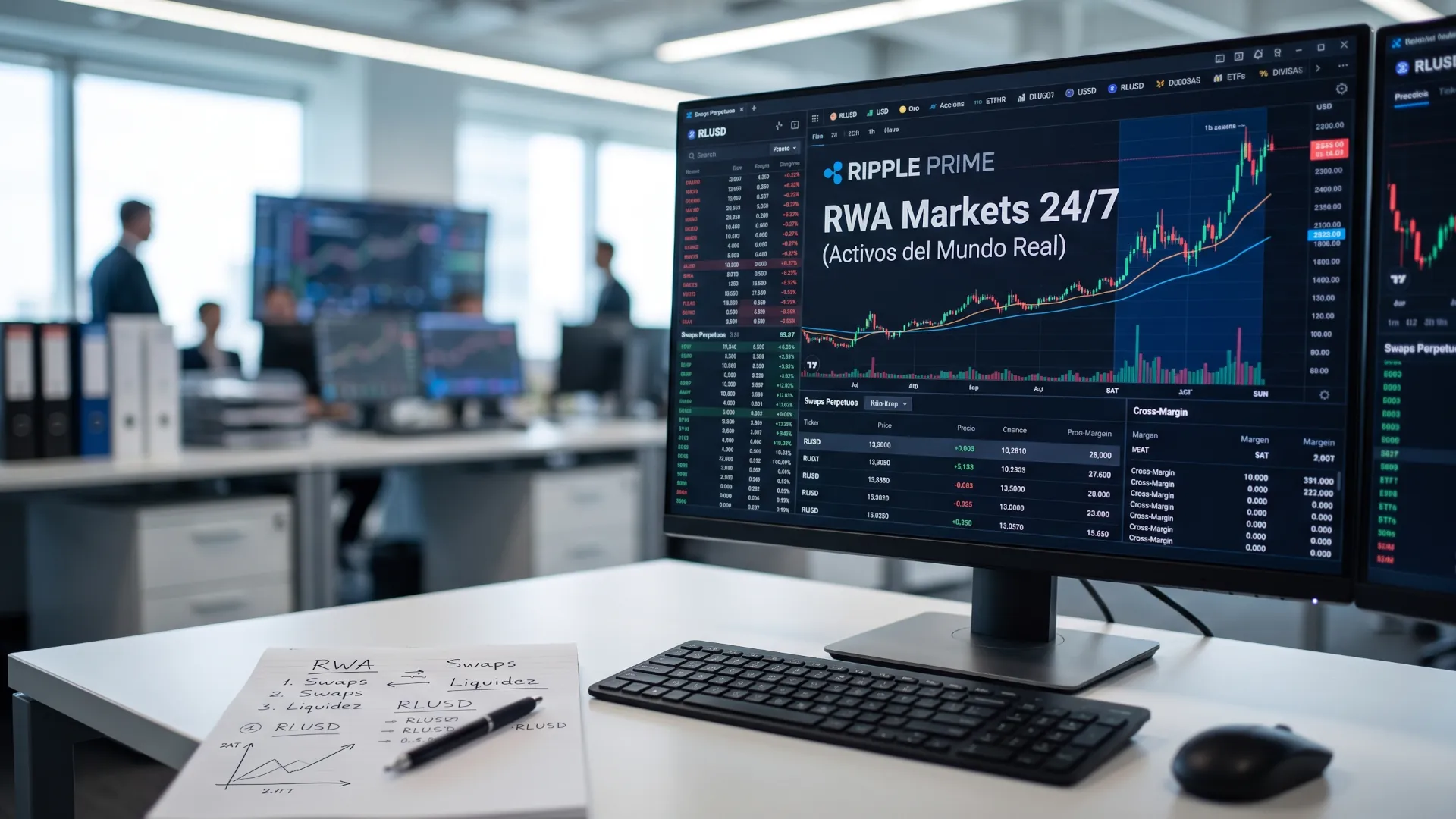
Wall Street closes on Friday and does not trade again until Monday. Ripple Prime began to sell that gap by opening perpetual swaps on real-world assets to its institutional clients, with more than one hundred reference markets and continuous seven-day trading, according to the company's statement. Virtu is among the first clients, and the collateral can be RLUSD, Ripple's stablecoin.
The mechanism is simpler than it sounds. A swap pays out according to the movement of a price, so the client takes a position without buying the stock or the bullion. In this case the price comes from the perpetuals that trade.xyz lists on Hyperliquid, contracts with no expiry date that also trade at the weekend. Ripple Prime is principal in every trade, so the client does not face the trading platform but Ripple, and can cross-margin with the rest of their portfolio at the firm.
The schedule, however, arrived long before the market's real depth. Daragh Maher, head of digital asset research at HSBC, wrote to his clients on Monday, October 19, that the launch is "evolutionary, not revolutionary" and that limited liquidity may hold back large orders. Two days earlier, on Saturday the 17th, the perpetuals that serve as reference for these swaps had their first weekend with the product live: $51.6 million in leveraged positions on chips were liquidated in ten minutes while stocks were not trading.
What did Ripple Prime open and on what terms?
The reference covers everything from stocks and equity indices to ETFs, metals, energy and currencies. Trading and settlement are continuous, weekends included, and the client can use RLUSD as collateral and cross-margin with what they already have deposited at the firm.
Everything comes, for now, from the British Virgin Islands CIV license. The company says it wants to operate from more regions, without dates or names, and the statement does not mention any European authorization for a client who arrives tomorrow.
Item
Launch detail
Reference markets
More than 100, across stocks, indices, ETFs, metals, energy and currencies
Schedule
Continuous trading and settlement, weekends included
Counterparty
Ripple Prime, which acts as principal in every swap
Collateral
RLUSD, with cross-margin against the rest of the portfolio
Jurisdiction
British Virgin Islands CIV license
First named client
Virtu
Cross-margin is the part that matters most to an institutional desk and also the least glamorous. If a fund holds gold and an index at the same firm, the loss on one leg is covered by the cushion on the other.
That capital saving is what Ripple sells against spreading the operation across three different platforms, even if the price is concentrating counterparty risk in a single broker and depending on its solvency.
What is not known is the size. The statement gives no volume figures, and the analysis by OptimistFi of Hyperliquid's public data notes that it also does not clarify whether Ripple Prime hedges its side on trade.xyz's books. Without that figure, no one can measure how much of the institutional flow reaches the book that sets the reference prices.
The thin book HSBC puts on the table
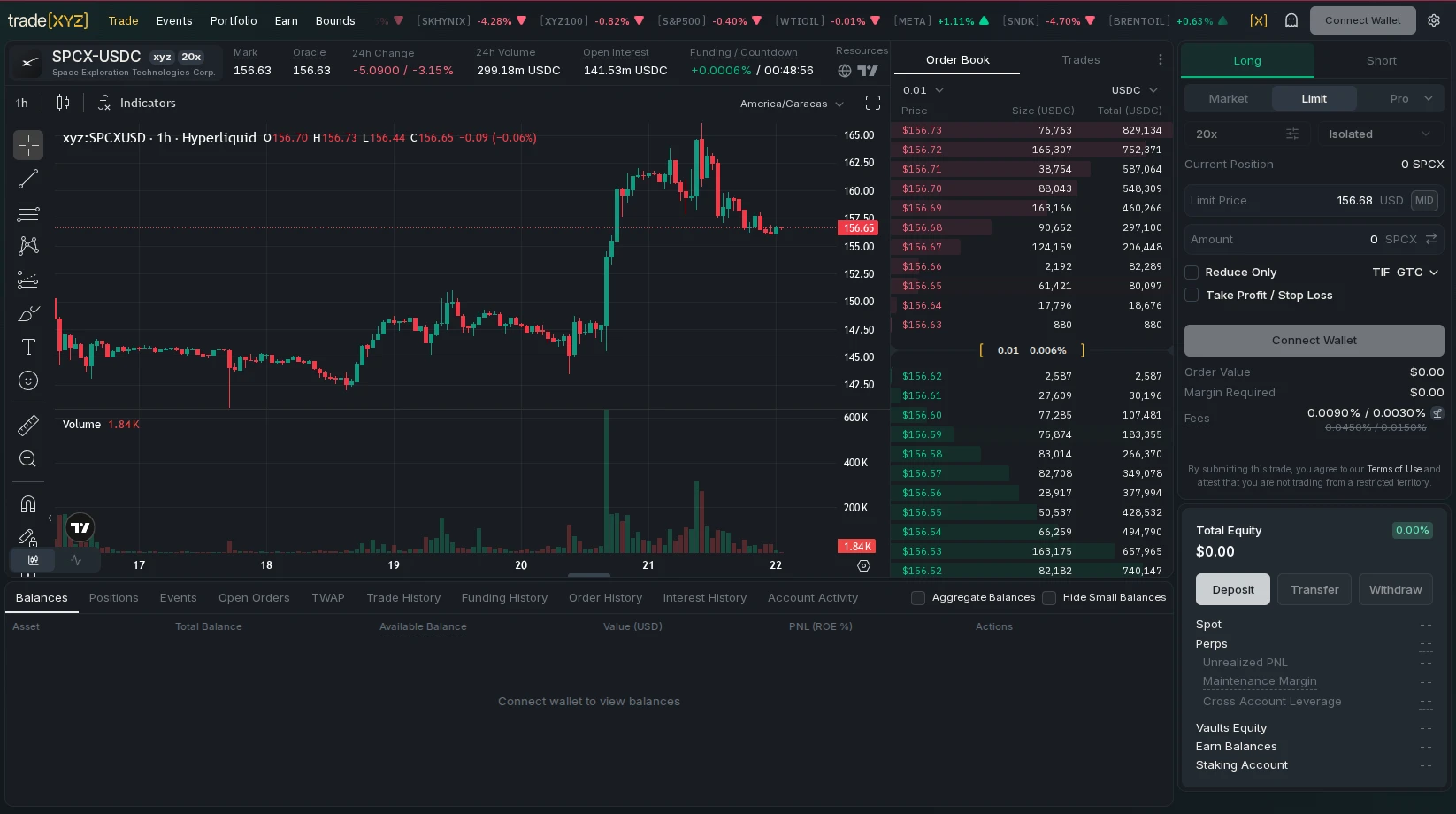
Trade.xyz's open interest stood at $3.73 billion spread across 115 markets on the afternoon of Friday, October 16, according to OptimistFi's calculation based on the platform's public data. That is close to a quarter of all Hyperliquid's open interest and a respectable figure for a crypto platform, but small next to the markets it replicates.
A look at the trade.xyz platform
A scale comparison helps to see it. The US leveraged ETF market had 593 products and $256 billion in assets at the start of October, 426 of them tied to a single stock, according to Morningstar Direct. Ripple already finances part of that business, and now it wants the same clients to move at night too.
The episode of Saturday the 17th shows how such a book behaves when a large order arrives. Between 21:22 and 21:32 UTC, $51.6 million in positions on chips were forcibly closed, $38 million of them from traders betting on gains, according to CoinGlass data. SOXL, a fund that triples the daily move of chip stocks, accounted for $12.7 million.
The selling started on Binance and took less than a second to reach Hyperliquid. In that first minute, Binance traded $21.9 million in SanDisk against $3.1 million in Trade XYZ: the same underlying, a book seven times deeper on the big venue.
With stocks closed, the reference was set by Trade XYZ's rules, which allow trading itself to set prices until outside quotes return. Quotes returned on Monday the 19th, and with them the comparison that did not exist on Saturday.
Who really gains from continuous hours?
Maher's diagnosis is that, until there is depth, activity will concentrate among market makers, proprietary traders and hedge funds looking for price differences between the contract and the asset it replicates. These are precisely the participants who make money from thin books and gaps between venues, not those who need to hedge a real portfolio at size.
For the classic institution the gain is different: being able to react to a Sunday headline without waiting for Monday and doing so with the collateral already held at the firm. That is worth something to a macro fund looking to cut risk after a news event, and worth less to someone seeking a competitive price on large blocks. Maher sums it up in one condition: the case improves when there is enough depth to express views and adjust risk with conventional markets closed.
Ripple, meanwhile, earns from financing and settling, not from getting the price direction right. The company entered this business with the purchase of broker Hidden Road for $1.25 billion, closed in October 2025 and rebranded as Ripple Prime.
In August it launched its equities derivatives business and on October 6 it expanded its agreement with Brevan Howard to provide brokerage services to its funds. RWA swaps are another layer of the same business, which is why volume matters more than the narrative.
The tokenized stock arrives before the market
It is worth clarifying what is traded here, because the easy headline is a different one. No client buys a tokenized stock or receives rights over a stock: they receive a swap that tracks the price of a perpetual that tracks the price of the stock. The chain has three links and two of them are crypto, which leaves the final price at the mercy of a market that does not hold the stocks.
That matters because the RWA tokenization narrative promises markets open all day with the depth of the real market. What has arrived first is the schedule. The tokenized part is the RLUSD collateral and continuous settlement; the deep part remains on Wall Street, closed at the weekend. Ripple is selling access, which is different from selling liquidity.
The new risk is not that the price moves without the exchange. It is that it moves with no one on the other side: such a book turns a sell order into a cascade of liquidations, and those cascades already happened two days after the launch.
On top of that, the counterparty is a single broker. The client does not run the risk of the book, they run the risk of Ripple Prime, which has to cover its exposure on the other side and does not say how.
Depth is not announced, it accumulates
It remains to be seen whether trade.xyz's open interest rises above that $3.73 billion when Ripple adds jurisdictions, as it promises without a date, and whether the company ever publishes its swap volume. Until it does, the only available evidence is how the reference markets behave over a violent weekend, and October 17's does not invite celebration.
The 24-hour clock is already installed and will not be unplugged. What is missing is what no statement can bring: orders willing to cross at four in the morning without the price being set by the last person who sold in a hurry.