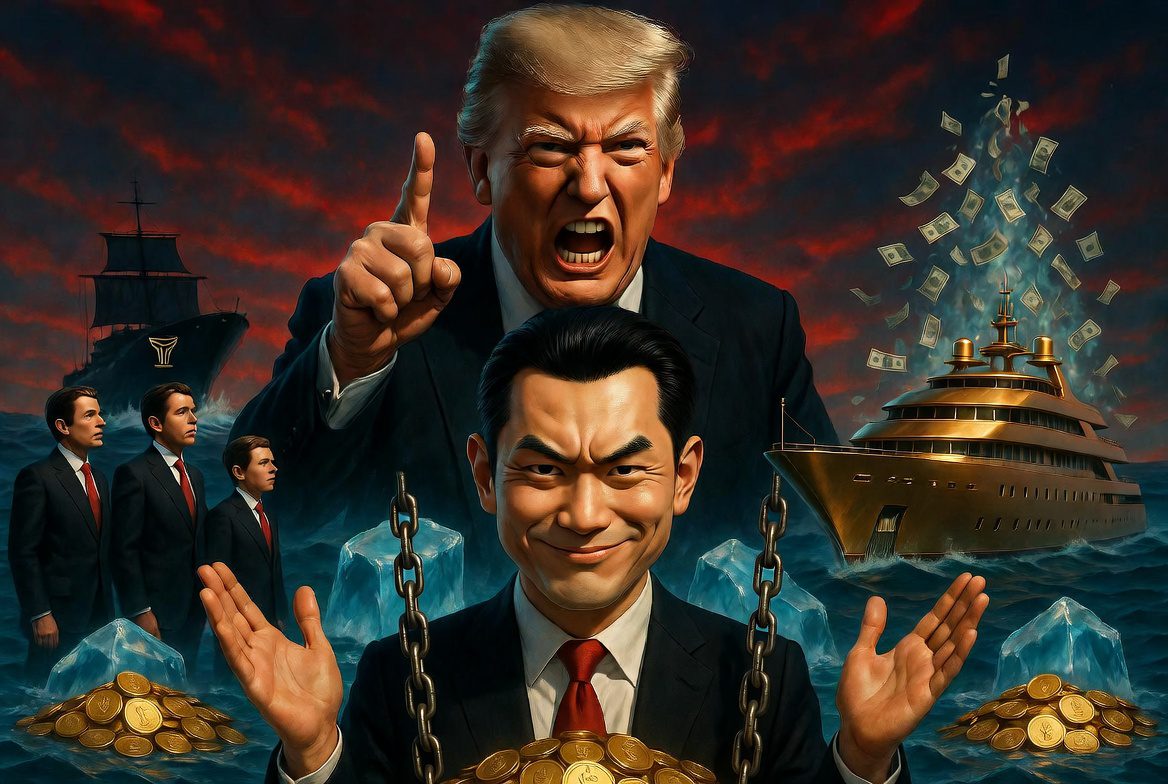
If shamelessness were a digital asset, World Liberty Financial (WLFI) would have a market capitalization larger than Europe's GDP. What in October 2024 Donald Trump and his clan sold as a liberation from the banking yoke now looks more like the script of a con artists' movie, where all the protagonists try to steal the loot while the police knock at the door.
Justin Sun, that villain with a porcelain smile, has once again shown why he is the emperor of chaos. Yesterday, Sun was in "total revenge" mode, calling the project a scam after seeing how the 75 million dollars he invested in the Trumps' company were frozen in the protocol. But today, in a turnaround that would make even Machiavelli himself blush, Sun has written on his X account that "The scammers made far ocean fishing'tanto the president and me!".
Sun's move
Translation for humans: Sun has decided that it is better to be the "poor deceived man" alongside the most powerful man in the world than to be the enemy who sinks the president's children's racket. It is a textbook move: blame the "technical staff" to save the Trumps' face, in exchange, surely, for getting his millions back.
Meanwhile, the president's children seem to have suffered a bout of amnesia. From being the Web3 ambassadors who put their faces in every promotional video to attract whales and suckers, they have gone to having nothing to do with the company's operations. The message is that we only put up the name; if you got fleeced, talk to the programmers. But why hasn't the WLFI ship sunk yet? Because in the castle's basement there are petrodollars.
United Arab Emirates
While the WLFI token bought by the man in the street has bled more than 64% in a year, the USD1 stablecoin linked to the company appears in the global crypto Top 25. The secret has a name of its own: Aryam Investment. Four days before the president's inauguration in 2025, the United Arab Emirates injected 500 million dollars. Thanks to this gentlemen's agreement in the shadows, the project survives today as a geopolitical tool between Abu Dhabi and the White House. Meanwhile, President Trump's loyal followers watch their savings evaporate in a smart contract that today nobody knows who controls.
The finishing touch to this dark comedy takes place at Dolomite, a decentralized lending platform (DeFi) that works like a digital pawnshop. WLFI's CTO, Corey Caplan, happens to be the co-founder of Dolomite. Taking advantage of playing at home, the project has deposited 3,000 million of its own WLFI tokens as collateral to obtain real liquidity.
The Terra/LUNA collapse
It is a scheme that consists of using your own "stickers" created out of thin air to back real loans. If the price of WLFI falls one more cent, Dolomite's algorithms will execute an automatic liquidation, massively selling those tokens on the market. It will be a chain reaction that will make the Terra/LUNA collapse look like child's play.
The villains will flee in their private jets to climates without extradition, and the last retail investor will be left with a cap bearing a logo nobody wants to wear anymore.