The crypto community has set its sights on a rather bizarre situation within AAVE. It all started when Stani Kulechov, founder of the protocol, reported an event as strange as it was costly: a DeFi trader used AAVE to buy $AAVE tokens worth 50 million dollars in USDT.
The final result was surprising: the trader ended up with just under 36,000 dollars in his wallet. The rest of the money practically evaporated. And no, it was not a hack. According to Kulechov himself, everything happened exactly as the system was designed to work.
50 million dollars disappearing with one click
It all began with a DeFi trader who had a clear goal: to take his 50 million dollars in USDT and convert them into $AAVE tokens. To do so he decided to go with what seemed the safest option: AAVE, the very home of the token he wanted to buy.
On paper, the decision made sense. AAVE is one of the largest DeFi protocols in the ecosystem, with a huge TVL and deep liquidity pools capable of absorbing large operations without too many problems. In addition, the protocol's operations are currently powered by CoW Protocol, a system designed precisely to optimize executions and minimize problems such as slippage or MEV. Up to that point, nothing seemed out of the ordinary.
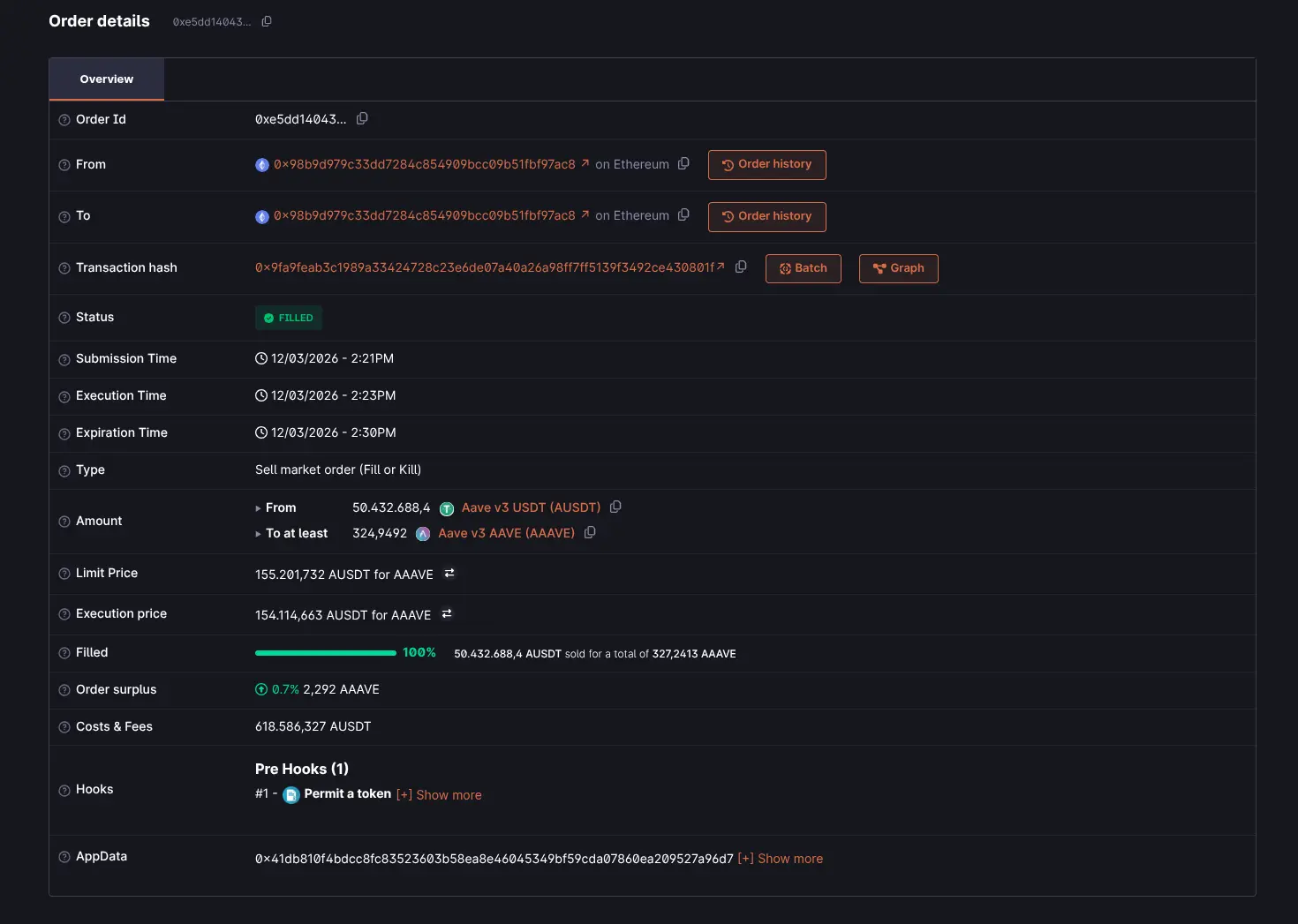
Our trader goes, opens AAVE, connects his wallet and carries out the operation with a warning: his operation is very large and may have "high slippage". The trader accepts and the transaction begins to be processed 0x9fa9feab3c1989a33424728c23e6de07a40a26a98ff7ff5139f3492ce430801f.
When the operation ends, his 50 million in USDT have become just over 36 thousand dollars. That's right, how 50 million USDT disappear in one click.
Binance sues The Wall Street Journal over a report on alleged ties to Iran
A serious AAVE flaw
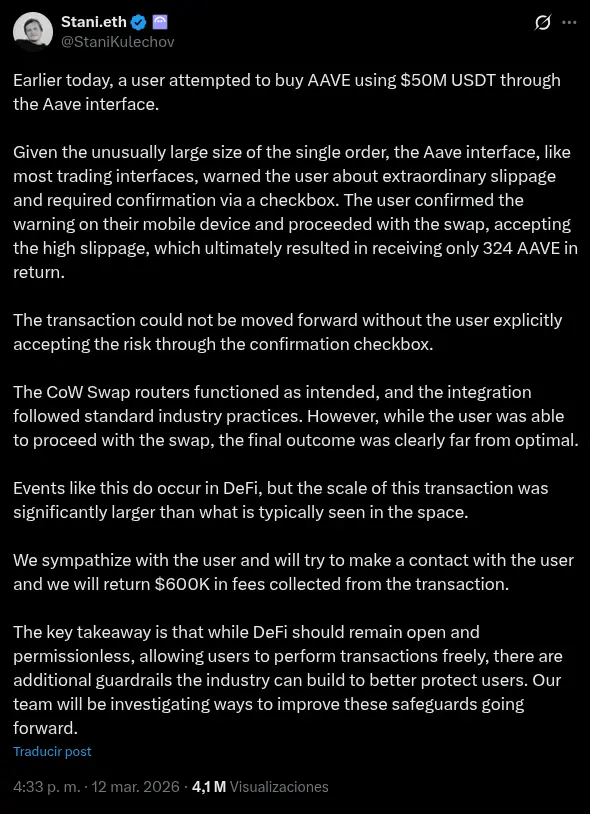
Faced with the event, Stani Kulechov comes out to talk about what happened. First, he stresses that in this type of event, AAVE usually tells traders that this can lead to high slippage or price slippage, and that additional confirmation is required for the operation. Something our trader accepted.
Kulechov adds that once the operation was accepted and carried out, everything was left in the hands of CoW Protocol. The problem here is: how do you route a swap operation of 50 million USDT so that the user ends up with just over 36 thousand USDT? Not only that, how is it that AAVE ends up with 600 thousand dollars in fees while the trader loses 99 percent of his wealth with one click?
Kulechov does not talk about it, he only states in his X post that they will try to contact the trader to return the 600 thousand dollars in fees, and that they will investigate security measures to prevent this from happening again.
An implementation problem
This is clearly an implementation bug, and to prove it, let's look at the explanation from @mgrabina, an AAVE engineer. Martin explains that the operation in question was carried out with a slippage of 1.21%, which means that our trader would at most lose about 50 thousand dollars on his operation, not counting fees.
But the reality is that he has lost everything. Martin tries to tell us that everything has been transparent, that it can be checked in the CoW Protocol block explorer, and it is true, except for one thing: in the explorer you can only see operations already carried out, not future operations.
In the AAVE interface, on the other hand, you can see the full swap, with what you are exchanging and what you will receive. And this is where the real flaw is: if AAVE as a swap space sees a loss of value in said operation (caused by slippage or a bad exchange rate), why doesn't it prevent the operation?
JP Morgan accused of facilitating a $328 million crypto Ponzi scheme
It's easy: if in a swap operation you are losing more value than the slippage you have accepted, then said operation should not be done. It forces those values to be reconfigured (which will obviously put you on alert) and will give room to avoid these problems. Well, none of that happened, which is why Stani talks about "security measures to prevent this".
If your protocol accepts things like slippage indications, and with all that it makes the swap outside those values, you cannot blame the user for "clicking a box", much less celebrate by saying "everything went as planned".
The plague of MEV Bots
In all this, the big winners have been the MEV Bots, which have taken it upon themselves to manipulate the trader's transaction to keep all the money for themselves. But not only the MEV, even a builder (an Ethereum block builder) has come out with a hefty profit from this.
Tobal Garcia (@tobalgarcia_) of Sky, explains what exactly happened in the transaction process and who are the big winners in all this. First, the builder Titan, well known in the Ethereum community, has taken more than 33 million dollars from the operation. Two other MEV bots operating with Titan have taken a combined 12 million dollars, the liquidity providers have kept 2.9 million, LIDO, which acted as the block proposer, has kept 1.2 million dollars, CoW/AAVE kept 600 thousand in fees and the rest is what the user received: 36.2 thousand dollars.
As can be seen on-chain, there are no small names. Titan is one of the largest block builders (like a miner) on the Ethereum network. LIDO is the largest staking platform on the network, and carries enormous weight when it comes to proposing blocks, which, by the way, many are built by Titan. The collusion of these actors is clear in what has happened with this trader, and in what has happened with many others for years, since Ethereum became a staking network, although during its Proof of Work time, it also had said problem, with less impact.