Looping (repetitive borrowing) is a trick in the crypto world to invest with far more money than you actually have. Basically, it consists of posting your coins as collateral to take out a loan, using that loan to buy more coins, and repeating the process over and over again. This multiplies your potential gains, but also your debts.
While in traditional markets leverage is usually managed through central intermediaries, in the crypto ecosystem, looping automates this process to generate returns that can exceed 60% a year, a figure that attracts risk-hungry investors.
Although it seems like a brilliant strategy, it is extremely dangerous. The risk is not only for the person doing the trick, but for the entire ecosystem, including you even if you don't use it. Why? Because if the price of the coin falls even slightly, a "domino effect" is triggered. The system starts automatically selling everyone's collateral to cover the debts.
These massive sales make the price fall even faster, creating a chain reaction that can leave platforms without funds. In the end, the entire system locks up and the serious problems end up affecting all users equally.
BLACKROCK AND UNISWAP BREAK DOWN THE WALL BETWEEN WALL STREET AND DEFI
What is Looping and how does it work?
In essence, looping consists of depositing a cryptoasset as collateral in a DeFi protocol (such as Aave or Morpho), borrowing another asset against that deposit, swapping the borrowed asset for the original one and depositing it again to repeat the process.
Because DeFi protocols require overcollateralization, each "loop" allows borrowing only a fraction of the deposited value, according to the permitted loan-to-value (LTV) ratio. For example, with an 80% LTV, a user can deposit USD 1,000, borrow USD 800, deposit them again and borrow an additional USD 640, continuing until marginal returns are exhausted.
Historically, this technique became popular during the "yield farming" boom in 2020, when protocols such as Compound began distributing governance tokens as an incentive for both lenders and borrowers.
In certain scenarios, the incentives received can make the net interest rate for borrowing positive, creating an unusual situation where the user receives payments for holding debt. Today, the strategy has become more sophisticated through the use of flash loans, which allow multiple leverage cycles to be executed in a single atomic transaction, eliminating the need to carry out the steps manually. It is worth remembering that flash loans make it possible to do looping without having prior capital (or with very little). This means there are people moving millions in loops without actually having a penny in their pocket. It is leverage taken to the absurd.
The crucial role of DeFi, stablecoins and tokenized derivatives
The DeFi ecosystem provides the modular infrastructure needed for looping to thrive. Stablecoins often act as the preferred borrowing asset due to their parity with fiat currencies, which facilitates risk calculation and immediate liquidity to buy back the main asset. However, the integration of tokenized derivatives, such as liquid staking tokens (LST), has taken looping to a new level of technical complexity.
By using derivatives that already generate an intrinsic yield (such as staked ETH) as collateral to borrow more units of the same asset, users create leveraged positions on assets that are closely correlated.
This allows much higher levels of exposure to be reached with an apparently lower liquidation risk, as long as the parity between the derivative and the underlying asset remains stable. However, this interconnection means that any failure in the derivative's issuance protocol or a loss of parity (de-peg) can trigger a cascade of liquidations across multiple platforms simultaneously.
ASTER DENIES BEING BINANCE'S ARM FOR MANIPULATING THE DEFI WORLD
Some examples
But we can see this type of strategy much more clearly on certain platforms. For example, Aave, is one of the most widely used money market protocols for manual and assisted looping. This is because this platform allows users to deposit cryptoassets (such as ETH) and borrow stablecoins (such as GHO) with defined loan-to-value (LTV) ratios.
Thus, for example, on Aave, ETH can have a maximum LTV of 82.5%, which defines the technical limit of how many "loops" a user can perform before returns decrease significantly.
Another example can be seen in Metronome, a protocol that allows users to automate the looping of tokens that already generate yield (yield-bearing tokens). This is particularly useful for liquid staking assets, allowing investors to leverage their intrinsic yield efficiently and safely through automated monitoring of interest rates.
The dangers of a hyper-leveraged strategy
At this point one thing is clear: the biggest risk of looping is cascading liquidation. Because positions are highly leveraged, even a small drop in the price of the deposited asset can push the collateralization ratio below the permitted threshold.
When this happens, the smart contract automatically liquidates the collateral to cover the debt. In a highly interconnected market, the massive liquidation of a single large position can push the asset's price down, causing other looping positions to also reach their liquidation point, creating a domino effect that destabilizes the entire market.
In addition to market risk, there are technical and operational dangers:
- Smart contract risk: The automation of these strategies depends on the integrity of the code. An error in the lending functions or in the price oracle can be catastrophic.
- Rate volatility: Interest rates in DeFi are variable and depend on market utilization. A sudden increase in the cost of borrowing can turn a profitable strategy into a net loss within minutes.
- Liquidity risk: In moments of high volatility, the liquidity needed to carry out the swaps required within the loops can disappear, preventing users from closing their positions in time to avoid losses.
THE DEFI LIE: WHY THE FINANCIAL REVOLUTION NEVER ARRIVED
Two cases that broke the market
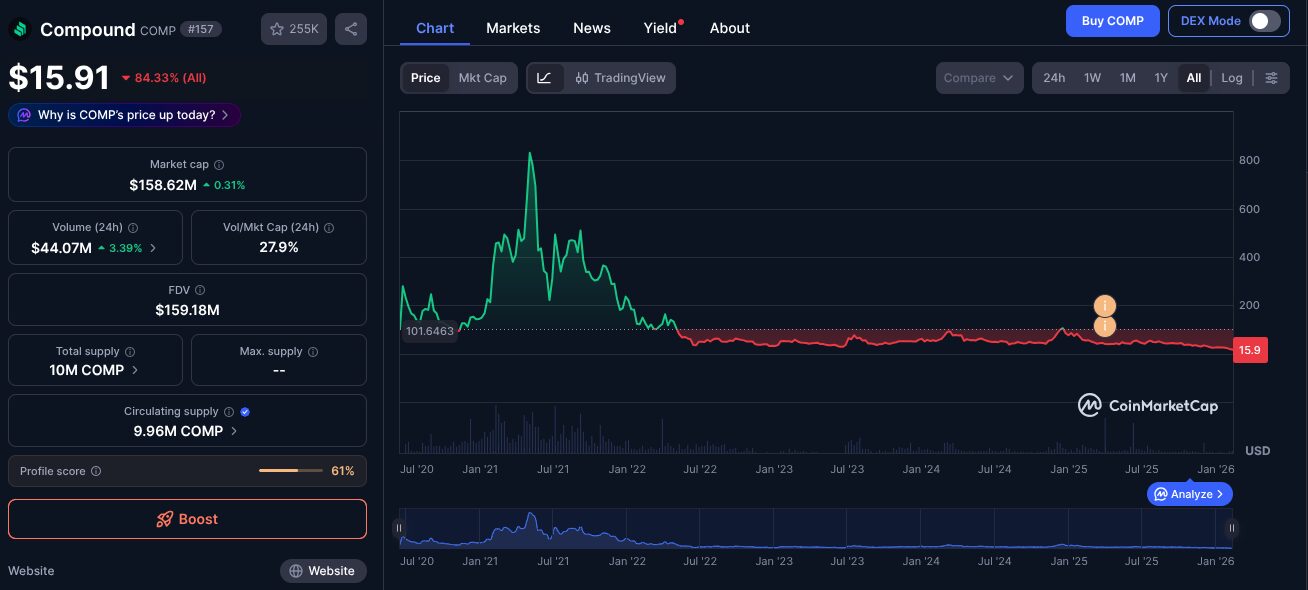
And here we can see two examples of what happens when these events take place. Our first case takes us to Compound. In mid-2020, the Compound protocol began distributing its governance token (COMP) both to those who deposited capital and to those who borrowed.
At that time, users discovered that they could deposit one asset, borrow another and deposit it again repeatedly to maximize the number of COMP tokens received as a reward. But, in certain cases, the incentives received exceeded the interest cost of the loan, creating a situation where users received net payments for holding debt. This massively inflated the protocols' Total Value Locked (TVL), but also increased systemic fragility in the face of possible changes in asset prices.
Put that way, it doesn't seem very impressive or "dangerous", but if we look at a chart of the COMP token's value, we can see the terrible consequences. And it is that in the midst of this looping, the COMP token grew like foam until it fell to levels below its starting value, putting the entire ecosystem into losses.
The Morpho case
Another more contemporary example of looping can be seen in Morpho. The strategy in this case is "simple". Morpho is designed to optimize the interest rates of platforms such as Aave, which attracts users looking to leverage their positions efficiently. That is its hook, and if you add to that the ability to do looping, then you have a great honeypot.
And the impact of this is seen when approximately 64% of Morpho's volume comes from users actively executing looping strategies. This shows that a sudden drop in the value of collateral (such as ETH) would not only affect isolated individuals, but would put at risk most of the liquidity managed by the protocol due to the high concentration of leveraged positions.
Systemic impact and threats to the ecosystem
All of the above leaves one thing very clear: looping does not only affect the individual investor; it represents a systemic risk for the digital asset ecosystem. By artificially inflating the protocols' Total Value Locked (TVL), this strategy can give a false sense of liquidity and adoption. Much of the capital that appears to back DeFi is, in reality, the same capital recycled multiple times through debt. That is why it is worth remembering that a high TVL can be just a mirage of debt.
THE CRYPTO COMPANY LINKED TO THE TRUMP FAMILY ENTERS DEFI LENDING
If a significant part of the market uses looping on the same assets, the ecosystem becomes extremely sensitive to external "shocks". A severe market correction would not only result in individual losses, but could drain the reserve funds of lending protocols if liquidators cannot act fast enough or if the collateral assets lose value too quickly to cover the debts incurred.
This fragility is what leads experts to warn that, although looping is a powerful tool for capital efficiency, its excessive and chaotic use has the potential to undermine the foundations of trust and stability on which the financial infrastructure of the DeFi world is built.