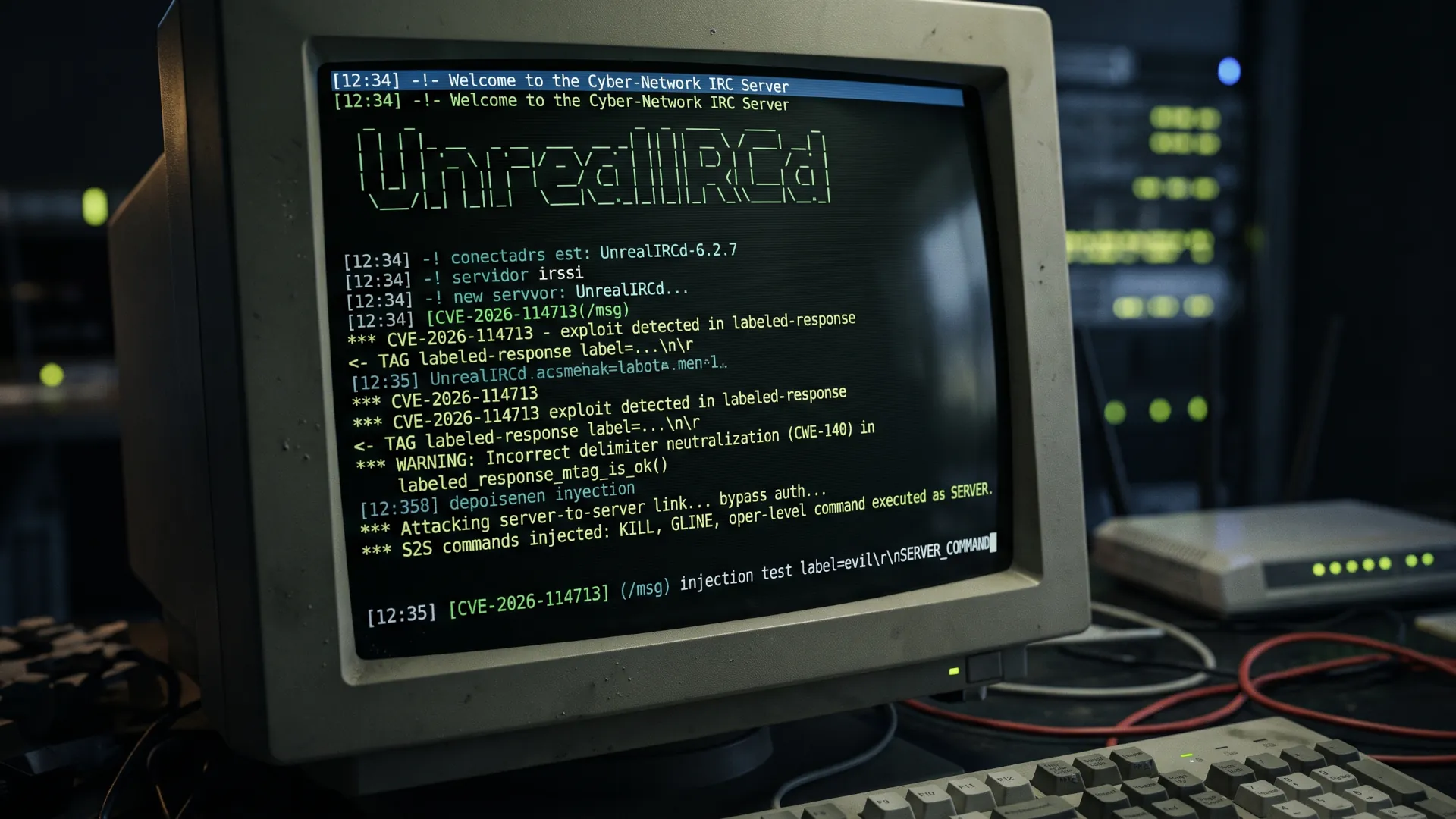
UnrealIRCd released version 6.2.7.1 and a hot patch on November 7, 2026, closing nine security flaws at once. One of them allows any user, with no privileges at all, to execute commands with the authority of a server on the network. The release note for version 6.2.7.1 describes it as the most serious problem found in the project in fifteen years. On November 13, the United States cybersecurity agency added it to its catalog of confirmed exploitation and set the 16th as the deadline.
The identifier is CVE-2026-114713 and the bug lives in labeled-response, an extension of the IRCv3 standard that lets a client tag a request so it can later recognize which response belongs to it. The server returns that tag without stripping the line breaks the client has inserted into it. In a text protocol where every line is a command, a leftover line break is a new order, and the official classification fits: CWE-140, improper neutralization of delimiters.
The distance between a curious flaw and an incident is set by the topology. On a standalone server, the injected line stays on the same machine that already received it from the client and the attacker gains nothing. On a network with two or more linked servers, that text enters through the administration channel and the neighboring node executes it as if a trusted peer had signed it. IRC is still alive in free software communities, on game servers and in technical support channels, and many of those nodes are self-hosted on a single machine.
An administration channel that does not ask for credentials again
The link between two servers on a network is an already established trust relationship. There is no user to impersonate and no password to guess: there is a channel the design treats as internal, and that is where this flaw finds its opening.
The two ends of that channel are not users: they authenticate once with a shared password or a key fingerprint, and from that moment they exchange messages with a prefix that identifies the sender. The receiver does not re-check credentials on every line because the link is already established, and that is the point of peer trust. The labeled-response specification adds the piece that breaks here: a `label` tag whose value is chosen by the client, opaque and 64 bytes at most, which the server must repeat as-is in its response.
In UnrealIRCd, the routine that validated that value checked the format and did not escape the content when returning it. The CVE-2026-114713 entry in the NVD points to the labeled_response_mtag_is_ok() function inside labeled-response.c and sums up the result without embellishment: any user on a network with two or more linked servers can inject commands between servers that execute with server authority. The CVSS 3.1 score is 8.6 out of 10 with changed scope and low complexity, with no prior privileges or user interaction.
What that client achieves is listed in the advisory itself: killing other people's connections, imposing network bans and acting in general with operator permissions without being one. The text signed by the maintainer adds that the bundle of nine fixes includes two IP address leaks, one of them a "decloak" that reveals the victim's IP to anyone interested.
The rest of the chain is not new either. Servers on a network have authenticated to each other since the 1990s, and what is new is that a correlation field has ended up being a write path inward.
Two remediation paths and four possible states
The declared range runs from 6.0.0 to 6.2.7, and the problem does not end there. The 5 branch is also exposed and has been end-of-life since July 1, 2023, so there will be no fixed binary for it. Bram Matthys, the project lead, writes that older versions have not been reviewed and that several of the fixed flaws likely date back to 3.2.x, leaving those installations without a diagnosis or a repair date.
The fix comes in two ways and the first saves the maintenance window. The hot patch is launched with ./unrealircd hot-patch bundle-20261107 on any version between 6.0.0 and 6.2.7, replaces the module in memory and reloads the configuration without interrupting service. The second is to update to 6.2.7.1 and restart the process. The subsequent check distinguishes the two states and should be run, because the most costly flaw of this kind is the one believed to be patched.
| Version |
Status |
What to do |
How to verify it |
| 6.2.7.1 |
Fixed |
update and restart |
module-status returns 6.2.7.1 |
| 6.0.0 to 6.2.7 |
Affected |
hot-patch without restart |
module-status returns 5.0-hot-patch-bundle-20261107 |
| 5.x, end-of-life on July 1, 2023 |
Affected |
blacklist-module and restart |
the module disappears from MODULE -all |
| 3.2.x and 4 |
Not reviewed |
upgrade to 6.2.7.1 |
no check is possible |
The preliminary step recommended in the advisory has a catch. Before patching, it asks operators to run a spam filter with a regular expression that blocks tags containing forbidden characters, and warns that this net only covers the network if every server is on 6.0.4 or higher. On a mixed network, the filter protects the new nodes and leaves the old ones out, which is exactly the scenario where the gap between servers turns an escaping bug into a remote control.
The eight remaining flaws do not escalate privileges, but none is cosmetic. Two reveal a user's IP address, one hangs the server when checking blacklists and another takes it down when changing identity from the services. Among the rest there is a counter that replies "server full", a cap on bans and a whowas crash.
Three days to comply in a catalog of 1,781 entries
The KEV catalog added the flaw on November 13, 2026 with a deadline of the 16th. That is three days, which in practice means a federal administrator spends the weekend applying the patch. The entry adds three assessment tags: active exploitation, automatable and total technical impact. The first is signed off by the agency rather than the project, because the UnrealIRCd advisory mentions neither campaigns nor a public exploit, nor victims.
That deadline reads better next to the others and next to the work each product demands. The November 2026 Patch Tuesday entered the same catalog on November 10 with an Outlook zero-day and a deadline of the 24th. The Chrome CVE-2026-125350 got the same date. Two weeks for patches that force desktops and browsers to restart; three days for a server fixed with a command and a reload.
Outside federal agencies, no deadline applies. A community node can stay on 6.2.7 for months without anyone reviewing it, and that is the real audience for this flaw.
For the profile that runs UnrealIRCd, the window is more realistic than it looks. An IRC operator already knows how to rehash without cutting the service because they do it every time a configuration changes, and the patch is verified with a command that returns the name of the installed bundle. What does not exist is the coercion: no one is going to audit compliance on a five-server network set up by hobbyists, and forgetfulness is as likely as laziness.
Trust between honest peers breaks on the client side
IRC's design assumes that the servers on a network are peers that know each other and authenticate once. This flaw does not break that authentication, it sidesteps it: it uses an extension meant for a client to order its replies and turns it into a write channel into the interior of the network. The pattern repeats in any text protocol where a client-chosen field returns to the sender unsanitized, and this week the OpenSSH and musl flaw reminded us that the pieces almost no one reviews still cause scares.
Matthys adds the most uncomfortable detail. The audit that found these nine flaws was internal, with the help of artificial intelligence, and totals about a hundred hours since February 2026. His conclusion is that any network daemon without recent security fixes has probably not been visited by a model, or has been visited by someone who did not count it. Anyone running a self-hosted node has a simple decision these days: apply bundle-20261107, upgrade to 6.2.7.1 or cut the link with the rest of the network while deciding.