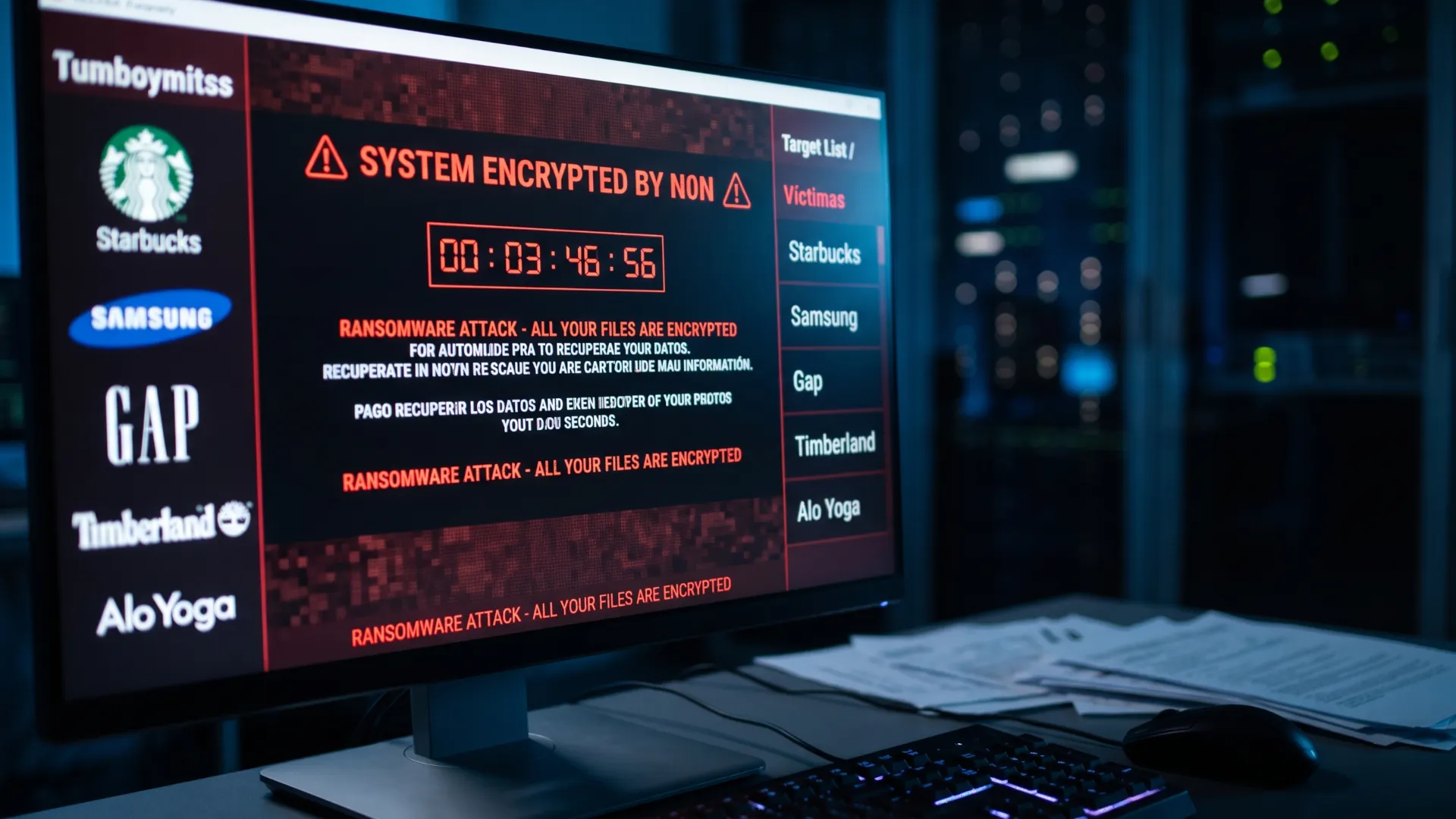
N0N says it has hit Starbucks, Samsung, Gap and Timberland: 10 of 18 posts on November 16, according to RansomNews. No company has confirmed it. The tally published by the real-time ransomware attack tracker closes out the day of November 16, 2026 with eighteen organizations listed by three different operators and a weekly average of 47.9 victims per day.
It is worth starting with what a list like this means: a post is a claim by the attacker, not a confirmed incident. Some entries are true, others are inflated and a few are invented to pressure the company. No company is condemned for appearing there, and none is safe for staying off it. The rest of the day is taken up by Qilin and other groups, with different profiles and targets.
That said, the volume does tell a story. Ten of the eighteen belong to N0N, seven to Qilin and one to INC Ransom, a concentration that says less about one group's success than about the economics of extortion: affiliates post in waves and a single broker places several names in one afternoon. According to the RansomNews dashboard as of November 16: 610 organizations listed in November and 9,761 across all of 2026. They measure posts, not confirmed victims.
Names with a lot in common
N0N's list is a cross-section of US retail. A coffee chain, a consumer electronics maker, a fashion group with several brands, an entertainment industry data firm, two small insurers and an appliance retailer. The only name outside that pattern is Samsung Electronics, which appears tagged as South Korea.
The bias is no accident. Consumer-facing companies bring together what extortion looks for: personal data, operations that cannot stop without a headline and a visible brand whose damage is measured in front pages. An industrial manufacturer can run at half capacity for a week and pay quietly.
Qilin spreads its names across industry and services, with a machinery maker and a supplier of automotive security systems in Malaysia as the clearest examples. None of that sounds like a headline and yet it is where the economic impact is measured in supply chains.
The business of publishing before proving
The model of these groups has changed in two years. Previously, publication came after a successful encryption. Today many affiliates publish early, with partial data and a countdown, betting that media pressure will do the work that the technology did not. The list stops being an inventory of damage and becomes a negotiating tool.
That explains how often names appear and then vanish from the list with no public explanation. A company that pays before publication rarely appears, and one that negotiates may see its entry withdrawn. The victim count measures posts, not compromises, and that difference is enormous when added up over a full year.
It also explains the noise. When publishing is cheap, groups copy each other, claim targets they have not touched and recycle old access. The draining of 48.6 million from Mercado Bitcoin wallets showed the other end of the trade: a verifiable technical trail. Here there is no trail, only posters.
Why retail in November?
Think of a chain with hundreds of stores. Its point of sale talks to inventory, to loyalty programs and to billing. Encrypting the central servers leaves stores unable to take card payments and unable to process returns. On a peak-season Friday, that is not an inconvenience: it is a hemorrhage.
The math is not abstract. A week without card payments in the middle of the season can cost more than the ransom the group demands, and the attacker knows that calculation before the victim does.
The season matters. November and December account for half a year's revenue for US retail, and an attack that halts operations for 72 hours on those dates carries negotiating power it does not have in February. It is no small detail that the wave arrived ten days before Thanksgiving.
Then there is personal data. A list of emails and a purchase history are worth little on the black market, but they are worth a great deal as a legal argument. Notification obligations in the United States and Europe turn the theft of customer data into a regulatory cost, and that cost can be estimated, quantified and used at the negotiating table.
What the list does not tell us
It does not say whether there was encryption or how long it lasted. It does not say whether the published data is real or an old sample. It does not say whether the company paid, and in most cases it never will. Nor does it say who is behind the keyboard: N0N is an affiliate brand, not an organization with a payroll.
The aggregate numbers serve another purpose. The average of 47.9 victims per day and the 610 posts in November describe a market that is not cooling. Against the annual total of 9,761, the current pace implies that the last quarter is contributing a growing share of the pie.
There is a comparison that helps gauge the size of the problem. Groups that attack essential services, such as the one that left 115 supermarkets in Europewithout refrigeration, operate with less volume and more damage per incident. Retail takes more hits and less technical depth. Both models coexist and both are growing.
What to do if your company appears on the list?
The first step is to verify, not improvise: an external forensics team, a backup outside the network and a channel to customers that does not depend on corporate email. The second is to decide on the legal framework early, because in Spain breach notification has deadlines and silence is not an option if personal data is affected.
The third is the one almost nobody does well: talk to management in economic terms. How much each hour of a closed store costs, how much notification costs, how much the fine costs and how much reputation costs. Without that math, the negotiation is run by whoever has the countdown on their screen and everyone else just listens.
The chain of failures that compromised thousands of corporate devices was a reminder that the entry point is usually an exposed, unpatched service, not a sophisticated actor. For retail, the real surface is broader: logistics providers, marketing agencies, loyalty platforms. Every integration is a door.
What to expect in the coming weeks
November closes with the shopping season and a calendar that tends to speed up on Friday afternoons, when corporate response is slower. If the pace of 47.9 holds, the year will end above ten thousand posts, a figure that measures not attacks but the normalization of an extortion market.
The reassuring reading is that the public list exaggerates. The uncomfortable reading is that, even if it exaggerates, every real name behind the list has had a bad day. And that the difference between appearing and not appearing depends less and less on luck and more on having asked the boring questions beforehand.