In emerging markets, digital assets function both as an engine of financial inclusion and as a puzzle for regulators, and that is precisely the case of Kontigo in Venezuela. The combination of hyperinflation and sanctions has favored the emergence of platforms operating in a gray area, halfway between humanitarian aid and financial assistance to a sanctioned government.
In fact, the case of Kontigo Inc. is a critical example of this duality. Its scrutiny not only exposes control failures in Silicon Valley, but also reveals the sophisticated architecture created to evade OFAC. In the end, the restrictions imposed on these fintechs set an inevitable precedent for the oversight of financial tools in high-risk zones.
THE PRICE OF THE USDT STABLECOIN SOARS IN VENEZUELA AMID THE ECONOMIC CRISIS
Digital assets in a context of macroeconomic crisis
To understand the rise of fintechs in Venezuela, it is important to analyze the conditions that turned digital assets into an operational necessity for the population and, eventually, for the State itself. Venezuela has gone through one of the most severe periods of monetary instability in contemporary history, with inflation reaching approximately 600% in 2025. In this environment, the local currency, the bolívar, lost its function as a store of value and a reliable medium of exchange, driving a de facto dollarization that found in stablecoins, particularly USDC and USDT, a lasting digital infrastructure.
The use of these assets is not marginal. It is estimated that by the first quarter of 2026, 10% of transactions in Venezuelan supermarket chains will be made through digital assets. This has led local companies such as Crixto to develop wallets that allow payments in stores without the need for specialized terminals, making it easier for ordinary citizens to protect their savings from constant devaluation. However, this same infrastructure has been used by the government to move revenue that the traditional banking system, restricted by SWIFT and OFAC sanctions, could not process.
The Kontigo case
But while the Crixto case is striking, there is an even more serious one: Kontigo Inc. This company initially positioned itself as a neobank designed for «global citizens,» with a particular focus on the Latin American market.
VENEZUELA'S CRYPTO SECTOR: TRUMP'S NEXT TARGET?
Founded in 2023 by Jesús Castillo, the company managed to attract capital from top-tier investors, including Y Combinator, Coinbase Ventures, Soma Capital and DST Global. Kontigo's public narrative emphasized the fight against financial exclusion and protection against inflation. However, behind this facade of innovation hid an operating structure designed to interact with the Venezuelan economy in ways that defied OFAC prohibitions.
The «mirror» structure and the circumvention of legal terms
Kontigo's operations reveal a fundamental contradiction between its legal documents and its commercial activity. While its terms and conditions explicitly prohibit the use of the platform by people in sanctioned countries such as Venezuela.
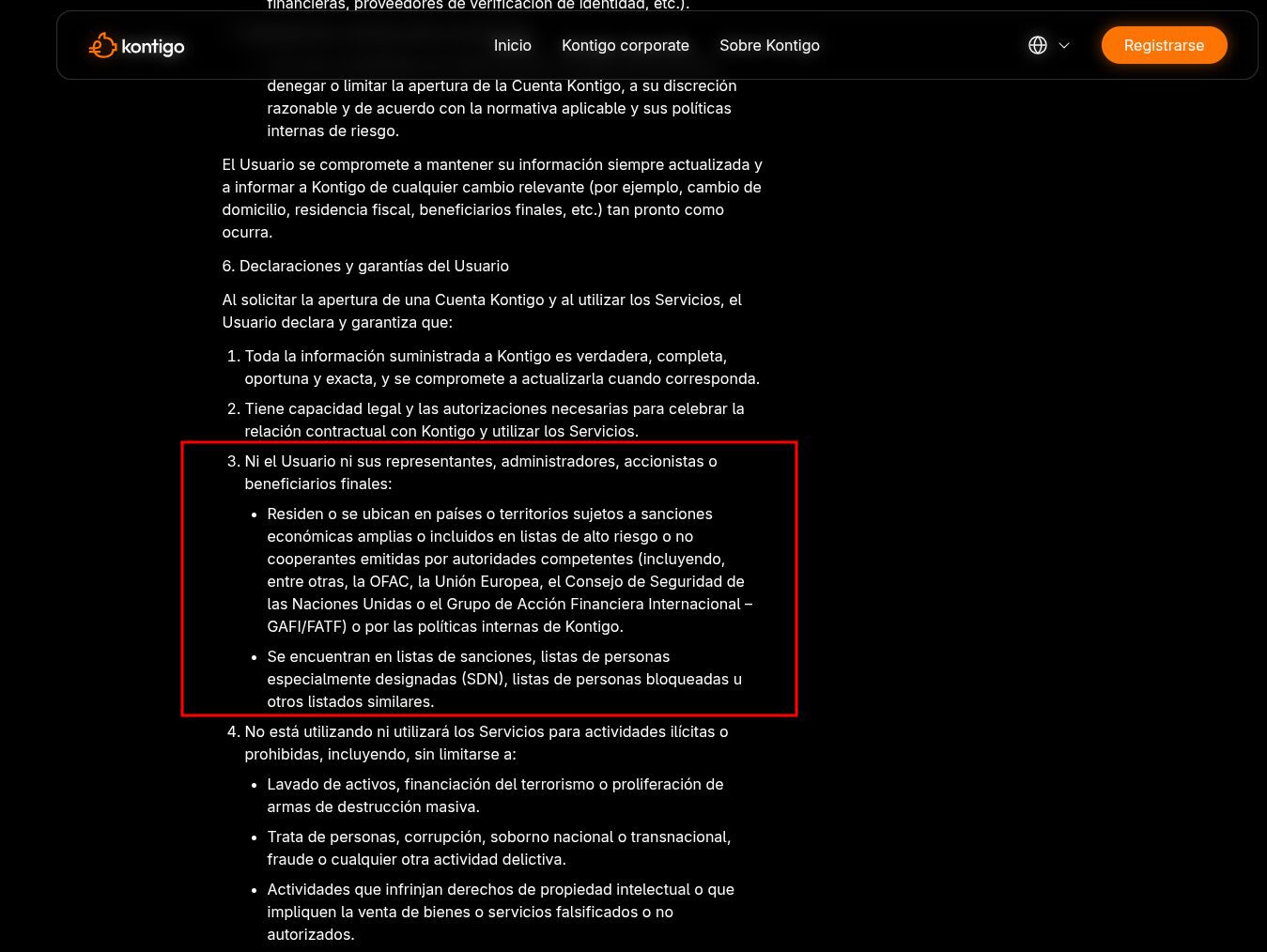
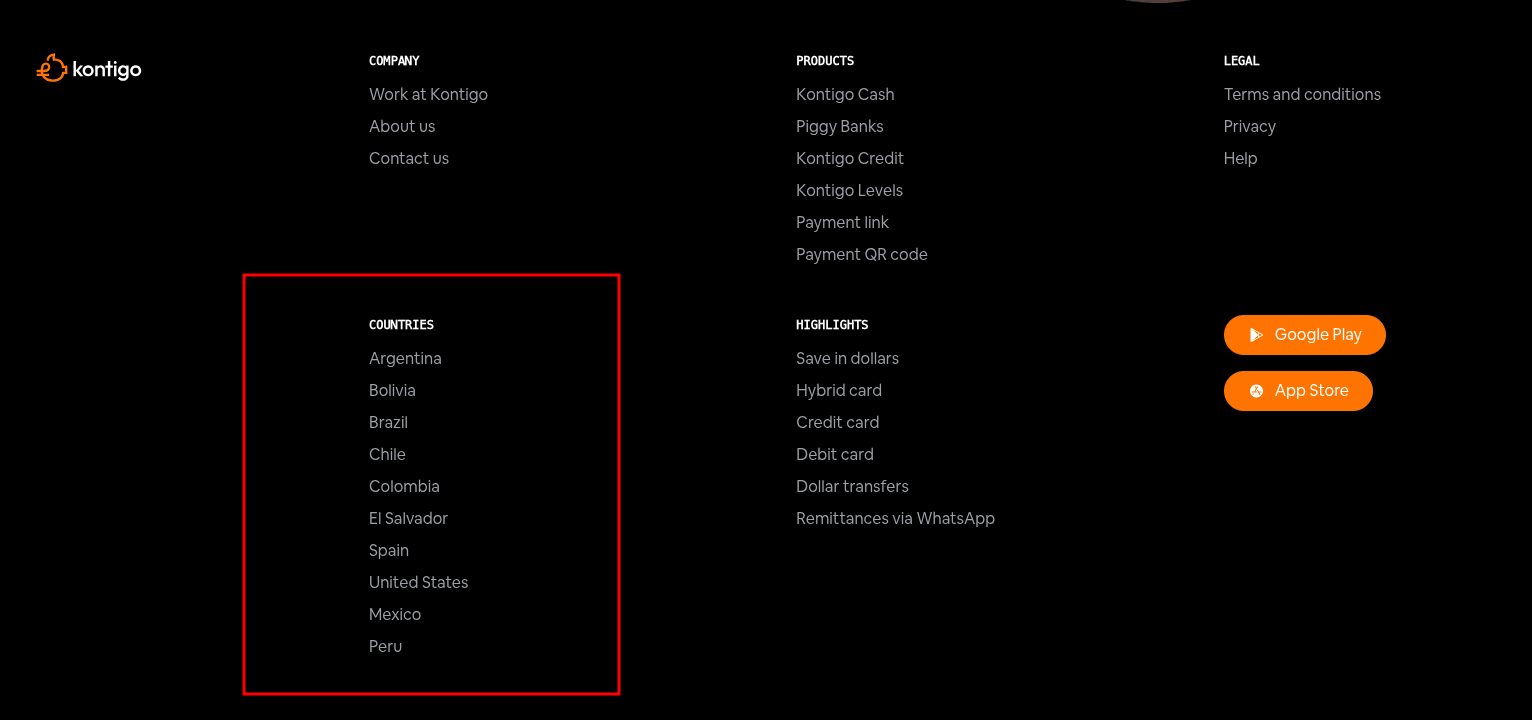
Even though the country does not appear on the list of countries on its main website, its social media marketing strategy was aimed almost exclusively at the Venezuelan public, using local influencers to promote the launch of the app in the country.
To facilitate these operations, Kontigo Inc. (registered in Delaware) operated in Venezuela through a local subsidiary called Oha Technology C.A. This outsourcing structure enabled an arbitrage mechanism whereby users could deposit cash dollars in local Venezuelan banks, which were internally converted into USDC within the app.
This process created a blind spot for U.S. authorities, since capital of Venezuelan origin was transformed into «clean» digital assets within a platform backed by U.S. financial infrastructure. That blind spot was compounded by non-compliance with KYC/AML regulations, since Kontigo is subject to these measures, something Venezuelans could not pass due to the sanctions imposed on the country.
In this way, Kontigo enabled illegal activity and opened the door for the Venezuelan State to bypass sanctions.
VENEZUELAN BUSINESSES OFFER DISCOUNTS OF UP TO 80% IF YOU PAY IN STABLECOINS
The anomaly of the Sunacrip license
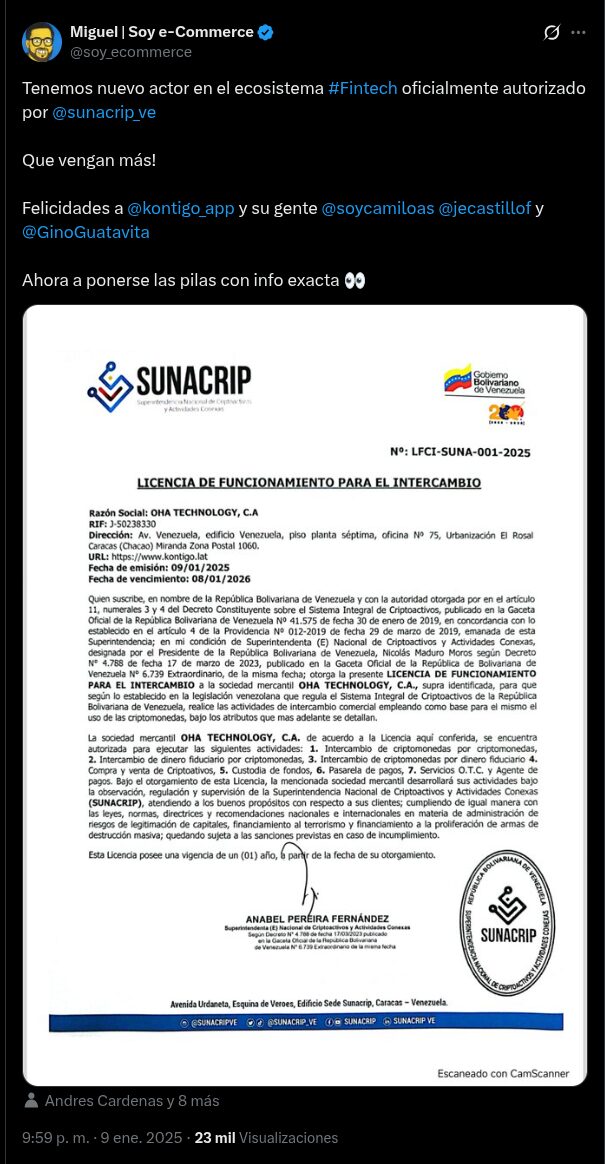
Of course, this would not be possible without the direct participation of the Venezuelan state, which has a clear presence: SUNACRIP, the cryptocurrency control agency. And indeed, on January 9, 2025, Oha Technology C.A. received cryptoasset exchange license No: LFCI-SUNA-001-2025.
So far everything seems normal, but what is highly irregular is that this license was issued by an agency that has been under an intervention board since 2023, following the multimillion-dollar embezzlement known as «PDVSA-Cripto.» In that embezzlement carried out by Tarek El-Aissami, a total of 25 billion dollars was stolen, a clear indication of the government's level of involvement in crypto schemes.
Therefore, obtaining the license on this date, especially from a technically paralyzed regulator, suggests the existence of direct arrangements with the regime of Nicolás Maduro, and now with that of Delcy Rodríguez. This institutionally links the fintech to the top of Venezuelan power at a time when most licenses of other ecosystem players remained frozen.
The collapse of the financial bridge
The end of Kontigo began when these «harmless coincidences» started to attract the attention of Kontigo's investors. And knowing that Kontigo's operations depended on its ability to connect the world of digital assets with the traditional U.S. banking system, what was about to happen would bring it all down.
First, the fintech did not maintain a direct relationship with the major banks, but instead used a technology intermediary called Checkbook, which in turn had custody accounts at JPMorgan Chase. This structure allowed Kontigo users to access virtual checking accounts and make dollar transfers, using the Chase Bank brand in its advertising.
The JPMorgan alarm
But at the end of December 2025, JPMorgan Chase made the drastic decision to freeze the accounts of Kontigo and another similar fintech, BlindPay. This measure was not an attack on stablecoin technology, but a regulatory compliance action motivated by three critical red flags:
- Links to Venezuela: The bank's monitoring systems detected operations that originated or ended in a jurisdiction under strict OFAC surveillance, violating jurisdictional risk policies.
- Unusual operational activity: A massive increase in chargebacks (refund claims) and ACH returns was recorded. According to Checkbook CEO PJ Gupta, this was a consequence of uncontrolled growth in Kontigo's user base, which «opened the floodgates» to thousands of online registrations without adequate security controls.
- Legal and reputational risk: JPMorgan, as final custodian, chose to cut off the intermediaries' access to protect itself from possible multimillion-dollar fines derived from the unintentional facilitation of sanctions evasion.
The disconnection from JPMorgan triggered a domino effect that led Stripe, Bridge and Lead Bank to cease their relationship with Kontigo, leaving the funds of thousands of users blocked in custody accounts that are now the subject of a judicial investigation.
THIS IS IBIS: THE FINTECH FOR PAYING WITH STABLECOINS AND MASTERCARD IN VENEZUELA
But Kontigo's situation went from being an operational problem to a full-blown high-level corruption scandal after the publication of an investigative report by journalist Jason Mikula in Fintech Business Weekly.
According to this investigation, Kontigo was not only a financial services platform, but allegedly functioned as an evasion tool designed in collaboration with prominent figures of the Maduro regime.
Family ties and the role of Y Combinator
Mikula's report alleges direct connections between Kontigo's leadership and relatives of Nicolás Maduro, specifically mentioning the ruler's son as one of the key links in the power structure that facilitated obtaining state licenses.
This revelation cast a highly critical light on Silicon Valley investors. Tom Blomfield, former CEO of Monzo and partner at Y Combinator, was singled out for leading the relationship with the startup, which has raised questions about the quality of the due diligence carried out by these funds before injecting capital into an entity with such high exposure to sanctions.
Kontigo's response to this: total rage and aggressiveness. The company's episode of online aggressiveness was such that they directly threatened the CEO of Klarna for «spreading falsehoods.» However, at the time of the accusations, Kontigo's accounts were already under scrutiny and the tidal wave of reviews had already begun; they could no longer argue «falsehood» in the face of a clear fact, one that even the company itself has accepted, as evidenced in a recent statement on the social network X.
The final blow
Furthermore, these events coincided with those of January 3, 2026, when U.S. military forces captured Nicolás Maduro in Caracas, marking the end of his mandate and the start of a forced transition. A few days after this event, Kontigo announced that it had suffered a «hack,» a narrative that many analysts consider a smokescreen to justify the paralysis of funds that had already been frozen by federal authorities as part of the sanctions evasion investigation.
WHAT WOULD HAPPEN IN VENEZUELA IF WASHINGTON BLOCKS THE USDT STABLECOIN
Thus, what began as a tool of empowerment for citizens suffocated by inflation turned into a sophisticated evasion engine that served the interests of a sanctioned regime. At this moment, Kontigo is in intensive care; its operations and continuity hang by a thread, especially with the current investigation into the company, but the evidence is clear. In fact, they did not hide it much when at their events, they showed with a certain pride how the app served to evade sanctions at the Government level.