ARTEX, the AI harness that helped breach 200 companies
A China-linked group of attackers used ARTEX, an open penetration testing framework built in Go and coordinated by several artificial intelligence agents, to attack more than 200 organizations in 14 countries. CrowdStrike attributes the campaign to an adversary it calls Vapor Panda, formerly known as VexatiousTemper, and describes a qualitative leap: it is not that AI helps write exploits, it is that the framework itself decides what to look at, in what order and where to keep pushing.
The detail that sets this case apart from the hundreds of announcements about offensive AI is the pace. Analysts speak of 140 sensitive targets compromised in eleven days, a cadence that no espionage cell can sustain with manual work. ARTEX exists as a public project, with its code in plain sight, and that makes it something worse than a private tool: anyone can copy it, improve it and adapt it without asking permission.
For a mid-sized company, the practical consequence is that the reaction window has narrowed. The time between the initial scan and the first serious exploitation attempt is no longer measured in weeks, and the background noise that used to give away an automated attack now looks too much like the normal traffic of any compliance scanner.
ARTEX a single harness
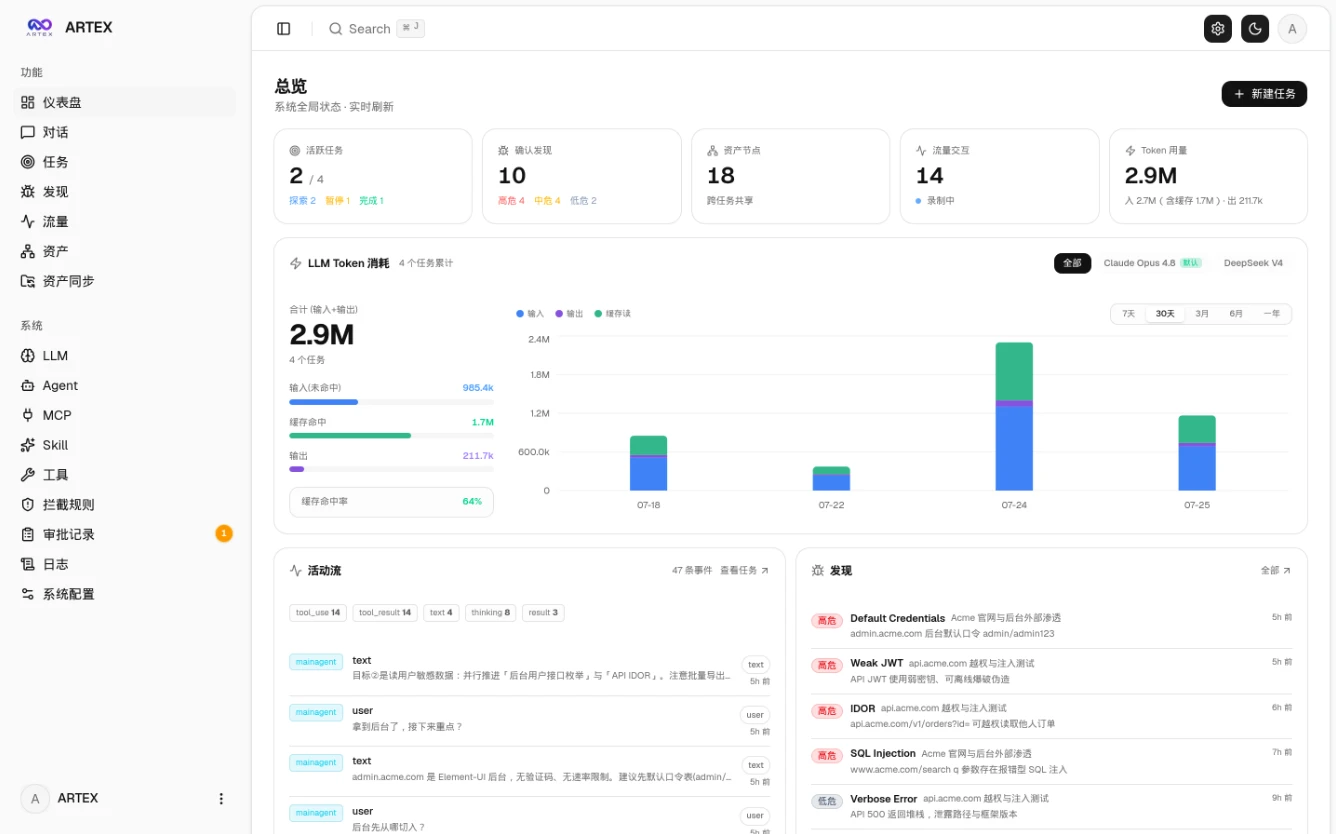
ARTEX is a multi-agent pentesting framework with a dual purpose: it can be used for legitimate auditing and it can be used for intrusions. Its Go design makes it easy to deploy on modest servers and orchestrate tasks in parallel, and its agent architecture allows work to be split between reconnaissance, service enumeration and exploitation without a human making every decision.
Artex the harness used to break into several companies
That division of labor is the real novelty. In a traditional attack, the operator chooses the next step and automation only speeds up repetitive tasks. With a set of agents, the system can test hypotheses in parallel, discard those that do not pay off and come back with another strategy, all within the same session. The operator goes from executor to supervisor.
The profile of who can attack also changes. A framework like this reduces the need for a specialist at each phase. It is enough to have someone who can read results and decide when to escalate. The barriers to entry for professional intrusion, which depended on knowledge accumulated over years, are lowered to the ability to configure a tool well.
From 200 targets in 14 countries to 140 in eleven days
The campaign described by CrowdStrike targets high-value objectives, not an indiscriminate sweep of the internet. The reports speak of organizations in 14 countries and a subset of 140 sensitive victims compromised in eleven days, which suggests a very efficient prior selection phase followed by concentrated exploitation.
That pattern is the hardest to detect. A massive scan generates alerts in any monitoring system, whereas a campaign that spends hours on each target and quickly discards those that show no promise leaves fewer traces. Volume is not the signal, selectivity is, and current defensive tools are trained for the former.
The framework has been seen in several parallel espionage campaigns, according to the analyses published in recent weeks, which points to shared use by more than one team. When an offensive tool becomes commonplace, it stops being a reliable indicator of attribution and becomes a detection problem for everyone.
When does the attacker also have a copilot?
ARTEX's advantage is not in finding flaws a human would not find, but in not getting tired. The exhaustive enumeration of services, the reading of manuals and the search for exposed credentials are tasks an agent performs at any hour and at an almost negligible marginal cost. What used to be cut short for lack of time is now done in full.
For the defender, that means small weaknesses stop being irrelevant. A forgotten admin panel, a key in an old repository or an internal service with a default password are exactly the kind of finding an agent turns up on the fourth pass and a human analyst dismisses out of boredom.
The answer is not magic either. Reducing the attack surface, shutting down what is not used and reviewing old credentials is still more effective than any model. The difference is frequency: what used to be done once a year now has to be done every quarter, because the other side does not rest between campaigns.
What is already being seen in other incidents
The ARTEX campaign is not alone. In recent weeks, several cases have appeared that share the same pattern: offensive automation is no longer a conference promise and has become campaign infrastructure. The the Chainalysis hack,in which an attacker used agentic techniques to access internal systems, is the most cited example in the on-chain analytics sector.
The abuse of institutional trust follows the same path. Impersonating technical support in Microsoft Teams to gain remote control and then abusing Active Directory Certificate Services is a classic chain that is now executed faster and with fewer specialists. AI does not invent the technique; it shortens the time between the idea and the execution.
It is also visible in malware. Families such as Yoba sign their samples with identities of known assistants to slip into repositories, and VOLTA uses language models to classify victims. Each isolated piece seems minor, and together they describe a shift in costs: what once required a team now requires an account and an afternoon.
For the defender, the cumulative effect is that the trust surface has expanded without inventories growing at the same pace. Every service that connects to a model, every tool that links to another and every integration that was approved without review adds a path that an agent can explore without rest.
The advantage that cannot be bought
There is a temptation to read this case as an arms race between models, with the good guys buying the best one to defend themselves. That reading is comfortable and half false. ARTEX is open source, and no defensive budget prevents a competitor from downloading the same tool.
What can be bought is time. Logging what happens, retaining the logs, knowing the real inventory and having a plan for the first sixty minutes of an incident are unglamorous investments that reduce the damage when the attack arrives automated. Early detection still depends on someone who knows what is normal on their network.
The pattern of offensive AI has already been seen in other recent campaigns, such as the use of ChatGPT and Claude signatures to slip malware into repositories, and it will be repeated. The question every organization should ask itself is not whether it will be the target of such a framework, but how many of its systems would still be standing if someone devoted to examining them the time an agent does not charge for.
With more than 200 organizations in fourteen countries and a cadence ten times that of a human team, ARTEX marks a before and after in commercial espionage. The next time someone proposes postponing the quarterly access review because "nobody is going to attack us," it is worth remembering that on the other side there is no longer a tired analyst.