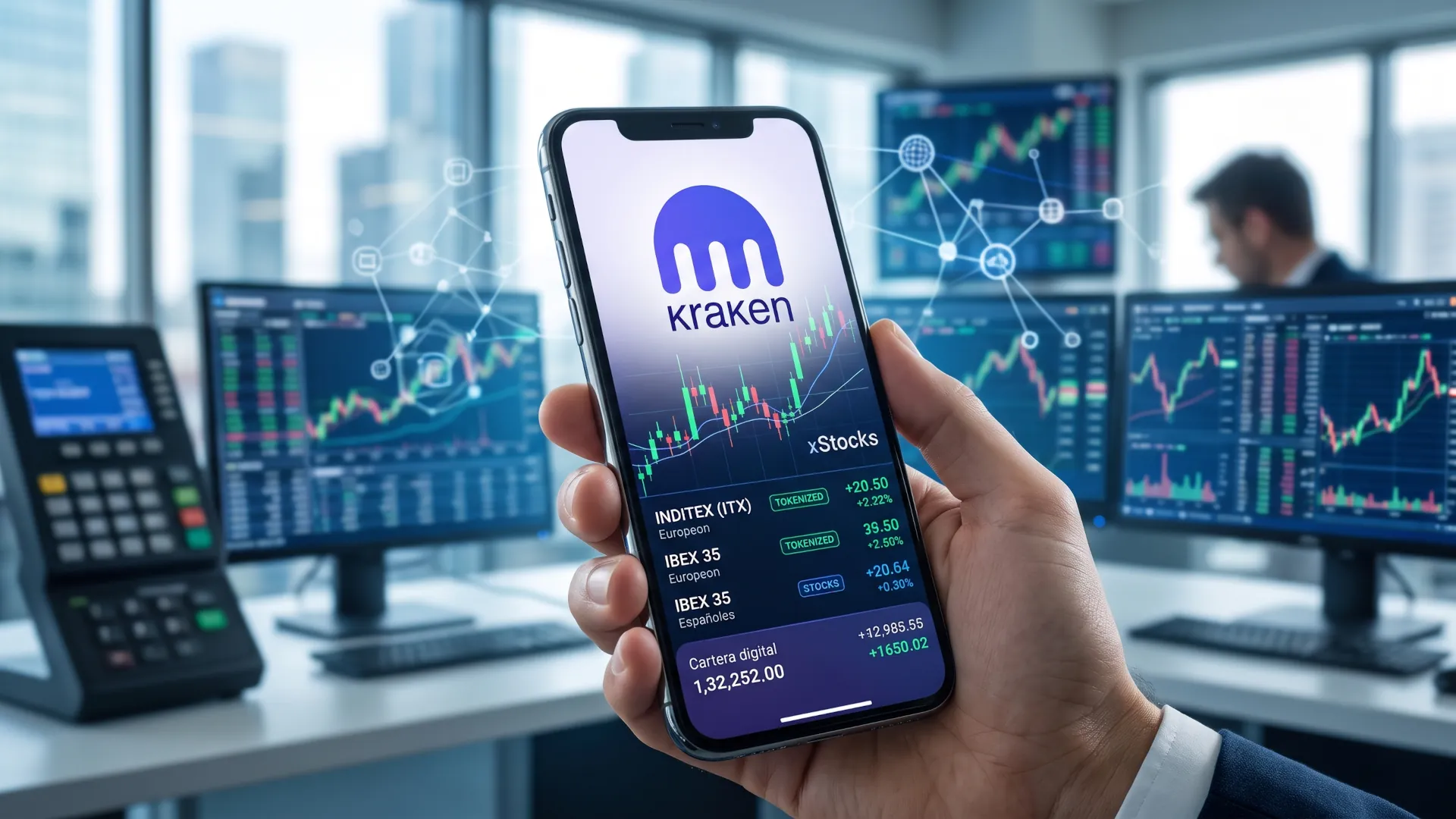
A saver with a Kraken account can this week buy exposure to Inditex's price without opening an account with a Spanish broker and without paying for the full share. Payward, the exchange's parent company, announced on November 11, 2026 the rollout of more than 200 tokenized shares of companies listed in the United Kingdom and the European Union, and eleven of them are from the Ibex 35. With this batch, the xStocks catalogue exceeds 1,500 assets across shares, exchange-traded funds and tokens linked to stock market listings, according to the figure the company itself cites.
What is bought is not a share, even if the product's name suggests it: it is a token that replicates its price. The distinction is not a technicality: whoever holds one of these tokens does not appear in the shareholder register, does not vote at general meetings, does not receive corporate information and cannot claim anything over the company's assets if it is liquidated. The real share exists, is bought and is held with a regulated custodian, but it belongs to the issuing structure, not to the buyer of the token that moves on the chain.
That is the point that decides whether the product fits in a portfolio. The tokenization of European equities reaches the general public with a long set of small print and with more than 550,000 holders already on board.
What the buyer of a token actually buys
Each token is backed one-to-one by a real share deposited with a regulated custodian for as long as the token remains in circulation. If someone sells the token, the corresponding share is released. In the meantime, the token's price tracks the share's with a known addition: the price includes a 1% spread over the market price, a cost the buyer pays on entry and does not recover through the value's rise.
A portfolio exposed to the price of eleven Ibex stocks is not a portfolio of shares. The first tracks the listing and collects or reinvests what the company distributes; the second adds a claim on the company and a voice in its decisions.
Dividends do not reach the current account either. When a company distributes profit, the issuing structure reinvests that amount in more units of the same token, so the balance grows in quantity, not in cash. For a long-term portfolio it resembles an accumulation fund.
Kraken's xStocks catalogue sets out the product's limits in writing. Holders have no voting rights, nor any legal right over the underlying share, and they also retain no claim on the remaining assets if the company is liquidated. The platform classifies these products as high risk and warns that all capital can be lost.
| Concept |
Data |
What it implies |
| Total catalogue |
More than 1,500 assets |
Shares, ETFs and tokens from stock market listings |
| Assets under management |
More than 1.1 billion dollars |
Sum of all xStocks products |
| Cumulative volume |
More than 45 billion |
Historical trading, not daily |
| Holders |
More than 550,000 |
Investors with some balance |
| Price spread |
1% over market |
Entry cost that is not recovered |
| Backing |
One share per token |
Deposit with a regulated custodian |
The table explains why the product is attractive for the platform and for the issuer, and why it is worth reading twice before assuming one is buying a stake. A 1% spread on a small trade seems little; repeated on every entry and exit it weighs more than a conventional broker's fee.
How is the real share actually held?
Execution and custody of the shares are handled by the firm GTN for all operations. The issuer of the tokens is not Kraken, but Backed Assets (JE) Limited, a company domiciled in Jersey that assumes the obligation to maintain one-to-one backing. That separation between platform, issuer and custodian marks the point where an investor should ask who is liable if something fails.
The tokens do not live only inside Kraken. They circulate on networks such as Solana, Ethereum and TON, can be withdrawn to one's own wallet and used in decentralized finance applications. That portability is the technical difference compared with a share bought at a traditional broker, where the security does not leave the intermediary's registry system.
The offer of more than 7,000 US stocks that Kraken opened in August to residents of the European Economic Area it had already brought equities to the app. What changes now is where the securities come from: a single portfolio can mix a Frankfurt stock with a token that moves on Solana.
Spain joins, the United Kingdom stays out
In the European Economic Area, Spain included, the client must first pass a questionnaire and can only buy and sell with fiat money, without paying with cryptocurrencies. German DAX securities are also available on 360X, Deutsche Börse's subsidiary covered by the European Union's pilot regime for distributed ledger technology-based market infrastructures.
The paradox of this batch is that the securities are British and European, but the investor resident in the United Kingdom cannot buy them. The products remain blocked for that market and are also not available in the United States or to US persons.
Nor is there any registration with local securities regulators. The tokens are not registered as securities in the jurisdictions where they are distributed, and trading hours and geographic restrictions change from one platform to another. For the buyer that translates into an uncomfortable question: who do they claim against if the issuer defaults.
The European Securities and Markets Authority warned in September 2025 that tokenized shares that only replicate the price, without direct ownership, create a specific risk of misunderstanding among investors who may believe they are shareholders without being so. The warning did not prevent the product then and does not prevent it now, but it accurately describes the most likely error in this batch.
Eleven Ibex securities and the full DAX
The first wave includes the 40 companies of the German DAX and eleven companies of the Ibex 35. The Spanish list is made up of Santander, Inditex, Iberdrola, BBVA, CaixaBank, Amadeus, Telefónica, Repsol, Aena, ACS and Endesa, with the breakdown of the eleven companies published on 12 November. The criteria are the most traded securities in each market, with staggered additions.
- Santander, BBVA and CaixaBank cover the Spanish banking sector of the index.
- Inditex, Iberdrola, Telefónica, Repsol and Endesa contribute consumer, energy and telecommunications.
- Aena, ACS and Amadeus complete the list with infrastructure, construction and travel technology.
The asset count in the sector report pushes the offering above 1,500 products and repeats the figures for assets under management, volume and headlines. None of those magnitudes distinguishes between shares with rights and exposure tokens, a detail worth keeping in mind when comparing the catalogue with that of a broker.
Two models of tokenizing a share
The market is splitting into two schools. One copies the price and gives up the rights, which is what this European batch does. The 18.5% of the decentralized finance market accumulated by Pendle is built with derivatives on those securities, contracts that mature and that do not aspire to make the buyer a partner in the company.
The other school tries to put the rights inside the token. The 63 OKXICE securities that include voting and dividends follow that logic, although their plan is still pending approval from the US regulator and several listed companies have objected to the use of their shares. Without that permission, the model with rights will remain the exception.
Between the two extremes sits the European investor, who can choose the price of Inditex today and full ownership only through a traditional intermediary. Convenience and voting rights do not travel in the same product.
The share register stays where it was
Equity tokenization advances where it finds the least regulatory friction, not where it best solves the problem of ownership. A token that replicates a price is easy to issue and to restrict by country, and that is why it is deployed first. One that conveys full ownership requires registering the holder and coordinating with companies that in several cases have already rejected that use of their shares.
For the Spanish investor, the practical decision is whether they want the price of Inditex or a part of Inditex. The first option is available today from a mobile phone, with a 1% surcharge, dividends in tokens and no voice at the shareholders' meeting. The second still requires a regulated intermediary, an ownership register and, in most cases, a higher fee.
That balance could change if European regulators end up defining what a tokenized security is and who is liable for it. Until the framework clarifies it, the market will grow through the derivative product door, the one that does not create new shareholders. The figure worth watching is not how many shares are tokenized, but how many of them grant something more than a price.