The market and regulation stopped moving in the same direction. In the week bitcoin fell 24%, Europe set a date for tokenized money. For anyone operating from Spain, December weighs more than any chart.
Bitcoin closes its worst month since 2022
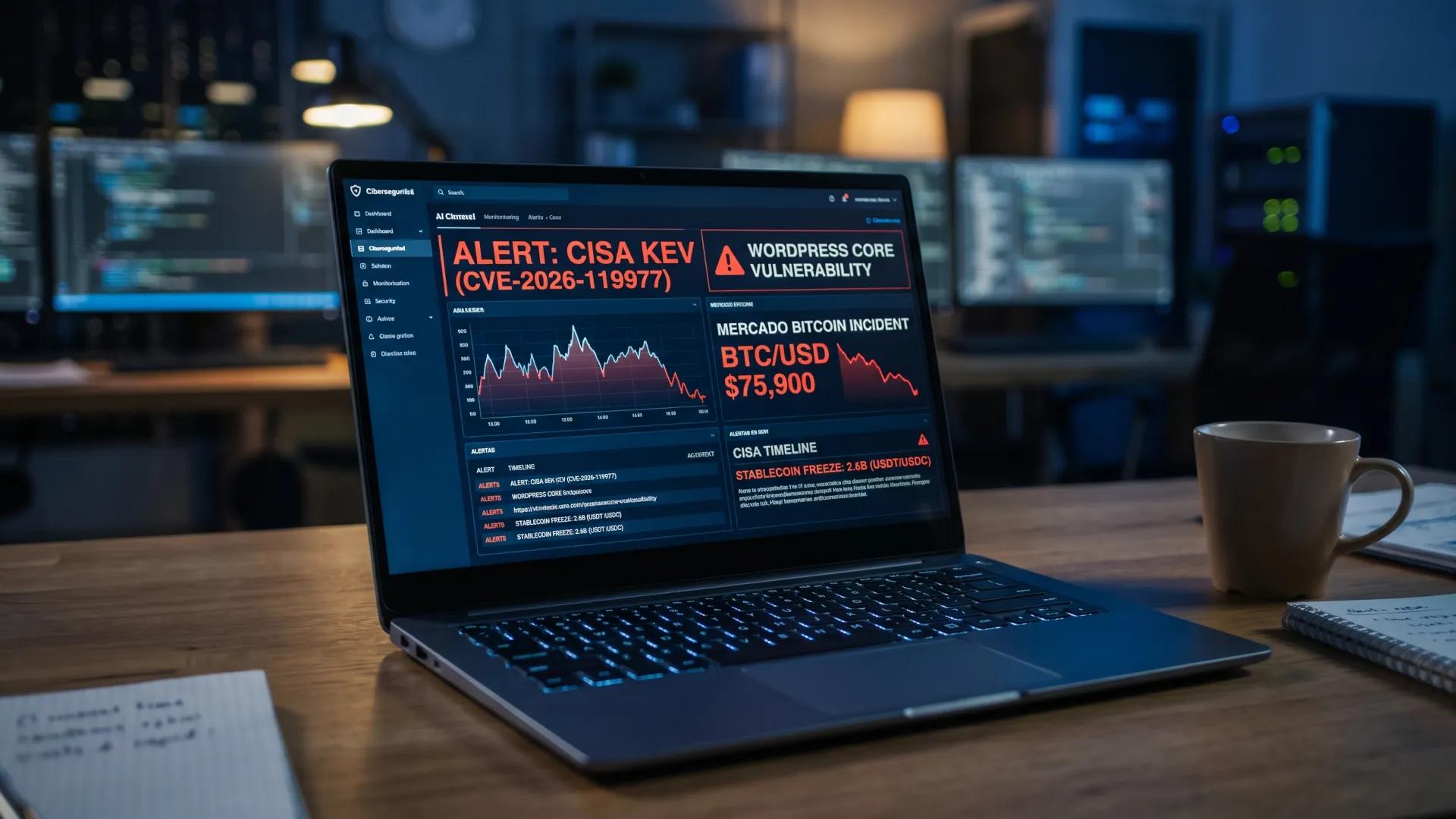
Bitcoin marked $57,778 in the Binance USDT pair at 19:00 UTC on Friday the 20th, its lowest level since September 2024. Three hours later it was trading at $59,050 and on Monday the 23rd it recovered $60,000 with a rebound that lasted a day. On Tuesday the 25th it broke through the zone again and marked $57,280, the month's low, as reported in the chronicle of the fall. The price has fallen 24.2% in November and 29.4% for the year, and is more than 50% below the October 2025 high.
The fall did not start in the sector. The Nasdaq lost 2.8% that Friday and ended negative for the year, the S&P 500 shed 1.5% and Anthropic's slump after its stock market debut dragged down venture capital. CoinGlass counted more than $1.5 billion in long position liquidations in 24 hours and some 225,000 traders affected, and Deribit stopped operating for nineteen minutes due to saturation. The data cited by Bloomberg puts the 40-day correlation between bitcoin and the Nasdaq 100 at 0.69.
The vehicle that brought the demand withdrew it. US spot bitcoin ETFs recorded $4.94 billion in net redemptions in November, an absolute record since January 2024, and 84% came out of BlackRock's IBIT, which lost $4.17 billion. The series ran six sessions of outflows until November 24, when $231.4 million were returned, the smallest daily amount since November 13. What changed is the cost of money, and the Fed decides on December 9 with the market pricing in a 25 basis point hike.
The reading is not a stampede. The third-quarter 13Fs showed 356,491 bitcoin in the hands of managers, an all-time high, and the gap with daily outflows measures only the delay with which each data point is published.
The detail of corporate treasuries adds pressure. Strategy holds 850,849 bitcoin at an average price of $75,452, far above the current quote. Next Technology sold 500 on November 21 for $29.22 million and was paid in USDT to finance its artificial intelligence business, the first proof that a company that had been accumulating for two years can become a net seller when the balance sheet tightens.
Huang returns and Wall Street celebrates without bitcoin
Nvidia's board reinstated Jensen Huang as chairman, chief executive and board member on Monday, November 23, eleven days after the resignation of the 12th. The decision was unanimous, the company said it had consulted senior US government officials and Reuters reported pressure from Donald Trump. The chronicle of the return includes the statement and the division of roles with Harvey Jones, who remains board chairman.
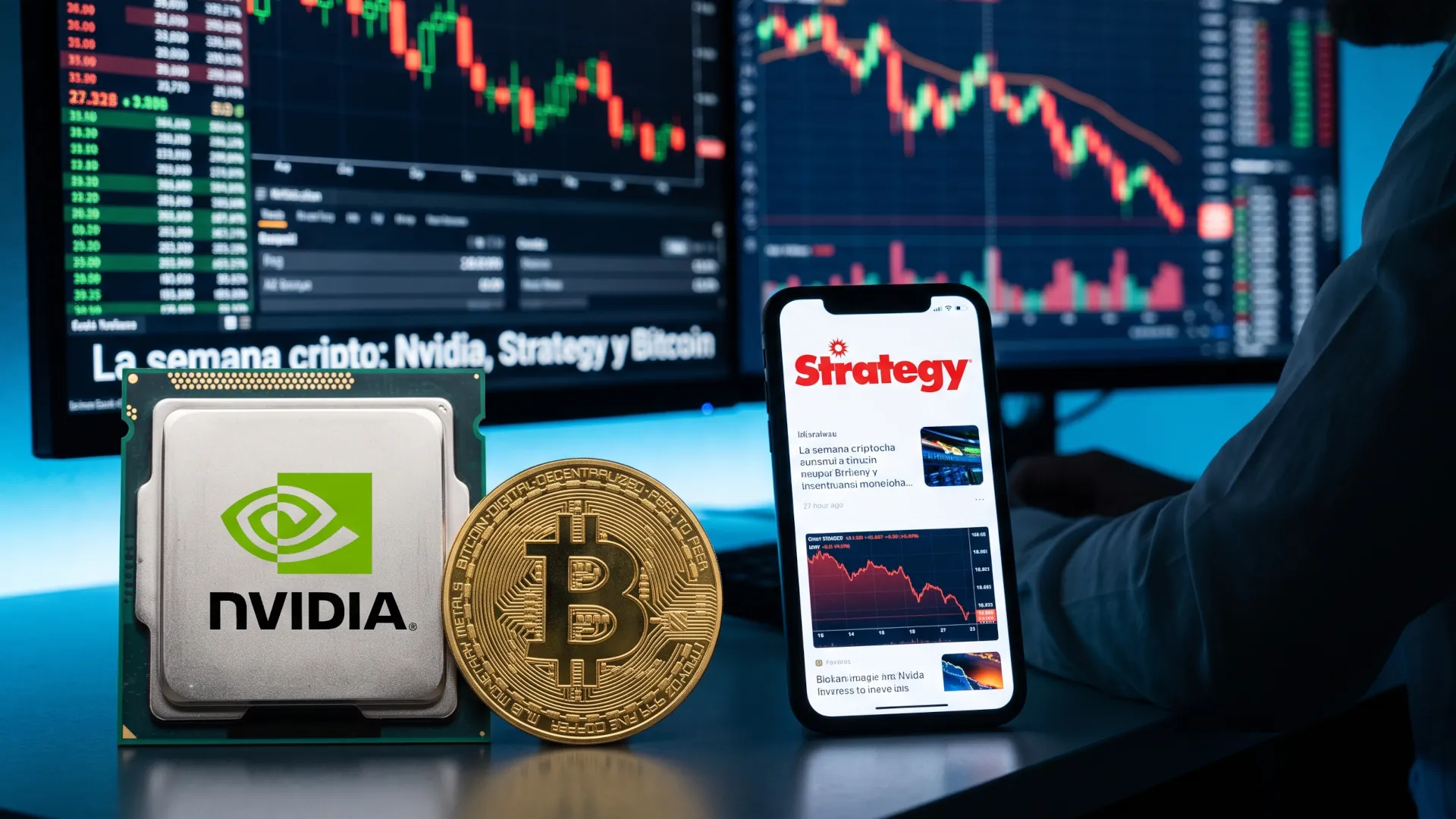
The market responded as if the problem had never existed. Nvidia closed at $165.05, up 31.48%, and recovered close to a trillion dollars in market capitalization. The Nasdaq advanced 6.5% and the S&P 500 4.7%. Bitcoin rose from $60,700 to $64,500 in the same session and lost the entire move in two days, with the funds returning $569.7 million on Monday and $84.9 million for ether.
The asymmetry has two explanations and the second is uncomfortable to admit. Nvidia answered on Tuesday whether artificial intelligence spending holds up one more quarter, and the answer was yes, with guidance above consensus.
It did not answer who buys bitcoin, and that is settled by fund flows and rate expectations. When a market cannot sustain a rebound on news like that, the signal is not technical: money uses every rise to reduce exposure.
Brussels decides who supervises European crypto
The ECB's Financial Stability Report, published on November 18 and endorsed by the Governing Council on the 12th, calls for ESMA to take over authorization, monitoring and sanctions for all cryptoasset service providers. Today each national authority authorizes and the European passport does the rest. The central bank's report sets no thresholds or timetable, and there lies its weakness, because a principle without arithmetic can be cited in any direction.
The tug of war is already open. The EU Council set out on October 9 a position that reserves direct supervision for significant providers, and Parliament's Economic Affairs committee votes on December 1 on a similar text. MiCA considers significant anyone with 15 million active users a year, a threshold the European system of central banks deems soft because it adds no concrete obligations.
The label already has its first case. Since November 12, USDC is the first e-money token classified as significant in the Union, and the EBA shares with the French regulator oversight of own funds, reserves, liquidity and redemption plans. The division of tasks leaves governance and qualifying holdings with the ACPR, which are the levers with which an issuer is changed from within.
The EBA went further on November 25: it raised restricting access to DeFi lending with stablecoins that lack MiCA authorization, a measure that hits applications acting as intermediaries.
It is the first time the European banking authority puts the retail gateway at the center of the DeFi debate. None of these pieces changes a license in Spain today: the CNMV continues to authorize and supervise local providers, and the ECB's opinion is an opinion, not a rule.
Spain appears in two files. The Commission sent on November 19 a reasoned opinion for failing to apply DAC8, with two months to respond, and opened a letter of formal notice for the pending transposition of the capital requirements reform and for unnotified MiCA articles. Neither stops the regulation, which applies directly, but both describe the missing plumbing.
The name that will lead that process has already been chosen. European leaders designated Pablo Hernández de Cos as ECB president on November 26, with formal ratification at the December summit and taking office in February. De Cos arrives with a clear thesis: stablecoins serve cross-border payments, but tokenized deposits are the infrastructure he prefers for wholesale money.
Tokenized money stops being a pilot
The ECB Governing Council approved on November 23 accepting as collateral bonds issued on platforms of the European distributed ledger pilot regime. In practice, a bank will be able to pledge a tokenized bond to request liquidity from the Eurosystem just as it today pledges a conventional bond. The technical details will come in spring, implementation is planned for June 2027 and the asset must meet all eligibility criteria and reach the central bank through an authorized link to a depository settling in TARGET2-Securities.
The same body published on the 24th its Tokenization Reference Model, which proposes starting with networks compatible with the Ethereum virtual machine to connect platforms and agree on how money and securities are transferred between them.
The warning matters more than the technical choice: if each network imposes its formats, a bank will have to connect to several to operate, and fragmentation reappears one level lower. Securities issued and settled entirely on distributed networks remain outside collateral and will be studied in phases.
The retail offering moved before the rules. Franklin Templeton launched on November 23 a euro money market fund, domiciled in Luxembourg and under UCITS format, which can be bought in Spain and six other countries. Shares are issued as tokens on the Benji platform, transferred between authorized wallets 24 hours a day and distribute yield by the second. The prospectus identifies the vehicle as erBENJI and requires a whitelisted wallet to subscribe or redeem.
Hong Kong followed the same path with an Asian accent. BlackRock opened there the first tokenized classes of a Hong Kong dollar liquidity fund, with $100 million under management as of November 20, and professional investors can subscribe with HKDAP, the stablecoin backed by the local dollar issued by the joint venture of Standard Chartered, HKT and Animoca. The difference with a pilot is the window: you go in and out with a token, not a transfer.
The ten key points of the week
Outside the price and Nvidia there were ten decisions with dates. In the key points that closed last week the focus was the drop below 62,000 and the Solana Foundation's purchase of CoinGecko.
- The bill that would turn the US strategic bitcoin reserve into law was ready for the House floor on November 24. H.R. 8957 prohibits selling the coins for twenty years, requires auditing holdings and gives the Treasury 180 days to set up the structure, with a legislative calendar ending January 3.
- South Korea presented on the 24th its second digital asset law. Won stablecoins may only be issued in consortia with a banking majority, with 5 billion won in capital, 100% reserves and monthly audits, and no shareholder may exceed 20% of an exchange without express authorization.
- Hong Kong published on the 20th the bill extending its licensing regime to dealing on behalf of clients, advisory, portfolio management and custody. The first reading will be on December 2 and leaves inside AI tools that recommend buying or selling a specific token.
- OKXICE, OKX's joint venture with the parent of the New York Stock Exchange, opened on the 23rd a market of 113 stocks and exchange-traded funds that operates without closing hours for selected US clients, under a temporary SEC exemption. The rollout is in phases and starts with names such as Fidelity, Robinhood, Coinbase and Circle.
- The HINC fund can be pledged on Aave Horizon since the 24th, with an initial loan of 55% of the collateral value. The institutional platform exceeds $500 million in deposits and until now only accepted high-quality collateral; the new fund includes high-yield corporate bonds.
- VanEck broke with Gemini and moved custody of its three ETFs to Coinbase, as confirmed by the forms filed on the 19th. The change affects the bitcoin, ether and Solana funds, will be effective around February 16, 2027 and does not withdraw funds or raise alerts about the assets.
- The Department of Justice requested on the 23rd the forfeiture of $1.17 billion in USDC from the October 29 Binance theft, spread across 36 addresses on 18 chains. The lawsuit turns a precautionary freeze into a civil request that a judge can grant or deny.
- Europol closed on the 24th an operation with eleven countries in Seville against audiovisual piracy: 57 services dismantled, 321 websites identified and more than 26 million euros in traced movements. No arrests were announced and no figure of seized assets was given.
- The Spanish company EthicHub entered insolvency proceedings. Lendingdev, the company that operates it, declares 4.67 million euros in liabilities with four employees and 694,803 euros in revenue, and the court opened the procedure on October 19.
- The Tax Agency uses blockchain traceability tools to locate cryptoassets in debt collection, as documented by the OECD's Tax Administration 2026 report. The text estimates that around 20% of seizures still require assisted manual intervention.
Cybersecurity, from the stolen key to the quantum calendar
On Friday the 20th, between 04:49 and 07:42 UTC, XMR1 went from $500 to $0.65. A wallet created that morning sold 363,804 tokens to 388 accounts for $13.5 million; the Wagyu operator attributed the access to the deployment key to an Icelandic hosting provider that suffered an attack, a point the chain cannot confirm. Native Monero did not move.
Chainflip lost some $12 million on Saturday the 21st with a more uncomfortable mechanism. The attacker registered a validator account with the minimum, used that access to exploit a memory flaw in a third-party networking library and gathered enough key fragments to sign vault operations off the network.
The pattern repeats in all three cases: the key or the permission was on a server, a library or a privileged role that no one reviewed with the same scrutiny as the contract. The lesson is not cryptographic, it is about attack surface.
Fusionist showed the cost of not closing the door in time. The attacker minted fake ACE, sold them for about $2 million and, as the bridge remained operational, 24 addresses exchanged 53.7 million fake tokens for real ones in two hours. Kraken added the market episode: its BTC/CAD pair reached 24,250 Canadian dollars, about $17,000, for fifteen minutes, and the exchange maintains the executed trades.
Long-term security had two documents. Google published in Science the Mermin-Peres experiment with 98.30% accuracy and a contextuality measure of 5.590 out of 6 possible, a hardware quality test that does not bring ECDSA's breaking any closer. The Ethereum Foundation recommended Keccak-256 for its future post-quantum signatures, admitted that artificial intelligence worries it more than the quantum computer and maintains 2029 as an internal deadline, with a calendar review in January.
The calendar that decides December
| Who |
What changes |
Date |
| European Parliament (ECON) |
Vote on ESMA supervision of significant providers |
December 1, 2026 |
| Hong Kong |
First reading of dealing, advisory and custody licenses |
December 2, 2026 |
| Federal Reserve |
Rate decision, with the market at 85-90% for a 25 basis point hike |
December 8 and 9, 2026 |
| European Council |
Formal ratification of Hernández de Cos as ECB head |
December 17 and 18, 2026 |
| US Congress |
End of the session with H.R. 8957 pending on the floor |
January 3, 2027 |
| ECB |
Hernández de Cos takes office |
February 2027 |
| Eurosystem |
Tokenized collateral from the pilot regime |
June 2027 |
What to watch next week?
- The Fed announces on December 9 with futures pricing between 85% and 90% a 25 basis point hike. If Kevin Warsh hints that it is the last of the cycle, the risk-free rate competing with bitcoin changes abruptly.
- ETF flows remain the thermometer. A single session with net inflows would break six days of redemptions, and IBIT concentrates 84% of the monthly bleed, so its first positive day would be worth more than any technical rebound.
- On December 1 Parliament's economic committee votes and on the 2nd the licensing bill is read in Hong Kong. Two votes that define the perimeter of supervision without depending on price.
- H.R. 8957 has five weeks of legislative calendar until the January 3 close. Without a floor vote, the reserve will remain a decree that the next president can reverse.
- The Ethereum Foundation reviews its post-quantum calendar in January and the network's difficulty adjustment came with a rise close to 9%, two data points that affect miners and validators before the price.
Infrastructure rises while the price falls
In the same seven days in which the funds returned $4.94 billion, the ECB accepted tokenized bonds as collateral, Franklin Templeton opened a euro fund for Spanish retail investors and the EBA began sharing oversight of USDC with the French regulator. None of those decisions depends on the quote, and that is why they describe better where the market is heading than a two-session rebound.
What changed this week is the center of gravity. The price follows the Fed and the Nasdaq, the rules are decided in Frankfurt and Brussels, and the products that reach the Spanish investor are issued in Luxembourg and settled on a chain.
For a local operator the consequence is practical: the December calendar matters more than the chart, and the cost of the MiCA label will be measured in how many small issuers survive the next annual review.