Renault integrates blockchain into the heart of the car of the future
Renault drives the vehicle of the future with blockchain to share data and algorithms securely and traceably
By Sergio Gomez · Published: · Updated: · 5 min read
Renault integrates blockchain into the heart of the car of the future
The participation of the Spanish company Kolokium in the PERTE of the DIVEC project, led by Renault, has served to demonstrate how a permissioned blockchain architecture can become the trust layer that allows partners to collaborate without losing control over their data and digital assets.
The digital transformation process in the automotive sector has made it clear that the future depends on collaboration. Sharing data on vehicle performance, driver behavior or the lifecycle of components is the fuel needed to train advanced artificial intelligence (AI) that delivers truly innovative services.
However, a fundamental paradox arises here: data and algorithms are the most valuable and strategic assets of each company. The risk of intellectual property leakage or misuse of information can paralyze the innovation the industry needs to compete globally.
In this context, a distributed trust architecture based on blockchain technology can resolve the collaboration paralysis when sensitive data and AI algorithms are shared. It is an approach that, in addition to guaranteeing security and digital sovereignty, opens the door to new collaboration models in data spaces, turning trust into a strategic asset for the industry.
The challenge to address
The Connected and Electric Vehicle (CEV) ecosystem is moving toward a more digital, sustainable and connected model, but this intensifies governance and security challenges that affect the entire value chain.
The most significant include:
Digitalization of the value chain: the modern vehicle has evolved into a "data center on wheels." This digitalization spans manufacturing, the supply chain, embedded systems and after-sales services, creating a complex and fragmented ecosystem.
Massive data management: the CEV generates exponential volumes of information through sensors, driver interactions and vehicle-to-everything (V2X) communications. Managing this information securely and efficiently requires robust and precise solutions.
Lack of interoperability: multiple actors (manufacturers, suppliers, software developers, service providers) operate in silos with disparate systems, hindering reliable data exchange.
Demand for traceability and security in critical environments: when a software update can alter vehicle behavior and a component failure has a direct impact on safety, having an immutable and auditable record stops being a luxury and becomes a legal and operational necessity.
The dilemma of the three actors
At Kolokium we believe that the real brake on innovation is not only technological, but also a problem of governance and trust. Traditional technologies can transfer data, but they cannot enforce usage rules between competing commercial entities without a trusted intermediary, which in turn creates a bottleneck, a single point of failure and a security risk.
This stalemate materializes in what at Kolokium we have called the "Dilemma of the 3 Actors":
Data Owner: Each manufacturer in the automotive industry owns a set of massive, high-value data, such as driving profiles, vehicle telemetry or sensor readings. Handing over control of this data means losing a key competitive asset and exposing oneself to privacy and regulatory compliance risks.
Algorithm Developer: A technology partner owns valuable intellectual property in the form of AI and machine learning models. Sharing the model so that others can run it is equivalent to giving away its most precious asset.
Service Consumer: A third entity, such as a mobility planning or geographic analysis firm or a public administration, needs access to the results of running the algorithm on the data (for example, to decide where to locate new charging stations, detect road risks, optimize routes, etc.), but it cannot be entrusted with direct access to either the raw data or the algorithm.
The solution: blockchain as a trust arbiter
This triple dilemma generates paralysis and a common problem that means no one hands over their assets. The system stalls because no one wants to give up their strategic digital assets. The data owner will not hand over their data to the algorithm developer for fear of leakage or misuse. The developer will not deploy their algorithm on the data owner's infrastructure for fear of theft or copying of their intellectual property. This distrust prevents the collaboration needed to innovate.
To overcome this deadlock, Kolokium has worked on DIVEC with a private, permissioned blockchain infrastructure based on Hyperledger Fabric, where smart contracts make it possible to encode and enforce collaboration rules automatically and verifiably.
A digital notary
The blockchain architecture acts as "a digital notary" or a decentralized and automated "custody service" to execute actions on digital assets (data, algorithms, results), recording cryptographic evidence of what happened.
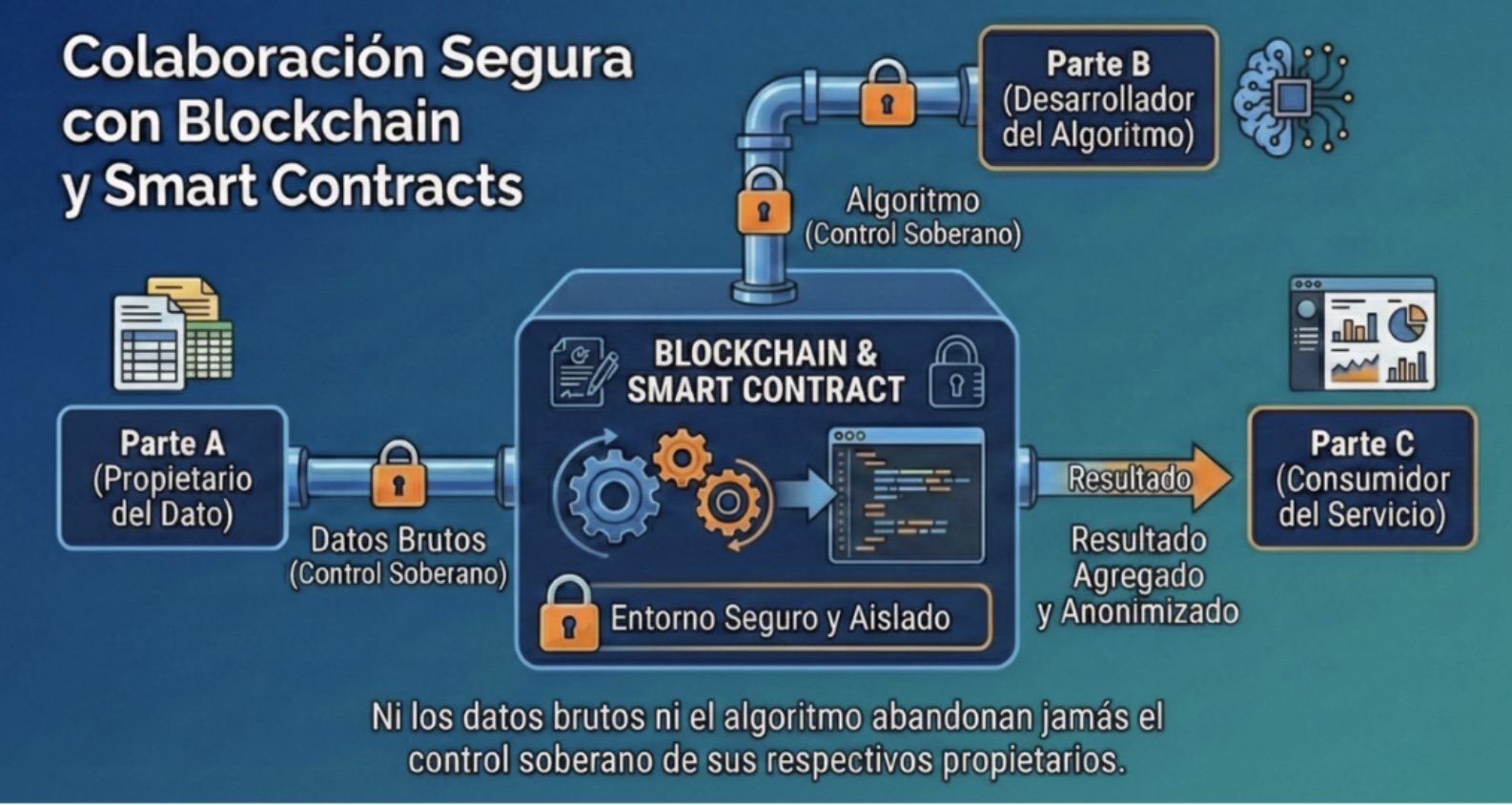
Through the use of smart contracts, a pre-established agreement is encoded and automatically enforced. Thus, the algorithm ofparty B (algorithm developer) runs on the data ofparty A (data owner) within a secure and isolated environment; only the aggregated and anonymized result is delivered toparty C (service consumer).
Neither the raw data nor the algorithm ever leave the sovereign control of their respective owners. None of the parties needs to give up direct control or ownership of their digital assets in order to collaborate.
Resolution of the "Dilemma of the 3 actors" in collaborative scenarios: data owner, algorithm developer and service consumer
This approach, applied by Kolokium in the DIVEC project, changes the paradigm from mere access control to granular and programmable usage control, which constitutes a technical and business innovation.
Trust as an operational asset
Blockchain technology makes it possible to lend credibility and decentralization to the processes and data shared among different actors. The design, construction and validation of a layer that provides immutable traceability, security and transparency. This comprehensively covers:
The management of vehicle data, from the sensor to the cloud.
The certification of the lifecycle of components, both software and hardware.
The certification of AI algorithms, their training data and the decisions they generate.
The guarantee of interoperability and verifiable trust between systems and partners.
Thanks to the above, not only are security and traceability guaranteed, but new models for sharing data and algorithms under verifiable rules are enabled, opening the door to monetization and collaboration schemes in data spaces that turn trust into real value.
Scaling the model to other industrial sectors
The participation of Kolokium in the DIVEC project positions the company as a benchmark in the application of blockchain in the connected mobility industry and reinforces its role in strategic technological innovation projects, where blockchain acts as the driving axis of trust. An approach that makes it possible to scale the model to industrial sectors in which areas such as Legal, QA, Compliance, IT or Operations need to guarantee integrity, verifiable execution and process auditing in complex environments.
*Sergio Gómez Martínez, Head of Product & Project Management Kolokium