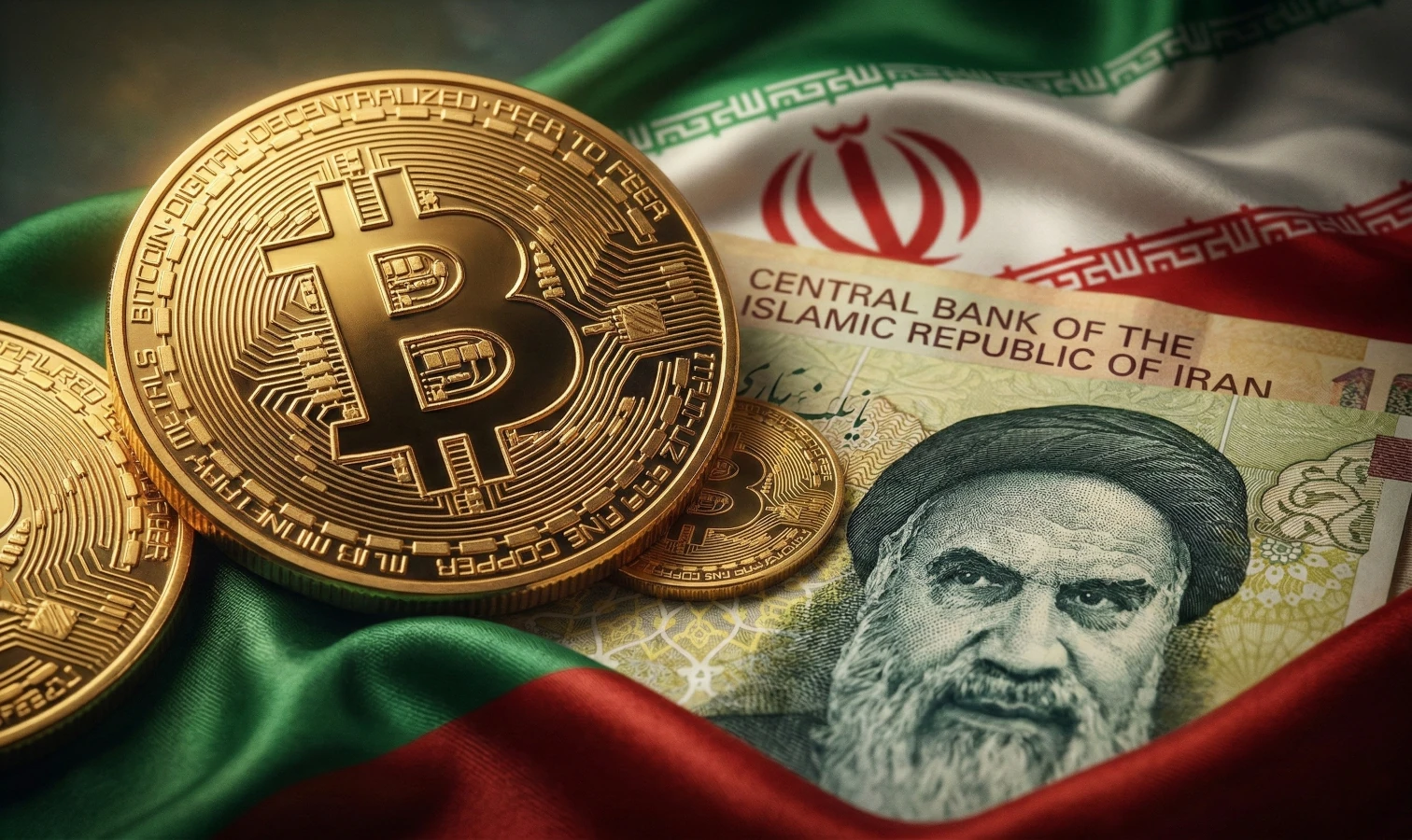
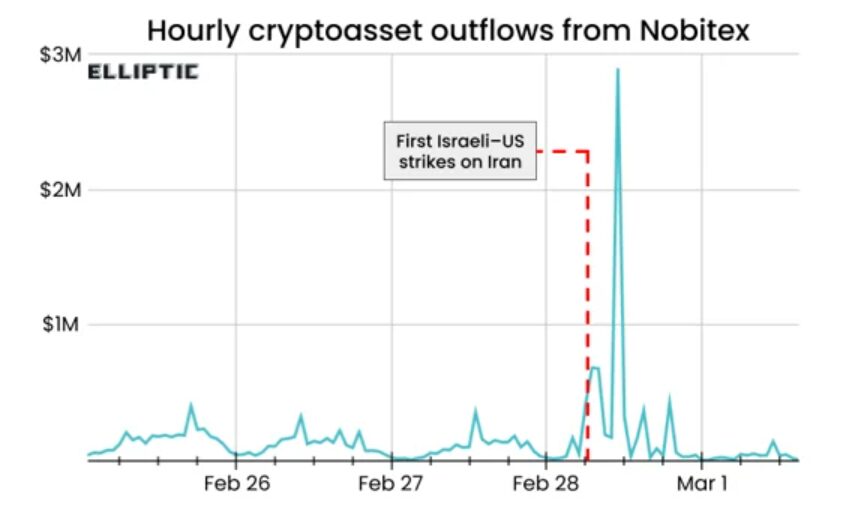
After the first joint US and Israeli airstrikes against Iranian targets, the country's financial system was shaken within minutes, with thousands of users seeking to safeguard their capital in cryptocurrencies, outside state structures. The impact was concentrated on Nobitex, Iran's main cryptoasset exchange, which recorded a 700% increase in outgoing transaction volume immediately after the military offensives were confirmed.
This massive exodus of digital capital is nothing more than a raw representation of how war panic translates instantly into fund movements seeking to dodge the collapse of the local currency and government control.
The phenomenon observed on Nobitex shows that, faced with the threat of a large-scale conflict, citizens and economic actors turn to cryptocurrencies as the main capital flight mechanism, allowing assets to cross borders almost immediately while the traditional banking system is paralyzed or comes under extreme scrutiny.
But beyond that, this mobilization of resources marks the starting point for understanding a new era of financial sovereignty in wartime, where the blockchain becomes the preferred conduit for safeguarding wealth against geopolitical uncertainty.
BITCOIN REBOUNDS 5.7% AND NEARS $70,000 AMID ESCALATING WAR
Nobitex, the financial lung under fire
To grasp the relevance of this infrastructure, it is crucial to understand that Nobitex is not just an exchange portal, but the central axis of Iran's cryptoasset ecosystem.
With a user base exceeding 11 million people, this platform consolidated itself in 2025 as a financial entity of massive weight, moving a total of $7.2 billion in transactions.
Its strategic importance has transcended the civil sphere, having even been linked to financial activities aligned with the IRGC and used by the Central Bank of Iran in a desperate attempt to shore up the value of a steadily falling rial. In a conflict context, Nobitex becomes a "lung" that allows the economic breathing of millions of people against the suffocating siege of sanctions and wartime instability.
Local tokenization
The technical mechanism that facilitates this function is as effective as it is controversial: the platform allows users to convert their rials directly into cryptoassets, which can be immediately withdrawn to external wallets. This process of tokenizing local capital offers an escape route that bypasses much of the scrutiny and restrictions of the global banking system, allowing wealth to leave Iranian borders silently.
By facilitating this bridge to exchanges abroad, Nobitex provides the necessary tools for large-scale capital flight. A situation that challenges traditional control mechanisms, placing itself at the center of a complex game of financial shadows in which blockchain technology serves as the last resort for economic survival and the evasion of international sanctions.
Sanctions, protests and Internet blackouts
Of course, this financial behavior is the result of a track record of resilience under constant pressure. During the first months of 2026, significant activity peaks had already been observed that prepared the ground for the current response, most notably the one recorded on January 9. That massive increase in asset outflows coincided with a wave of demonstrations across the country and the subsequent Internet blackout imposed by the regime to quell the protests.
Although the digital restriction caused a temporary reduction in Nobitex's operating volume, the flow of capital never stopped completely, suggesting that certain actors possess privileged access channels to the platform's reserves even when the official website is inaccessible to the general public.
TURKEY PROPOSES A 10% QUARTERLY TAX ON CRYPTO GAINS
Pressure on the Iranian regime
To this dynamic of internal instability is added the external pressure of the international community. Other large-scale spikes in cryptoasset outflows appeared immediately after the United States announced new sanctions targeting Iranian officials and financial evasion networks.
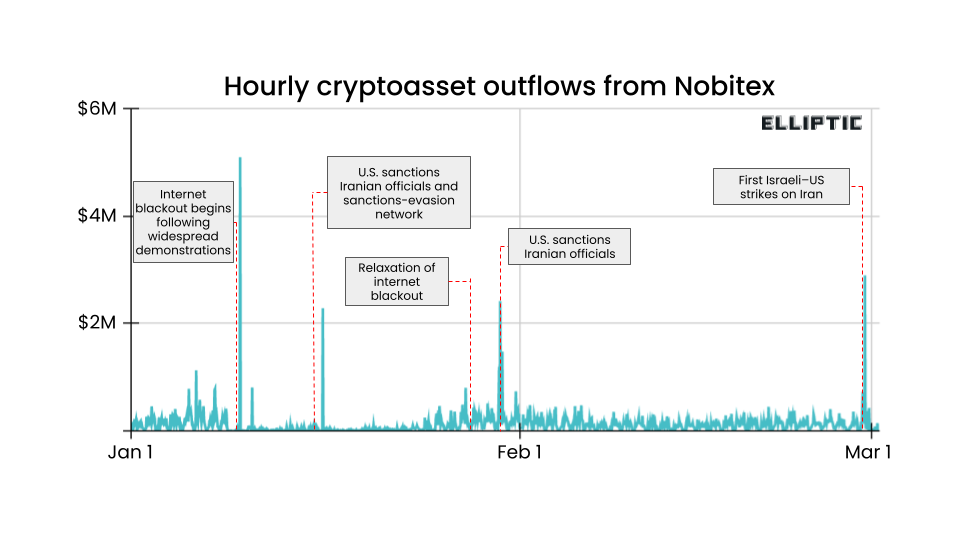
This background reveals that the use of cryptocurrencies in Iran has evolved from being a technological alternative to becoming a tool of geopolitical survival, used both by citizens seeking to protect their savings and by the state itself to try to stabilize the rial or evade economic blockades.
Thus, the current explosion of transactions after the military attacks is the culmination of a learning process in which the population and the government have learned to operate in the shadows of the blockchain under the most adverse conditions.
The trail of Tehran's money
The destination of these massive capital flows underscores the interconnection of Iran's digital economy with the rest of the world, defying geographic and political barriers. The traceability analysis carried out on the recent Nobitex outflows by Elliptic, suggests that the funds do not remain in static private wallets, but are predominantly transferred to cryptoasset exchanges abroad.
These receiving platforms are not new destinations; they are international entities that have historically maintained a significant volume of inflows from Iranian users. This pattern reveals a well-established exit infrastructure, where digital assets function as a liquidity bridge connecting an economy under siege with broader global markets.
The persistence of these movements, even under conditions of limited connectivity, points to notable operational sophistication. Despite periods of digital blackout, continuous outflows have been observed, indicating that certain actors retain access to the platform's holdings even when public web access is restricted.
This phenomenon points to the existence of specialized exit channels that allow capital to circulate abroad, consolidating cryptocurrencies as the preferred tool for transferring value in situations where the traditional financial system is inoperable or excessively risky.
DEPIN BLOCKCHAIN INFRASTRUCTURES SURPASS $8 BILLION AND GROW 54% IN A YEAR
The challenge of financial control in the digital era
Thus, the massive mobilization of assets from Iran after the recent military attacks not only represents a local crisis, but also poses an unprecedented challenge to the integrity of the international financial system. Nobitex's ability to facilitate the conversion of rials into cryptoassets and their subsequent withdrawal to external wallets allows capital to evade the scrutiny of global banking, becoming a critical vehicle for capital flight.
But at the same time, this phenomenon shows that, in times of conflict, cryptocurrencies function as a shadow infrastructure that allows actors under suspicion, including those linked to financial activities aligned with the IRGC, to move resources beyond the reach of international authorities. As these funds disperse to foreign exchanges that have historically accepted Iranian flows, the risk of money laundering and the erosion of economic sanctions become an undeniable reality.
The sophistication of these movements, which persist even during Internet blackouts, underscores a vulnerability in global compliance protocols that risk teams must address urgently. Ultimately, the Iranian case serves as a critical reminder that the blockchain is now the new battleground in the fight for financial transparency, where the speed of technology often outstrips the response capacity of traditional regulation.