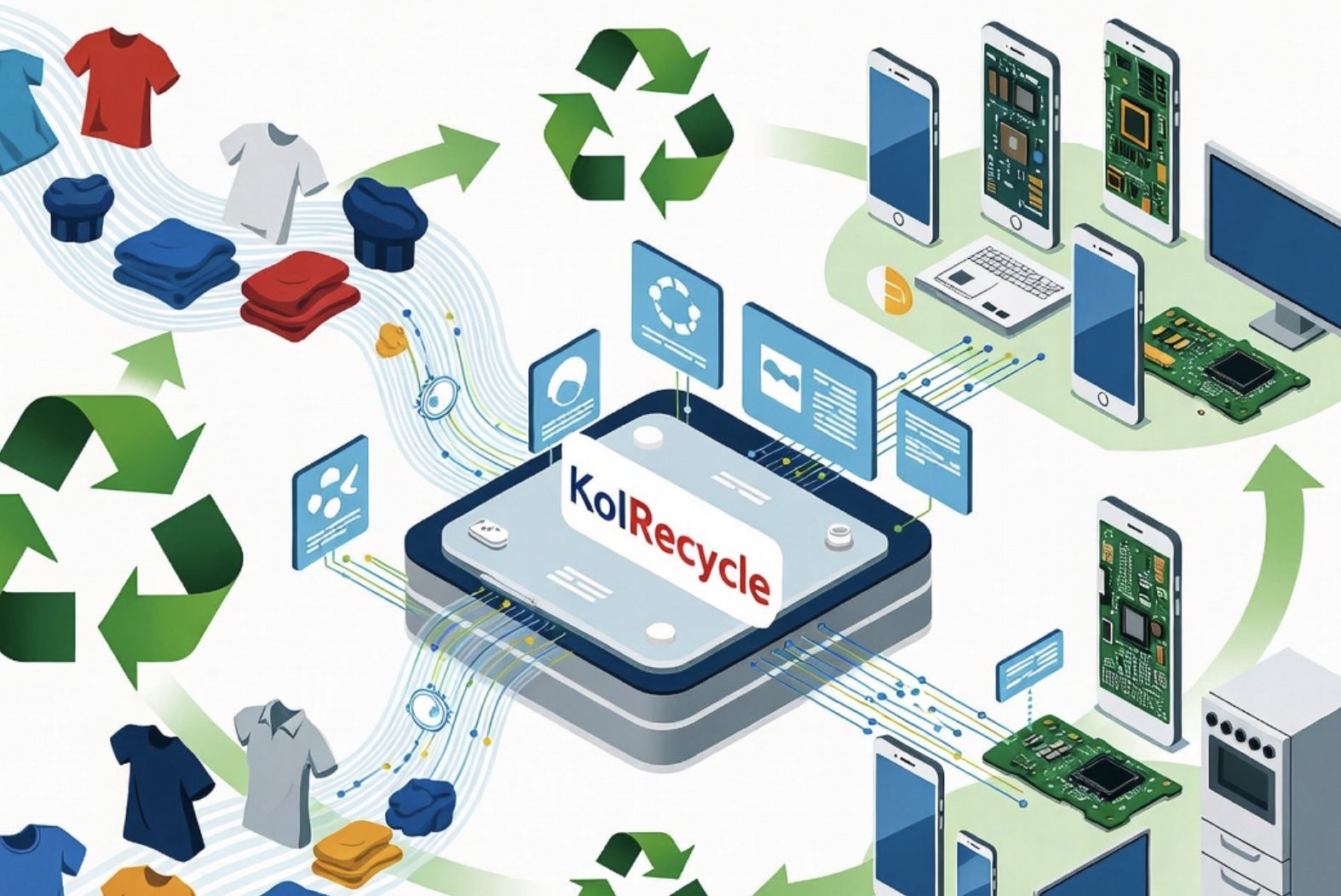
The Spanish platform KolRecycle has become one of the main solutions helping companies tackle the growing technical complexity of the circular economy in the European Union. With the entry into force of the application schedules of the Packaging and Packaging Waste Regulation (PPWR), the technology developed by Kolokium Blockchain Technologies makes it possible to turn legal obligations into auditable and verifiable data flows.
Data governance process
In this context, in 2026, Europe has left the transition phase behind and is entering a stage of operational requirements. The rollout of the Ecodesign Regulation (ESPR) and the Digital Product Passport (DPP) now requires sectors such as textiles and electronics to have structured, interoperable and verifiable information on the life cycle of each product. This framework is complemented by Law 7/2022 on Waste in Spain and the strengthening of Extended Producer Responsibility (EPR).
Data and blockchain, the pairing that will define the circular economy
Compliance with the rules thus ceases to be a documentary exercise and becomes a continuous process of data governance. Companies must not only comply, but also credibly demonstrate that aspects such as recycled content or the declared carbon footprint are real and traceable.
In this scenario, KolRecycle addresses one of the main challenges of the circular economy: the fragmentation among the different actors in the value chain. Manufacturers, distributors and waste managers traditionally operate in isolated systems, which hinders traceability. The platform, which is built on a permissioned blockchain network, connects these environments and allows information to be shared securely and verifiably.
KolRecycle as a cross-cutting architecture
Its technological approach is based on three pillars. First, governance and privacy, which allow sensitive data to be shared among actors while maintaining confidentiality and, at the same time, guaranteeing a single source of truth for regulators. Second, the generation of digital evidence: every milestone in the life cycle of the product or waste is recorded immutably, strengthening reliability in audits and reducing the risk of greenwashing. Finally, the platform is designed to integrate with the Digital Product Passport, facilitating the management of data accessible to both consumers and authorities through unique identifiers.
In the current regulatory framework of the European Union, the integration of infrastructures such as KolRecycle becomes a cross-cutting architecture capable of interoperating among all agents in the value chain. Beyond regulatory compliance, the adoption of these systems allows organizations to consolidate an operating model based on data integrity. This verification capability is positioned not only as a differentiating competitiveness factor, but as the essential technical core on which the circular economy is deployed at industrial scale.