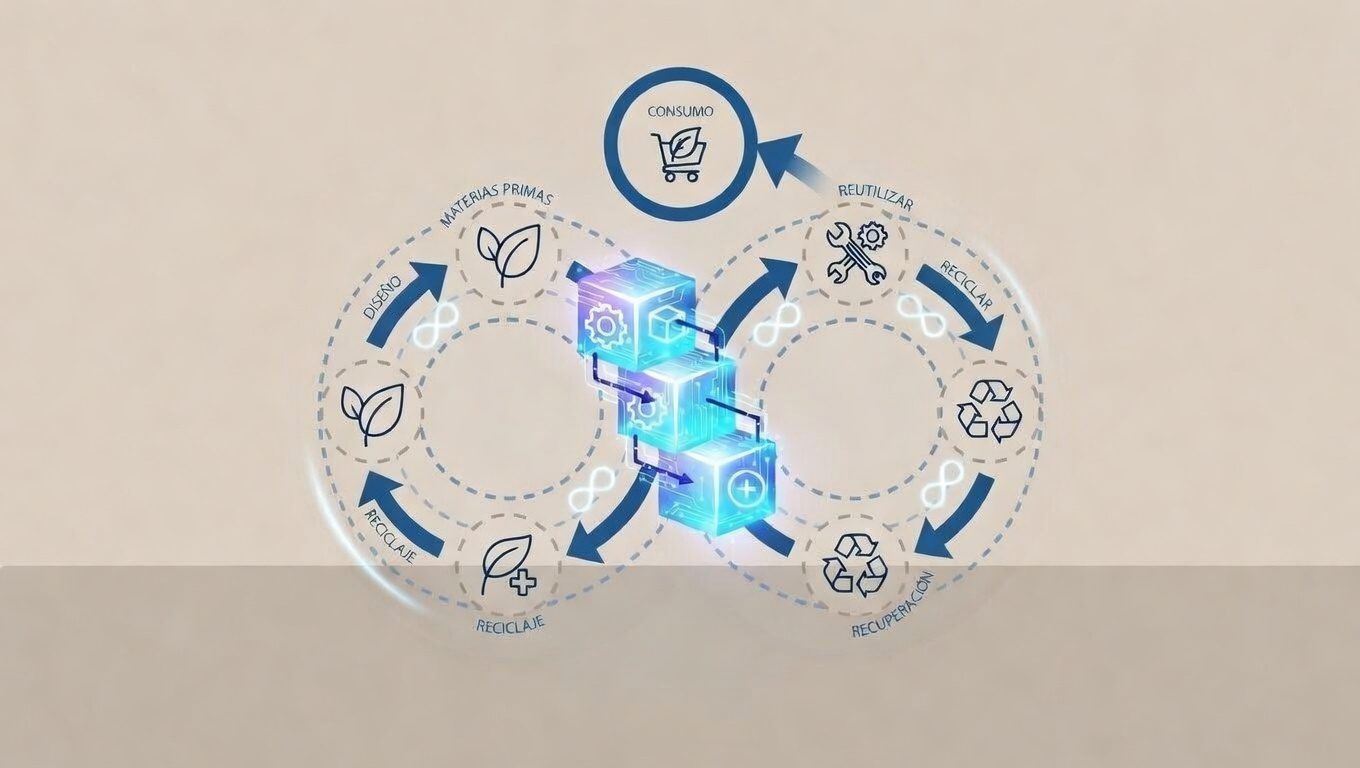
The role of data, traceability and the transformation of production processes are emerging as the major challenges for implementing the circular economy, a model in which technologies such as blockchain could prove key to guaranteeing trust among the different actors. This is according to an article published by José Juan Mora, founder and CTO of Kolokium, a specialist in technology, blockchain, digital identity, data governance and DevGovOps models.
In his analysis, Mora addresses the main challenges facing companies and administrations in this transformation process, from the redesign of supply chains to the need to guarantee product traceability. The author focuses on the strategic role of data and argues that only through secure, interoperable and verifiable governance models will it be possible to consolidate an efficient circular production system.
Data and the circular economy
In this context, he identifies blockchain technology as a key element for building trust among the different actors and facilitating the transition to this new model. The transition to the circular economy is advancing strongly in Europe and worldwide, driven by regulations that respond to growing social demand for sustainability. However, this structural change still faces significant challenges, especially regarding data management and the transformation of production processes.
KOLRecycle, the Spanish blockchain platform for recycling traceability
The circular economy model represents a break with the traditional linear production system based on make, use and throw away. Instead, it proposes keeping products, materials and resources in use for as long as possible. According to Mora, this approach rests on three pillars: reducing environmental impact, extending the useful life of products and regenerating natural systems.
However, putting this approach into practice entails a profound transformation of the entire value chain. From product redesign to the adaptation of logistics chains, companies must rethink their processes to incorporate principles such as reuse, repair or recycling. Mora notes that breaking this pattern is proving a major effort for all the actors involved, from producers to consumers.
Redesigning production processes
Among the main challenges, the expert highlights the need to redesign production processes, adapt supply chains to incorporate reverse logistics and assume greater responsibility for suppliers. He also underlines consumer behavior as a determining factor in consolidating the new model.
Beyond physical processes, Mora focuses on data, a critical element that often goes unnoticed. In the current model, information is managed in silos within each organization, which hinders its verification and limits trust among the different actors. This lack of transparency complicates the implementation of circular economy schemes, in which products must travel not only the path to the customer but also the path back into the production system.
According to the author, data traceability is essential to guarantee the efficiency and viability of these models. Without reliable information on the materials or components of a product, recycling or reuse processes become more costly and inefficient. In this context, Mora argues for the need to develop new data governance models in which information is accessible, verifiable and secure throughout the entire product life cycle. Unlike the linear model, in which data ceases to have value once the product's use ends, the circular economy requires that data accompany the product through all its phases.
Blockchain technology
To address this challenge, Mora points to blockchain technology as one of the main allies. Its characteristics, such as immutability, traceability and the ability to generate trust without intermediaries, make it possible to build more transparent and secure data systems. Blockchain can help companies transform their own information silos to be more secure, interoperable and reliable, Mora notes.
Mora also highlights that decentralized models allow companies to maintain sovereignty over their data while facilitating its sharing with other actors in the value chain under secure conditions. This perspective not only improves operational efficiency but also strengthens trust among the parties involved.
Ultimately, Mora asserts that the success of the circular economy will depend to a large extent on the ability of organizations to manage data correctly. Without a clear strategy in this area, these models are doomed to failure, he says.
The Kolokium CTO's analysis concludes that technologies such as blockchain can play a fundamental role in this transformation by facilitating more secure, traceable and reliable data models, essential elements for moving toward a truly circular economy.