
ISBE inherited years of networks, knowledge and a business ecosystem built around Alastria, the blockchain consortium set up in 2017 with the collaboration of nearly seventy large companies, institutions and professionals from various sectors. It is worth recalling that Observatorio Blockchain was one of Alastria's founding members.
ISBE began to take shape on the back of that experience: an infrastructure with a national remit whose construction was carried out during 2025 and which officially announced it went into operation on 19 December of that year. Long before ISBE was launched, Alastria developed Red T, based on Quorum, and Red B, built on Hyperledger Besu, where projects, proofs of concept, smart contracts and related solutions were developed in areas including digital identity.
Nearly 9 million euros
That starting point matters for understanding ISBE, because Spain already had years of experience and enterprise blockchain infrastructure behind it. This new stage therefore poses the challenge of turning that experience into continued use by companies and public administrations. After years of proofs of concept and pilots, the relevant indicator is no longer just how many use cases can be developed, but how many actually get used and what activity they generate.
ISBE is presented as an infrastructure ready for business and administrative applications in areas such as verifiable credentials, traceability, certification and tokenization. Its possible applications include diplomas, digital product passports, supply chains, public procurement, copyright, smart contracts, carbon credits and tokenized assets. The technical capacity to support all these applications exists. The question now is how many are actually used, who uses them and how intensively.
It is worth recalling the weight of public funding in the development of ISBE and its use cases. The project has an overall budget of 8,923,758 euros: the Community of Madrid manages 6,738,000 euros, of which 5,053,500 come from the European Union's Recovery and Resilience Facility and 1,684,500 from the regional administration's own funds. Added to this is Alastria's contribution, through technology assets valued at 2,185,758 euros.
Community of Madrid
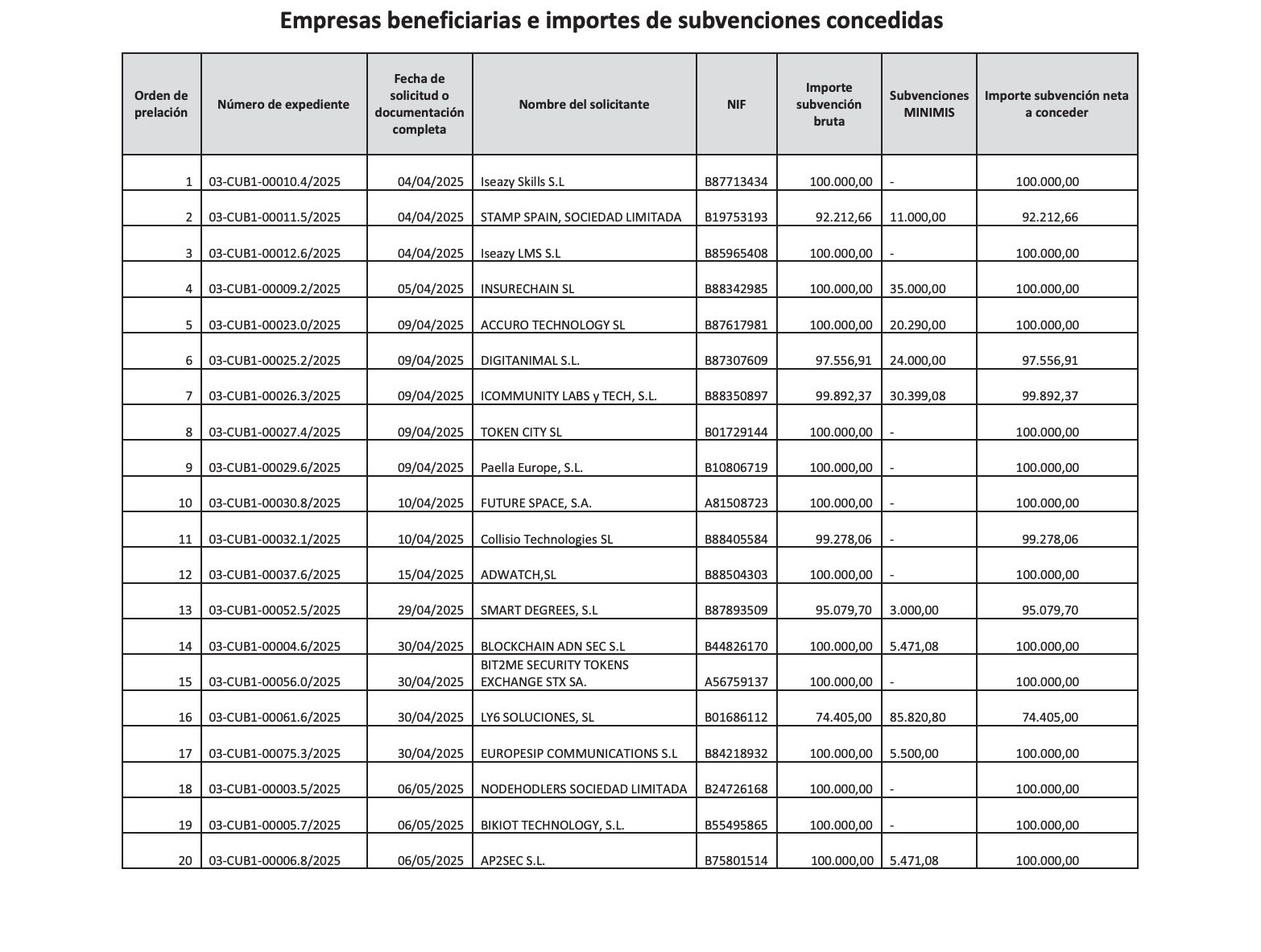
Within that budget, in 2025 the Community of Madrid allocated 2,032,220 euros to a grant program for SMEs aimed at developing blockchain use cases in areas such as verifiable credentials, traceability, secure data exchange and operational optimization. The grants could cover 100% of eligible expenses, up to a maximum of 100,000 euros per company, and stipulated that the funded use cases had to be deployed on ISBE.
The call from the Community of Madrid's Regional Ministry of Digitalization ended up awarding 1,958,424.70 euros to 20 companies to develop blockchain use cases. The beneficiaries were: Iseazy Skills, Stamp Spain, Iseazy LMS, Insurechain, Accuro Technology, Digitanimal, iCommunity Labs y Tech, Token City, Paella Europe, Future Space, Collisio Technologies, Adwatch, Smart Degrees, Blockchain ADN Sec, Bit2Me Security Tokens Exchange STX, LY6 Soluciones, Europesip Communications, Nodehodlers, Bikiot Technology and AP2SEC.
How many users does ISBE have
The grants helped drive applications on the infrastructure. The next step is now to check how many of them have moved from deployment to continued use by companies or users. Developing and deploying a use case on ISBE does not necessarily mean achieving adoption. Grants can help kick-start the first applications and generate an ecosystem around a new infrastructure, but developing a project and deploying it on ISBE is one thing, and adoption is another.
That is why the number of use cases is not enough to know how much ISBE is used. In traceability, what matters is knowing how many products or records are managed. In credentials, how many are issued and verified; in tokenization, how many assets exist and what volume they represent; and in smart contracts, how many organizations use them.
Adwatch, a case for measuring ISBE activity
As an example, Observatorio Blockchain chose Adwatch to analyze the activity of one of the subsidized projects. The company received 100,000 euros to develop a use case on ISBE for the certification of digital advertising. On 13 July, ISBE announced that Adwatch had deployed its advertising certification technology on its infrastructure and explained that the certifications generate cryptographic evidence that can later be verified independently.
Observatorio Blockchain tried to carry out that verification, but has not located in the public information consulted the address of the use case, a contract or the hash of a certification that would link that evidence to the activity observable on Blockscout, the blockchain explorer used by ISBE to publicly consult transactions, addresses and contracts on its networks. Publishing any of these identifiers would make it possible to locate the use case on the blockchain and measure the on-chain activity associated with Adwatch.
What Bare PRO and Case PRO show
To observe what activity can be verified directly on the blockchain, Observatorio Blockchain analyzed, through Blockscout's public API, 50 recent transactions from Bare PRO and another 50 from Case PRO, two ISBE production environments. In Bare PRO, the operations showed a highly uniform pattern: they occurred roughly once a minute, came from the same address, reached the same contract and used the same function selector. The pattern is consistent with an automated process that periodically executes the same kind of operation, although the available data do not allow its specific function to be determined.
The Case PRO sample showed a very similar pattern, with the same sending address, the same receiving contract, identified by Blockscout as EIP2535AccessControl, the same selector and a cadence of roughly one operation per minute. The transactions examined had zero value and showed no token transfers.
The match is relevant, but the scope of the check must be clear: these are samples of 50 transactions from each environment and do not represent all of ISBE's activity.
A transaction is not a user
The samples confirm that on-chain activity exists, but they also show why the number of transactions needs context to be used as an adoption indicator. In the operations analyzed, the same address repeatedly generates the same kind of call against the same contract. A process making one transaction per minute could produce 1,440 operations a day and 525,600 a year. They would be real transactions, but they would not amount to that number of users.
Nor can it be concluded that these operations are useless. Blockscout does not allow the specific function of the calls to be determined in this sample, and a transaction can serve a relevant purpose without transferring tokens or value. To interpret ISBE's activity, therefore, it is necessary to know which applications generate the transactions and what activity they represent.
Advertising certification
The same caution should apply to the number of use cases. The public grants allowed 20 projects to be developed, whose deployment had to take place on ISBE. Funding, deploying and continuously using a project are different stages.
Adwatch serves as an example. ISBE announced the deployment of its advertising certification technology and maintains that its evidence can be verified independently. However, Observatorio Blockchain has not located in the public information consulted an identifier that would link those certifications to a specific address or contract and measure their activity on Blockscout.
To better understand adoption, useful indicators would include active organizations and applications, end users, credentials issued and verified, certified documents, tokenized assets or economic volume managed. Data on what percentage comes from use cases and what corresponds to technical or automated processes would also help contextualize the transactions.
What ISBE has added
As we said at the start of this report, ISBE does not start from scratch. Alastria had spent years building networks, knowledge and a business ecosystem around blockchain, with projects that even reached production.
That makes it especially interesting to measure what new use ISBE has managed to generate since its launch. The checks carried out by Observatorio Blockchain do not allow all of ISBE's adoption to be measured. They do show that neither the transaction counter nor the number of use cases is enough on its own to do so. The question to ask, therefore, is: what new adoption has ISBE managed to generate on the ecosystem and experience inherited from Alastria?