Spain has become one of Europe's major benchmarks in the institutionalization of digital assets, placing itself ahead of markets such as Germany and France in terms of legal integration of blockchain technology and the development of retail banking services linked to cryptoassets. This is according to the report "Spain: Europe's hidden champion in digital assets", produced by the European institutional research firm Blockstories in collaboration with Observatorio Blockchain.
At the European vanguard
The study, presented during the Blockstories Horizon Madrid Summit, highlights how the Spanish market has managed to position itself at the European vanguard thanks to an ecosystem built from the top down. The paper identifies five major factors that explain the maturity of the Spanish market. The first has to do with the country's leadership in tokenization. Spain was the first EU state to formally integrate blockchain technology (DLT) into its main securities market law through Law 6/2023, as well as introducing the figure of the Entity Responsible for Registration and Record (ERIR).
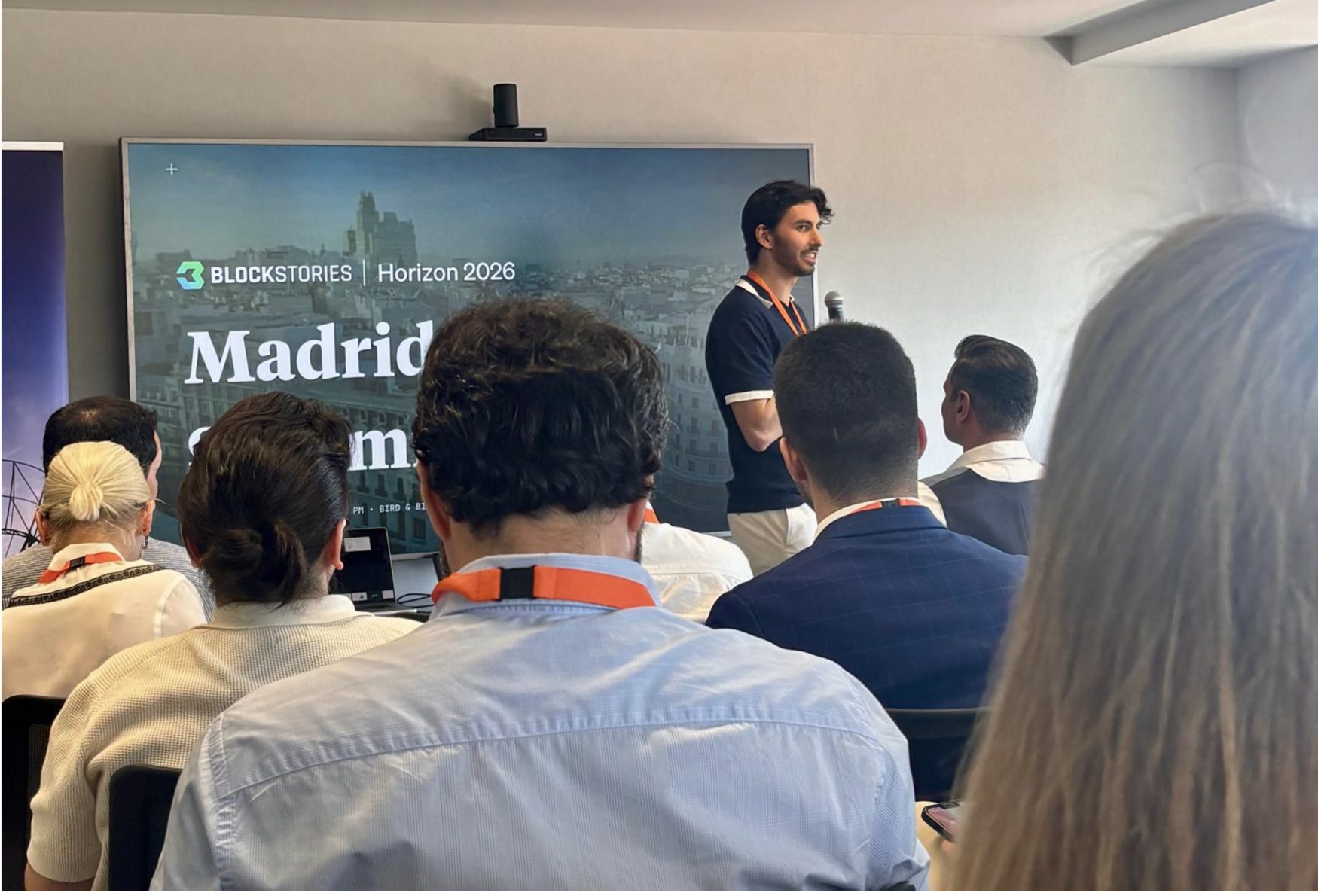
The authors of the paper stress that the Spanish ecosystem has been built in an institutionalized manner. Unlike other European countries, where growth came from native crypto startups, in Spain the development of the sector has been led by regulators, banks and supervised infrastructure providers. In fact, six of the first seven MiCA authorizations granted in the country correspond to traditional banking institutions.
Another key element is the role of banks in retail cryptocurrency adoption. BBVA and Santander were the first major EU banks to offer crypto services to retail clients in 2025. CaixaBank, Kutxabank and Renta 4 Banco are also preparing services linked to digital assets.
Bizum effect
The report's authors refer to the so-called "Bizum effect". With close to 30 million active users, Bizum has accustomed millions of Spaniards to the everyday use of instant digital money from their banking apps. Platforms such as Imagin, from Caixabank, or BBVA Jóvenes, have helped consolidate a user base fully familiar with digital financial interfaces, the study notes.
The report also includes the views of some of the leading experts in the Spanish ecosystem. Cristina Carrascosa, CEO of the law firm ATH21, stresses that the CNMV has spent years building internal knowledge about digital assets and blockchain, which has allowed Spain to get ahead of other European countries in tokenization and regulation.
Carrascosa also stresses the key role of the regulatory sandbox approved in 2020 in paving the way for the European DLT pilot regime, as well as the impact of MiCA in accelerating the entry of Spanish banks into the crypto business. She also recalls that the Bank of Spain's more critical stance toward stablecoins has led many institutions to opt for international consortia such as Qivalis instead of developing their own projects.
Financial tokenization
For his part, Javier González Cruz, chief revenue officer at Allfunds Blockchain, believes that Spain has greatly simplified the operational processes linked to financial tokenization. He explains that the regulatory framework allows a single entity to act as issuer, distributor and registrar of tokenized assets without depending on so many traditional intermediaries, a flexibility that, in his view, is accelerating the development of the sector.
Abel Peña, chief sales officer at Bit2Me, believes that Spain's early regulation forced crypto companies to professionalize from the outset. The KYC, anti-money laundering and consumer protection requirements, he explains, were initially seen as friction by the sector, but ended up strengthening the most solid companies. Peña believes that the entry of BBVA and Santander into the crypto market responded to the fact that clients were already buying digital assets outside traditional banking.
Miguel Ángel Zapatero, general counsel at Crossmint, argues that the transition from the old VASP regime to MiCA will trigger strong consolidation of the sector in Spain. According to his estimates, although close to 200 companies did register as virtual asset service providers, probably fewer than 20 will manage to fully adapt to the new European CASP framework. He also highlights that the market is moving away from speculation based on NFTs and memecoins to focus on use cases more closely linked to stablecoin payments and financial infrastructure.
Latin American market
Edwin Mata, co-founder and CEO of Brickken, explains that Latin America has become the main growth market for many Spanish companies in the blockchain sector. He notes that growing European regulatory complexity has led startups such as Brickken to expand into Latin American markets where there is more immediate demand for tokenization, digital private credit and stablecoins.
Finally, Isabel Rodríguez, senior associate at Bird & Bird, believes that Spain is building a highly relevant position within the European DLT pilot regime. According to her, several Spanish companies are already applying for licenses to operate regulated tokenized securities infrastructures, which could make the country one of the European leaders in this type of authorization.
Finally, the document stresses Spain's strategic position as a natural bridge between Europe and Latin America. In the region, stablecoins, remittances and tokenized credit respond to real needs linked to inflation, access to the dollar and international payments. Spanish companies such as Brickken already generate around 60% of their revenue in LATAM, reflecting the growing importance of this financial and technological corridor.
Advanced regulation
For his part, Maximilian Vargas, founder and CEO of Blockstories, argues that Spain should be part of the European conversation about the major institutional digital asset markets. "It has built a digital asset ecosystem different from that of other European markets, supported by three pillars: advanced regulation, the prominence of traditional banking and the strategic connection with Latin America," he says. Vargas stresses that Spain was one of the first European countries to incorporate blockchain technology into its financial legislation and to promote retail cryptocurrency services from major banking institutions
Spanish startups
For Covadonga Fernández, director of Observatorio Blockchain, "Spain is no longer a market that observes the digital financial transformation from the outside; it has become one of the countries where Europe's new institutional architecture for digital assets is being built, also driven by the innovative muscle of Spanish startups that have spent years developing blockchain technology, infrastructure and new use cases".
About Blockstories: it is Europe's leading media and research company specializing in the intersection between digital assets and financial institutions. Through its reports, its Blockstories Intel data platform and its exclusive events in cities such as Zurich, London and Paris, it provides critical information to the traditional financial industry.
About Observatorio Blockchain: it is Spain's benchmark news and analysis outlet on blockchain technology, cryptoassets, artificial intelligence and Web3. Since its founding, it has monitored the regulatory, technological and institutional evolution of the sector, becoming the essential reference space for professionals and companies in the Spanish-speaking ecosystem.