Their trading volumes are also collapsing. The market thus reflects the progressive abandonment by investors and liquidity providers. This process goes beyond a simple correction. The market is burying the traditional "altseason."
In previous cycles, capital rotated into any emerging cryptocurrency. In 2026 that has changed. Money now concentrates in networks that generate real revenue, comply with regulation and offer infrastructure utility that the institutional market can validate
Corpay and BVNK will bring stablecoins to more than 800,000 businesses
The zombie asset anomaly and the lack of creative destruction
For all these reasons, the concept of "zombie assets" has gained technical relevance to describe those protocols that, despite having failed operationally, continue to trade on digital exchanges.
And unlike traditional industries where insolvency leads to liquidation, the token ecosystem lacks an efficient cleanup mechanism, allowing projects with no users or active development to maintain an appearance of life that distorts capital allocation. In fact, during the Consensus 2026 conference, Anthony Pompliano, noted that this persistence of failed projects acts as a drag on innovation, immobilizing liquidity that should flow toward emerging sectors such as real-world asset tokenization (RWA) or decentralized artificial intelligence.
In fact, the continued presence of these zombie assets on tracking sites (such as CoinGecko or CoinMarketCap) fuels a false sense of diversity in the market. However, analysis of capital flows reveals that 90% of institutional liquidity is concentrated exclusively in Bitcoin, Ethereum and Solana, leaving the rest of the networks in a desperate fight for survival.
Thus, the reality at this point is clear: the market has stopped buying "smoke" and technological promises and now demands performance metrics that older projects, weighed down by years of mismanagement and technical debt, cannot provide.
The collapse of legacy infrastructures: the EOS case and its transition to Vaulta
In this sense, the EOS project represents perhaps the most emblematic failure in the history of infrastructure cryptoassets. After a record initial coin offering (ICO) that raised $4 billion in 2018, the protocol was unable to fulfill its promise to process one million transactions per second (TPS) and offer a fee-free network.
However, Block.one's management, marked by SEC fines and misuse of funds, turned the ecosystem into a "desert" with fewer than 10,000 daily active users before its definitive restructuring.
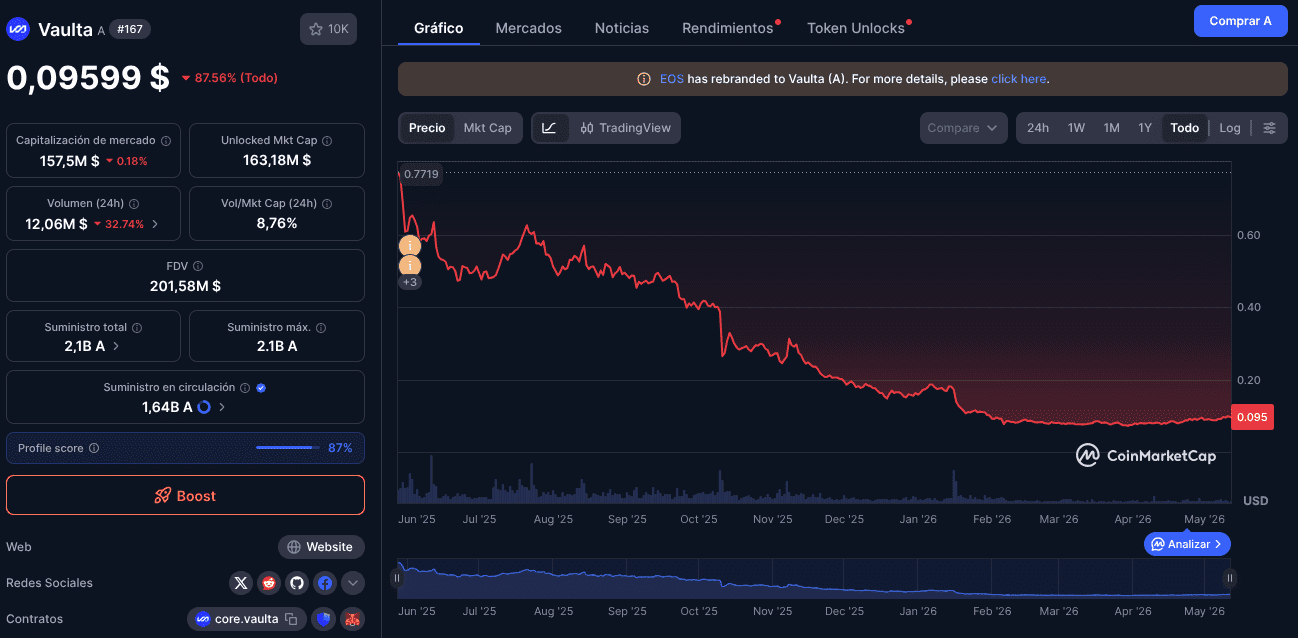
This led the project, in May 2025, to attempt a last-ditch rescue maneuver through a rebrand to Vaulta ($A), positioning itself as a Web3 banking network focused on regulatory compliance and institutional security.
Although the market initially reacted positively to the announcement of a 1:1 token swap and a staking program with an annual percentage yield (APY) of 17%, the reality in 2026 is devastating: the price of Vaulta has fallen nearly 80% since the rebrand, evaporating three-quarters of its market capitalization in less than a year.
The failure of the rented-resource architecture
Technically, Vaulta inherited EOS's structural vulnerabilities. The governance model based on Delegated Proof of Stake (DPoS), in which 21 supernodes manage the network, has been criticized for its massive centralization, with these nodes largely monopolized by exchanges that diminish the value of the retail user's vote. In addition, the resource auction mechanism for RAM has created prohibitive barriers to entry for decentralized application developers, who prefer to migrate to networks with more predictable gas structures and a real user base, such as Layer 2 (L2) solutions or high-performance L1 networks like Solana.
Despite the creation of the EOS Network Foundation (ENF) and the Banking Advisory Council, Vaulta's vision as a "banking operating system" has failed to materialize substantial partnerships with top-tier financial institutions that would validate its use. In 2026, institutional capital perceives Vaulta not as a technological resurrection but as a "facelift" on a failed dream from the 2018 cycle, which has driven the asset into a technical free fall where all historical support levels have been breached.
How complexity devoured the Polkadot and Cosmos hyperchains
Tezos and the obsolescence of self-amendment
For years, Tezos (XTZ) was the benchmark for on-chain governance and formal security through mathematically verifiable smart contracts. However, in the 2026 context, its "modu-litic" approach has failed to capture developers' attention in the face of the explosion of Rollups on Ethereum. The "Tezos X" roadmap, presented with the ambition of reaching one million transactions per second through Smart Rollups and the use of RISC-V execution environments, is now perceived as a late technical response to a market that has already standardized other scalability solutions.
The paradox of Tezos lies in its technical soundness versus its commercial irrelevance. Although the protocol has reduced block time to 6 seconds and launched innovative initiatives such as Metals.io for the tokenization of precious metals, transaction volume and total value locked (TVL) in its DeFi applications remain fractions of what its direct competitors manage.
As a result, the Tezos ecosystem has been reduced to very specific niches of digital art and academic applications, which has kept its native token, XTZ, at historic lows in relative capitalization, unable to compete for the liquidity that now flows toward infrastructures with greater network effects.
EVM integration and the interoperability challenge
On the other hand, Tezos's attempt to attract the Ethereum developer community through the implementation of Etherlink has come at a time of saturation in the L2 market.
Developers now have dozens of options with greater liquidity and more mature integration tools, such as Arbitrum, Base or Optimism. Tezos's architecture, although superior in terms of censorship resistance and forkless upgradeability, has failed to offer an economic incentive strong enough to justify the opportunity cost of abandoning the most vibrant ecosystems in digital assets.
The power system in the blockchain industry: from origins to resistance
The decline of payment and privacy protocols: Dash, BSV and DigiByte
The sector of cryptoassets focused exclusively on fast payments and privacy has been one of the hardest hit by the market's evolution in 2026. Projects such as Dash, Bitcoin SV (BSV) and DigiByte (DGB) face a crisis of technical and regulatory identity that threatens their definitive disappearance. Dash, in particular, has seen its value proposition centered on PrivateSend and InstantSend eclipsed by the mass adoption of Bitcoin's Lightning Network and the efficiency of stablecoins for everyday commerce.
The entry into force of the DAC8 directive in the European Union on January 1, 2026, which imposes strict tax transparency and data reporting requirements, has revived interest in on-chain privacy but has had the opposite effect for regulated assets. Exchanges under European and U.S. supervision have begun systematically delisting coins with optional anonymity features, such as Dash, to avoid conflicts with new anti-money laundering (AML) laws.
Despite Dash's efforts to integrate with platforms such as Alchemy Pay to improve its accessibility in 170 countries, its real use as a means of payment remains marginal compared with traditional payment rails that now use underlying digital asset infrastructures.
Bitcoin SV and the failure of infinite on-chain scalability
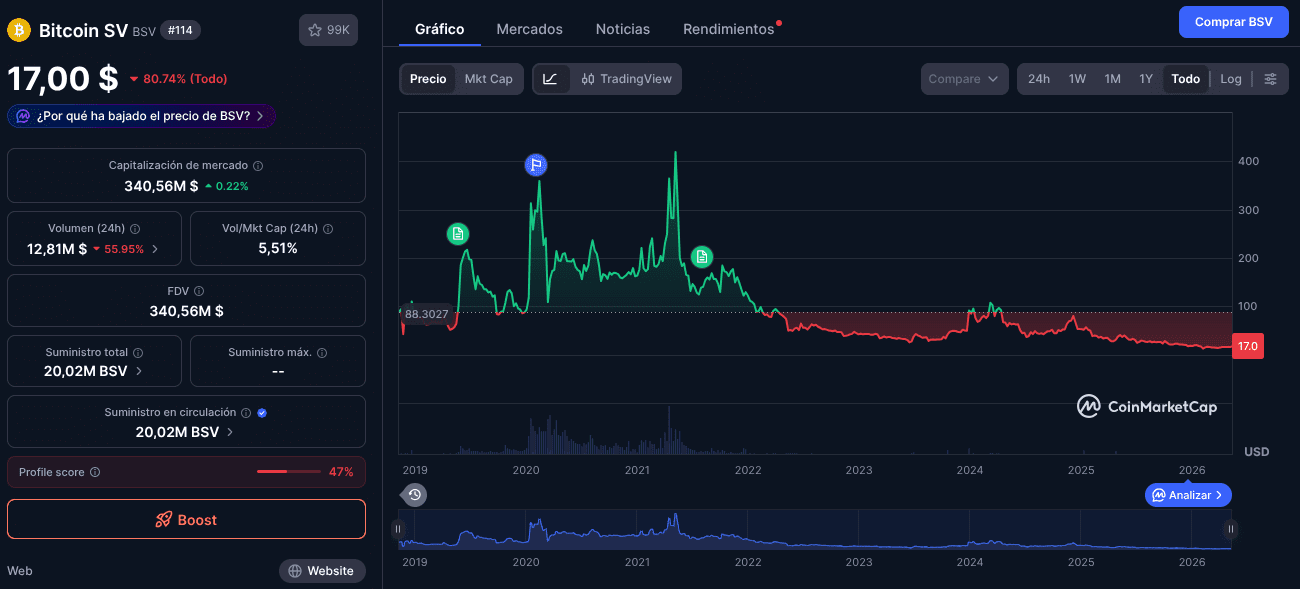
The case of Bitcoin SV (BSV) illustrates the collapse of narratives based on ideological forks. Its thesis of maintaining massive block sizes to enable unlimited transactions on the base chain has proven technically unsustainable in terms of node centralization and storage costs.
In fact, BSV has disappeared from the main market-cap listings, the victim of a total lack of institutional support and a user base that has migrated toward Bitcoin Layer 2 solutions, such as Stacks or Merlin Chain, which offer smart contracts without compromising the decentralization of the base layer.
Gaming and NFT sector fatigue: Gala, Enjin and Flow
The optimism surrounding gaming tokens and non-fungible tokens (NFTs) during the 2021-2022 cycle has turned into deep skepticism in 2026. The market has come to understand that most of these assets lacked intrinsic value or a sustainable game economy, relying almost exclusively on speculation over future prices. Leading projects such as Gala Games (GALA) and Enjin Coin (ENJ) have seen their valuations fall more than 68% compared with their all-time highs, reflecting a massive saturation of digital assets with no real demand.
Gala Games has tried to respond by redefining its GALA token as the gas asset for its own GalaChain infrastructure, in addition to implementing massive supply burns to induce scarcity.
Nevertheless, operational security risks and the cyclical volatility of game launches have kept institutional investors away from the project. For its part, Enjin, despite its migration to a Substrate-based network and continued development of its developer SDK, is struggling to regain relevance against ecosystems with greater traction such as Immutable X or Polygon.
Blockchain yes, but optional: Ubisoft's formula to avoid gamer backlash
The end of the speculative NFT bubble
The current reality shows that enthusiasm for NFTs has evaporated drastically. The number of available assets went from 38 million in 2021 to more than 1.34 billion in 2025, creating an oversupply that social and technology platforms are no longer willing to sustain.
The decision by companies such as LG to shut down its NFT marketplaces and the end of Reddit's avatar program have been clear signals that the focus of technology investment has shifted toward other areas, leaving specialized networks such as Flow in an extremely vulnerable position.
AI infrastructure and modularity: the challenge for Celestia, Monad and 0G Labs
Even the projects launched with cutting-edge technology in the last cycle are feeling the pressure of the market's purge. Celestia (TIA), which was hailed as the definitive solution for modular data availability, has seen its price fall 98% from its highs of $20.
Despite technical advances, such as the announcement of the "Fibre" protocol capable of sustaining 1Tb/s of blockspace, the market has penalized the lack of real revenue generated by the network and the massive selling pressure derived from token unlocks for venture investors.
The decentralized artificial intelligence sector, represented by protocols such as 0G Labs and Qubic, faces asymmetric competition against traditional technology giants.
While 0G Labs has demonstrated impressive milestones, such as training 107 billion-parameter models with a 95% cost reduction compared with centralized clouds, record investment of more than $500 billion in AI infrastructure by Microsoft, Alphabet and Meta has drained speculative interest from small-cap tokens. Investors now prefer the safety and returns of semiconductor and data center companies that dominate AI's physical supply chain.
Monad and the saturation of high-performance networks
Monad, an EVM-compatible L1 network designed for high performance, faces in 2026 the challenge of attracting liquidity in an environment where Solana already dominates market share among retail users and meme coins.
The cost of acquiring users for a new infrastructure in a saturated market is extremely high, and projects such as Monad or ZetaChain risk becoming technically superior but economically deserted ecosystems if they fail to establish exclusive partnerships with major financial services providers.
A16z launches a $2.2 billion fund for stablecoins, prediction markets and AI agents
The impact of security breaches: Harmony and Ronin as reminders of fragility
Trust remains the most valuable currency in the digital asset ecosystem, and those projects that have suffered catastrophic failures in their security infrastructure are in the final phase of their decline in 2026. Harmony (ONE) is the clearest example of how a single incident can destroy years of development. The 2022 hack of the Horizon bridge, attributed to the North Korean group Lazarus, resulted in the loss of $100 million and left the network in a state of paralysis from which it never recovered.
The foundation's failed attempt to issue billions of new tokens to compensate victims was rejected by the community due to its destructive inflationary impact. By May 2026, the ONE token ranks 95th, with a market capitalization of just $37 million and an ecosystem that analysts describe as lacking incentives for validators or developers.
Similarly, Ronin (RON), the sidechain created for Axie Infinity, continues to deal with the aftermath of massive hacks and a decline in interest in "Play-to-Earn" games, which keeps its valuation below $100 million and in steep decline.
The future of minority projects: from narrative to forced utility
As 2026 progresses, the digital asset market imposes a natural selection filter based on three fundamental pillars that will determine the definitive disappearance of most of the altcoins mentioned:
- Concentration of institutional flow: Capital no longer flows toward technical promises but toward infrastructures that enable the efficient settlement of real financial markets. Projects such as Bitcoin and Ethereum are increasingly treated as basic infrastructure, while mid-cap altcoins lose their status as an independent asset class.
- Obsolescence in the face of AI capex: The massive shift of liquidity toward artificial intelligence hardware and physical infrastructure has left "AI on blockchain" projects without the speculative support needed to fund their long-term roadmaps.
- Fragmentation and critical liquidity: With thousands of new tokens launching monthly, liquidity has fragmented to the point where only projects with massive communities and real users can sustain healthy trading volumes. Older networks that depend on selling their own tokens to operate face imminent technical bankruptcy as their prices fall below operating costs.
Japan to tokenize its sovereign debt to reduce costs and speed up settlements
This 2026 marks the end of the "Wild West" in digital assets, replacing irrational exuberance with a sophisticated, interoperable and, above all, demanding financial structure. Those projects that today make up the altcoin graveyard are not victims of bad luck but of the relentless verdict of a market that has matured and no longer forgives a lack of real adoption or governance mistakes inherited from the past. Blockchain technology has taken a back seat to make way for products that truly transform the global economy, leaving behind those that only knew how to sell a vision without substance.