While much of the global financial system closes its doors to Iran, deep within the blockchain the country has been creating a parallel reality to defy economic isolation. Since 2023, the Islamic republic has accelerated the construction of a digital financial infrastructure that by the end of 2025 reached an operating volume of $7.78 billion.
This growth is the desperate and calculated response of a nation whose local currency, the rial, has lost practically all its value over the past decade. What we are witnessing is the consolidation of cryptocurrencies as a new circulatory system in an economy that refuses to collapse under the weight of Western sanctions.
A GUIDE TO PROTECTING YOUR MONEY FROM VENEZUELAN CENTRAL BANK POLICIES AND THE DEVALUATION OF THE BOLÍVAR
The big Persian crypto user
However, the main protagonist of this transformation is not the retail investor, but the state apparatus itself. More specifically, the Islamic Revolutionary Guard Corps (IRGC), traditionally known for its military power, which has expanded its dominion into the financial cyberspace with alarming effectiveness.
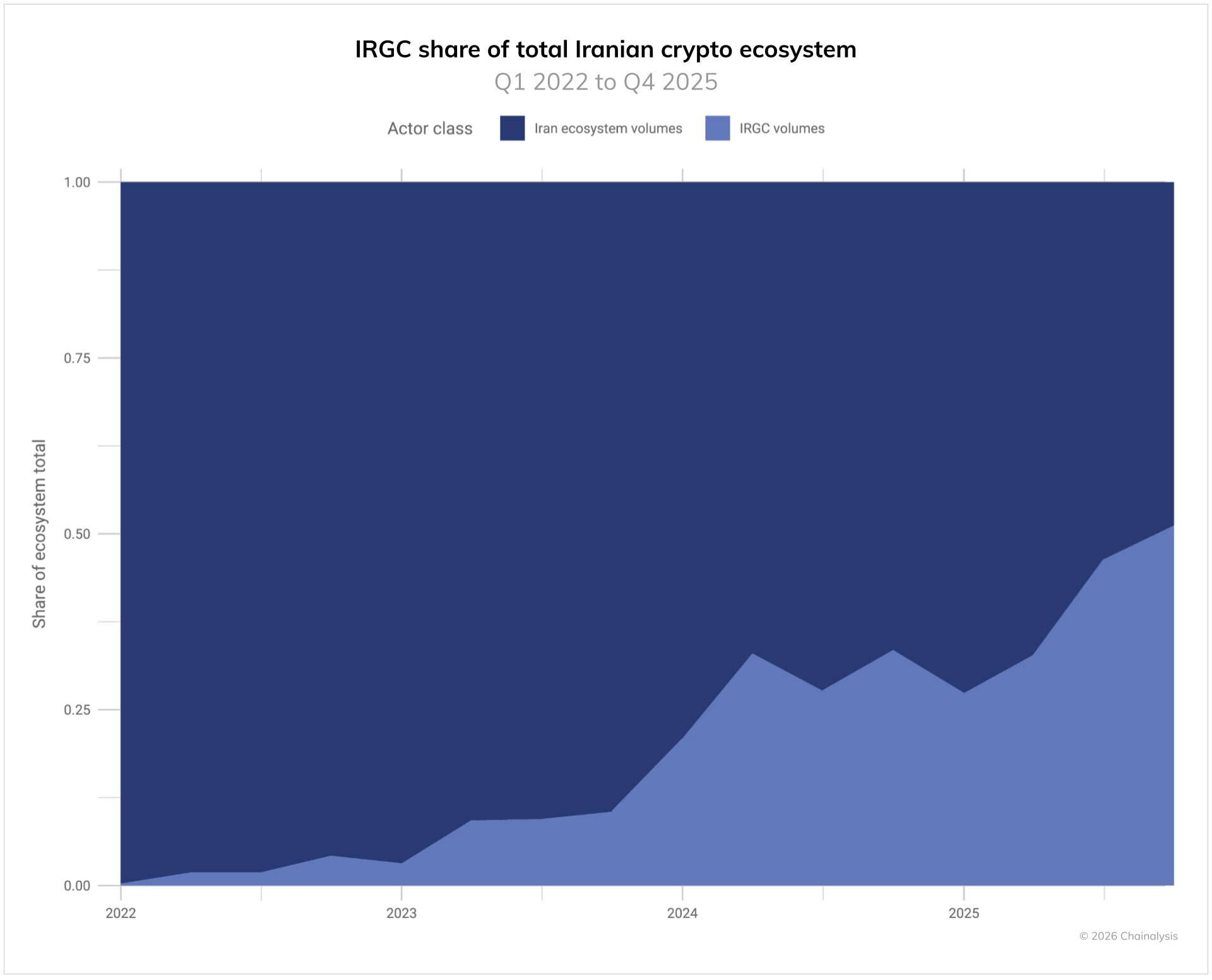
The most recent intelligence data from Chainlysis reveals that in the last quarter of 2025, digital wallets linked to the IRGC controlled approximately 50% of all value received in the Iranian crypto ecosystem. These are not marginal operations. We are talking about billions of dollars destined to finance regional activities and circumvent banking blockades. It has even been discovered that entities connected to the regime managed to move nearly $1 billion through exchanges registered in the United Kingdom, demonstrating that the tentacles of this financial network reach the heart of Europe.
Nobitex, the epicenter of it all
To achieve this large-scale evasion, Iran has developed a robust but centralized internal ecosystem. Local platforms such as Nobitex dominate the market, processing the vast majority of the country's transactions.
The technical preference is clear: the TRON network and the USDT stablecoin have become the de facto standards due to their speed and low costs, allowing the government and state companies to make international payments, including alleged arms transactions, outside the view of US regulators. This infrastructure allows the regime to operate in a gray zone, moving capital at a speed that the bureaucracy of international sanctions often cannot match.
PAKISTAN'S YOUTH USE BLOCKCHAIN DAILY TO EARN, PAY OR SAVE
However, this story has a second, far more human and dramatic face. While the government uses cryptocurrencies as a geopolitical tool, the civilian population embraces them as a pure survival mechanism. Faced with inflation that devours wages and a climate of political instability marked by mass protests in 2025, Iranian citizens have led what experts call a "flight to safety."
During the peaks of social unrest, significant increases were detected in Bitcoin withdrawals to private self-custody wallets. For the average Iranian, holding cryptocurrencies is not financial speculation, but the only viable way to protect a lifetime's savings from a state that could freeze bank accounts or a currency that depreciates daily.
Future under pressure
The immediate future, however, presents itself as an increasingly hostile battlefield. State repression and international pressure are converging to suffocate this digital lifeline. The year 2025 left deep scars, such as the massive hack of Nobitex that caused the loss of $90 million and exposed the vulnerability of local exchanges.
Added to this are government-orchestrated power cuts that paralyze digital mining and the actions of entities such as Tether, which has begun freezing wallets linked to Iran at an unprecedented rate. Therefore, as we move into 2026, the Iranian crypto economy faces the test of surviving in an environment where the regime tries to monopolize its use to evade sanctions, while the population struggles to keep its small window of financial freedom before it closes completely.